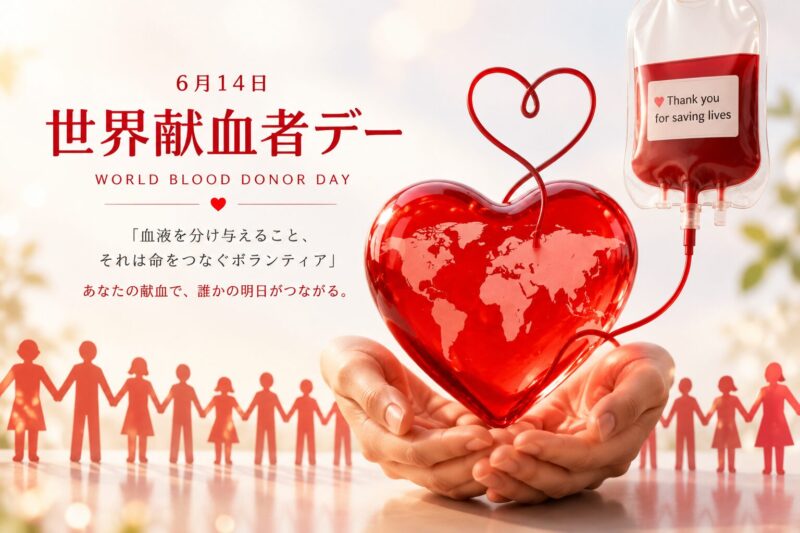
今日は「世界献血者デー」です。
この記念日は、ABO式血液型を発見したカール・ラントシュタイナーの誕生日(1868年6月14日)にちなんで、2005年にWHOが制定しました。
血液型の発見は、私たちにとって当たり前の知識ですが、発見前の輸血の世界は「運次第の賭け」でした。患者が死ぬか生きるかは、運が良いかどうかの問題だったのです。
今日はその衝撃の歴史と、158年前の今日生まれた一人の科学者の物語をお届けします。
6月14日の記念日まとめ
6月14日の主な記念日・出来事
・世界献血者デー(World Blood Donor Day)——WHO制定(2005年)。ABO式血液型発見者・ラントシュタイナーの誕生日(1868年)
・五輪旗制定記念日——1914年6月14日、パリのIOC会議で5色の五輪旗が制定された
・認知症予防の日——アルツハイマー病発見者・アルツハイマー博士の誕生日(1864年)
・手羽先記念日——1981年6月14日、「世界の山ちゃん」を展開するエスワイフードが創業
・アメリカ旗の日(フラッグ・デー)——1777年6月14日、星条旗がアメリカ国旗に制定された日
・チェ・ゲバラ誕生日(1928年)——キューバ革命の英雄・ゲバラが生まれた日
・映倫発足の日(1949年)——映画の倫理審査機関・映倫が発足した日
「輸血は運次第だった」——血液型発見前の恐怖の時代
今では当たり前のように行われる輸血——しかし、カール・ラントシュタイナーが血液型を発見する前の時代、輸血は文字通り「命がけの賭け」でした。
血液型が異なる血液を輸血すると、血液は体内で凝集(固まる)します。現代の医学ではその仕組みがわかっていますが、19世紀の医師たちはその理由すらわかりませんでした。
血液型発見前の輸血の現実
・同種(人間同士)の輸血は1825年頃から試みられていた
・しかし成功率は極めて低く、重篤な副作用(発熱・呼吸困難・ショック死)が頻発
・なぜ失敗するのかが全くわからず「輸血の成否は運次第」という認識だった
・一部の医師:「輸血は人体実験に近い」と批判していた
→ つまり「血液型が合わない輸血はロシアンルーレット」状態だったのです
「果たして、輸血が失敗するのは本当に運が悪いだけなのか?」——その謎に答えを出したのが、33歳の若き病理学者・ラントシュタイナーでした。
「自分と同僚の血で実験した」——ABO式血液型発見の瞬間
1900年、ウィーン大学の病理学研究室で助手をしていたカール・ラントシュタイナー(32歳)は、輸血の失敗の謎を解くために独自の実験を始めます。
実験材料は——自分自身と研究室の同僚たちの血液でした。
22人の血液を使った実験
・実験:自分を含む研究室メンバー22人の血液を集め、血清と血球に分離
・検証:異なる人の血清と血球を掛け合わせ、「固まるか・固まらないか」を観察
・発見:固まる組み合わせと固まらない組み合わせに一定の法則性がある
→ 血液にはA型・B型・C型(後のO型)の3グループがあると発見(1900年)
→ 翌1901年に論文発表(当初ドイツ語のみ発表のため普及に時間がかかった)
→ 後に弟子がAB型を発見し、現在のABO式血液型が完成
「血液型の違いが輸血の失敗の原因だった」——この発見によって輸血医学は革命的に変わりました。血液型を確認してから輸血するようになって以来、輸血による死亡事故は激減し、数え切れないほど多くの命が救われました。
ラントシュタイナーはこの功績により、発見から29年後の1930年にノーベル生理学・医学賞を受賞しています。
日本の血液型事情——A型が最多の理由
献血者デーにちなんで、日本人の血液型の話をひとつ。
日本人の血液型比率
・A型:約38%(最多)
・O型:約30%
・B型:約22%
・AB型:約10%
→ おおよそA:O:B:AB = 4:3:2:1
世界平均ではO型が最も多い(約44%)ですが、日本・韓国・中国ではA型が多い傾向があります。血液型の分布は民族・地域によって大きく異なります。
なお、血液型と性格の関係については科学的根拠がないとされていますが(日本の血液型占いは日本独自の文化です)、血液型は輸血・移植・出産時の医療安全において今も非常に重要な情報です。
五輪旗制定記念日——1914年6月14日、パリで「5つの輪」が生まれた
1914年6月14日——パリで開かれたIOC(国際オリンピック委員会)の会議で、5色の輪を組み合わせた「五輪旗」が正式に制定されました。
デザインしたのはIOC会長のピエール・ド・クーベルタン。5つの輪は「世界5大陸」を表し、青・黄・黒・緑・赤の5色と白い背景の6色には「すべての国旗の色が含まれている」というクーベルタン自身の説明がありました。
五輪旗の豆知識
・制定:1914年6月14日
・5色の輪:青(ヨーロッパ)・黄(アジア)・黒(アフリカ)・緑(オセアニア)・赤(南北アメリカ)の説もあるが、公式見解は「特定の大陸を表すものではない」
・初使用:1920年アントワープオリンピック
・日本での「五輪」という読み方:宮本武蔵の「五輪書」にちなんで読売新聞が名付けたという説がある
まとめ——6月14日は「命をつなぐもの」を考える日
血液型の発見が輸血を安全にし、無数の命をつないだ。五輪旗が世界の国々をひとつにつないだ。今日は「命と絆」を考えるのにふさわしい一日です。
まとめ
- 6月14日は世界献血者デー——ABO式血液型を発見したラントシュタイナーの誕生日(1868年)にちなんでWHO制定(2005年)
- 発見前の輸血は「運次第のロシアンルーレット」——血液型が違えば凝固・ショック死の危険があった
- ラントシュタイナーは自分と同僚22人の血液を使った実験でABO式血液型を発見(1900年)
- 発見から29年後の1930年にノーベル生理学・医学賞を受賞。輸血による死亡事故が激減した
- 日本人の血液型比率はA:O:B:AB≒4:3:2:1。世界平均はO型最多だが日本はA型が最多
- 1914年6月14日、五輪旗がパリのIOC会議で制定——5色の輪が世界の絆を象徴する
- 今日はチェ・ゲバラの誕生日(1928年)。キューバ革命の英雄の生誕98年
最後まで読んでくださってありがとうございました😊
今日は「献血」について考えてみてください。あなたの血液が、今まさに輸血を必要としている誰かの命をつなぐかもしれません。158年前の今日生まれたラントシュタイナーが、その橋を架けてくれました。
では、よい一日をお過ごしください。
see you soon.
What Day Is June 14th? “Blood Transfusion Was a Gamble” — The Man Who Discovered Blood Types Saved Millions of Lives, and the Day the Olympic Rings Were Born
Today is World Blood Donor Day.
The day was established by the WHO in 2005 to mark the birthday of Karl Landsteiner (born June 14th, 1868) — the man who discovered the ABO blood group system.
Blood typing feels like such an obvious, basic fact of life today. But before Landsteiner’s discovery, blood transfusion was literally a gamble — whether a patient lived or died depended almost entirely on luck.
Today, let’s tell the story of that shocking history, and the scientist born 158 years ago today who changed it forever.
June 14th Commemorative Days at a Glance
Main Events & Commemorative Days on June 14th
· World Blood Donor Day — Established by the WHO in 2005; marks the birthday of ABO blood type discoverer Karl Landsteiner (1868)
· Olympic Flag Day — June 14th, 1914: the five-ring Olympic flag was officially adopted at an IOC meeting in Paris
· Dementia Prevention Day — Marks the birthday of Alois Alzheimer (1864), discoverer of Alzheimer’s disease
· Tebasaki (Chicken Wing) Day — June 14th, 1981: founding of S.Y. Food Co., the company behind the “Sekai no Yamachan” chain
· Flag Day (USA) — June 14th, 1777: the Stars and Stripes was officially adopted as the flag of the United States
· Che Guevara’s Birthday (1928) — The birth anniversary of the Cuban revolutionary hero
· Movie Ethics Board Founding Day (1949) — The day Japan’s film rating and ethics organization was established
“Blood Transfusion Was a Gamble” — The Terrifying Era Before Blood Types
Blood transfusion — a routine, lifesaving procedure today. But before Karl Landsteiner discovered blood types, it was, in the most literal sense, a game of chance. Whether a patient survived or died often came down to luck.
When blood of incompatible types is transfused, the blood clumps — “agglutinates” — inside the body. Modern medicine understands exactly why this happens. But in the 19th century, doctors had no idea.
The Reality of Transfusion Before Blood Types Were Known
· Human-to-human blood transfusions had been attempted since around 1825
· Success rates were extremely low; severe reactions — fever, respiratory failure, fatal shock — were common
· No one understood why some transfusions failed and others didn’t; “success or failure is a matter of luck” was the accepted view
· Some physicians condemned transfusion as little better than human experimentation
→ In modern terms: receiving a transfusion of the wrong blood type was essentially a form of Russian roulette
“Is it really just bad luck when a transfusion fails?” — the young pathologist Karl Landsteiner, at 33, decided to find out.
“He Experimented on Himself and His Colleagues” — The Moment ABO Was Discovered
In 1900, Karl Landsteiner (age 32) was working as a research assistant in the pathology laboratory at the University of Vienna. Determined to solve the mystery of transfusion failures, he designed a simple but radical experiment.
His experimental material: his own blood, and the blood of his colleagues.
The Experiment Using 22 People’s Blood
· Method: Collected blood from himself and 22 colleagues in the laboratory; separated each sample into serum and red blood cells
· Test: Mixed different people’s serum with different people’s red cells; observed whether agglutination occurred
· Discovery: Some combinations clumped; others did not. The pattern was consistent and lawful — not random
→ Identified three blood groups: A, B, and C (later renamed O) — published in 1901
→ The initial paper was in German only, slowing its international reach
→ A student later identified AB type, completing the ABO system as we know it today
“The reason transfusions had been failing was blood type incompatibility.” Once this was understood, medicine changed completely. From the moment doctors began matching blood types before transfusing, deaths from transfusion reactions plummeted — and an uncountable number of lives were saved.
For this achievement, Landsteiner was awarded the Nobel Prize in Physiology or Medicine in 1930 — 29 years after his discovery.
Japanese Blood Type Statistics — Why Type A Is the Most Common in Japan
In honor of World Blood Donor Day, here’s a small detour into blood type geography.
Blood Type Distribution in Japan
· Type A: approximately 38% (most common)
· Type O: approximately 30%
· Type B: approximately 22%
· Type AB: approximately 10%
→ Roughly A : O : B : AB = 4 : 3 : 2 : 1
Globally, Type O is the most common (approximately 44%), but in Japan, South Korea, and China, Type A tends to dominate. Blood type distribution varies significantly across ethnic and geographic populations.
A note worth adding: the idea that blood type determines personality has no scientific basis — Japan’s blood type personality system is a cultural phenomenon unique to Japan (and a few neighboring countries). But blood type itself remains critically important medical information for transfusions, organ transplants, and maternity care.
Olympic Flag Day — June 14th, 1914: The Five Rings Are Born in Paris
On June 14th, 1914, at an IOC (International Olympic Committee) meeting in Paris, the five-ring Olympic flag was officially adopted.
The design was created by IOC president Pierre de Coubertin. The five interlocking rings represent the five continents of the world. Coubertin himself explained that the six colors — the five ring colors plus the white background — together contained at least one color from the flag of every nation participating in the Games at that time.
Olympic Flag — Fun Facts
· Officially adopted: June 14th, 1914, Paris
· The five rings and their continental associations (blue/Europe, yellow/Asia, black/Africa, green/Oceania, red/the Americas) are sometimes cited, but the official IOC position is that “the rings do not represent specific continents”
· First used at the 1920 Antwerp Olympics
· In Japan, the Games are called “Gorin” (五輪 = “five rings”) — a name reportedly coined by the Yomiuri Shimbun, inspired by Miyamoto Musashi’s classic text “The Book of Five Rings” (Go Rin No Sho)
Closing Thoughts — June 14th Is a Day to Think About What Keeps Life Connected
Landsteiner’s discovery made transfusion safe, and has connected countless lives across every generation since. The Olympic rings connected the nations of the world under five interlocking circles. Today is a fitting day to think about connection — about life, and about what holds it together.
Summary
- June 14th is World Blood Donor Day — established by the WHO in 2005 to honor Karl Landsteiner (born June 14th, 1868), discoverer of the ABO blood group system
- Before the discovery, transfusion was essentially Russian roulette — incompatible blood caused clotting, shock, and death, and no one knew why
- Landsteiner used his own blood and that of 22 colleagues to identify the ABO blood groups in 1900
- He received the Nobel Prize in Physiology or Medicine in 1930 — 29 years after his discovery — as transfusion-related deaths fell dramatically
- In Japan, blood type distribution is roughly A : O : B : AB = 4 : 3 : 2 : 1; while globally, Type O is most common
- On June 14th, 1914, the Olympic flag was adopted in Paris — five rings, six colors, one world
- Today is also Che Guevara’s birthday (1928) — the 98th birth anniversary of the Cuban revolutionary
Thank you so much for reading all the way to the end 😊
Today, take a moment to think about blood donation. The blood in your veins might be the bridge that carries someone through their worst moment. Karl Landsteiner — born 158 years ago today — built that bridge for all of us.
Have a wonderful day.
See you soon.


コメント