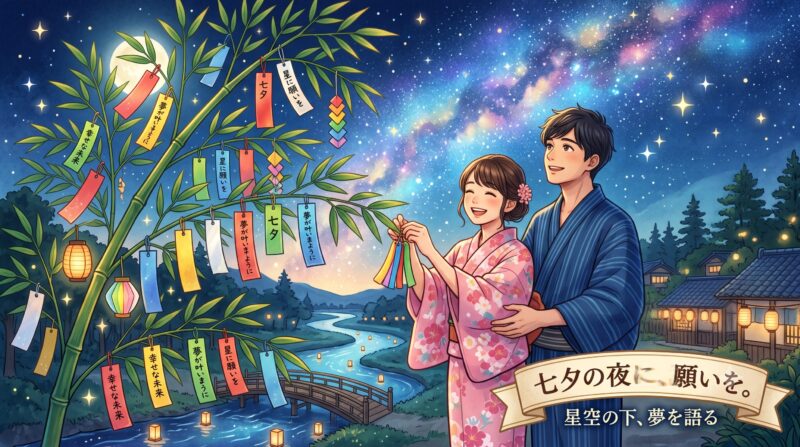
今日7月7日は、日本の夏を代表する伝統行事「七夕」
短冊に願いを書いて笹に飾る——子どものころからおなじみのこの行事、実はその由来や豆知識を知ると、もっと深く楽しめるんです。今日はそんな七夕の「なぜ?」をご紹介します。
織姫と彦星——年に一度の再会の物語
七夕の主役といえば、天の川を隔てて暮らす織姫と彦星。仲が良すぎて仕事をしなくなってしまった二人が、神様の怒りを買い、年に一度7月7日の夜だけ会うことを許されたという伝説です。
織姫星はこと座の1等星「ベガ」、彦星はわし座の1等星「アルタイル」。この二つの星に、はくちょう座の1等星「デネブ」を加えた三つを結ぶと、夏の夜空に輝く「夏の大三角」になります。今夜晴れたら、ぜひ空を見上げてみてください。
🎋「七夕」と書いて「たなばた」と読む理由
「七夕」という漢字を見ても、普通に読めば「しちせき」。「たなばた」とは読めませんよね。
実はこの読み方、日本古来の行事「棚機(たなばた)」に由来しています。旧暦の7月6日の夜から7日の朝にかけて、選ばれた女性(巫女)が水辺の小屋に籠もり、神様のために機(はた)を織る神事がありました。この「棚機つ女(たなばたつめ)」が、中国から伝来した織姫の伝説と結びついて、「七夕」と書いて「たなばた」と読むようになったと言われています。
七夕にそうめんを食べる理由
七夕の行事食といえば「そうめん」。でもなぜそうめんなのでしょう?
もともとは中国に「索餅」という小麦粉を練った紐状のお菓子があり、7月7日に食べると一年間無病息災でいられると言い伝えられていました。これが奈良時代に日本へ伝わり、平安時代には宮中行事として定着。やがて江戸時代に「そうめん」へと変化していきました。
細くて白いそうめんが天の川や織姫の糸を連想させることも、七夕との相性を高めたのかもしれませんね。今夜はそうめんで決まりです!
実はカルピスの誕生日でもある
1919年7月7日、乳酸菌飲料「カルピス」が発売されました。七夕の日に、あの白くて甘い飲み物が誕生したのです。
カルピスの白い水玉模様のパッケージは、発売当初から変わらないデザイン。天の川をイメージした模様とも言われています。七夕と相性抜群のドリンクだったんですね。
7月7日に星が見えない理由と「本当の七夕」
実は7月7日は梅雨の真っ只中。織姫と彦星が年に一度の再会を果たす夜なのに、雨で星が見えないことがほとんどです。
もともと七夕は旧暦の7月7日に行われていました。旧暦に換算すると現代の暦では8月中旬〜下旬頃にあたり、梅雨も明けて星がよく見える季節。仙台七夕まつりが8月に開催されるのはこのためです。
国立天文台では「伝統的七夕」として旧暦の七夕の日を毎年発表しています。本物の星空で二人の再会を見届けたい方は、ぜひ旧暦七夕にも注目してみてください。
✍️ 今日のまとめ
年に一度しか会えない二人の物語、千年以上受け継がれてきた願いの文化、そして今夜のそうめんとカルピス——七夕は「想いを届ける日」ですね。
今夜は大切な人のことを思いながら、短冊に願い事を書いてみてください。どんな小さな願いも、星に届くはずです
本日も良い一日をお過ごしください。
See you soon.
Today, July 7th, is “Tanabata” — one of Japan’s most beloved summer traditions. 🎋
Writing wishes on strips of colored paper and hanging them from bamboo — a custom familiar to most of us since childhood. But knowing the origins and the stories behind it makes the whole experience even richer. Today, let’s explore the “why” behind Tanabata.
Orihime and Hikoboshi — A Story of Once-a-Year Reunion
The stars of Tanabata are Orihime (the Weaver Princess) and Hikoboshi (the Cowherd Star), separated by the Milky Way. The legend goes that the two fell so deeply in love they stopped working altogether, earning the wrath of the gods — and from then on, they were only permitted to meet once a year, on the night of July 7th.
Orihime is Vega, the brightest star in the constellation Lyra. Hikoboshi is Altair, the brightest star in Aquila. Connect these two stars with Deneb — the brightest star in Cygnus — and you get the “Summer Triangle,” blazing in the summer night sky. If the sky is clear tonight, look up.
Why “七夕” Is Read as “Tanabata”
Looking at the characters “七夕,” you’d naturally read them as “shichiseki” — there’s no obvious reason to read them as “tanabata.”
The reading actually comes from an ancient Japanese ritual called “Tanabata” (棚機). From the evening of the 6th through the morning of the 7th of the seventh lunar month, a chosen woman — a shrine maiden — would seclude herself in a waterside hut and weave cloth as an offering to the gods. This figure, the “Tanabatatsume” (weaving woman of the shelf loom), became intertwined with the Chinese legend of the Weaver Star, and over time, the characters “七夕” came to be read as “tanabata.”
Why We Eat Sōmen on Tanabata 🍜
The traditional food of Tanabata is sōmen (thin white wheat noodles). But why sōmen?
It traces back to an ancient Chinese food called “sakubei” — a rope-like confection made from kneaded wheat — which was eaten on July 7th with the belief it would keep illness away for a full year. This custom made its way to Japan in the Nara period, became established as a court ritual in the Heian period, and eventually transformed into sōmen by the Edo period.
The thin, white strands of sōmen also evoke the Milky Way and the threads of Orihime’s weaving — which may be another reason the pairing felt so right. Tonight’s dinner is settled!
It’s Also Calpis’s Birthday
On July 7, 1919, Calpis — Japan’s beloved lactic acid beverage — went on sale for the very first time. That sweet, milky white drink was born on Tanabata.
The white polka-dot pattern on Calpis packaging has remained unchanged since its debut. It’s said to evoke the image of the Milky Way — making Calpis, it turns out, the perfect drink for Tanabata all along.
Why You Usually Can’t See the Stars on July 7th — and the “True Tanabata”
Here’s the thing: July 7th falls right in the middle of rainy season. The one night a year when Orihime and Hikoboshi are supposed to reunite — and it’s almost always raining, with no stars in sight.
That’s because Tanabata was originally observed on the 7th day of the 7th lunar month, which in the modern calendar falls somewhere in mid-to-late August — after the rainy season, when the stars are clearly visible. This is exactly why the famous Sendai Tanabata Festival is held in August.
The National Astronomical Observatory of Japan announces the date of the “Traditional Tanabata” (旧暦七夕) each year. If you’d like to actually witness the two stars’ reunion under a real night sky, keep an eye on that date.
Today’s Takeaway ✍️
A story of two who can only meet once a year. A culture of wishes passed down for over a thousand years. And tonight: sōmen and Calpis. Tanabata is a day for sending your feelings out into the world.
Tonight, think of someone dear to you, and write your wish on a tanzaku strip. No matter how small the wish — the stars are listening.
Have a wonderful day today.
See you soon.


コメント