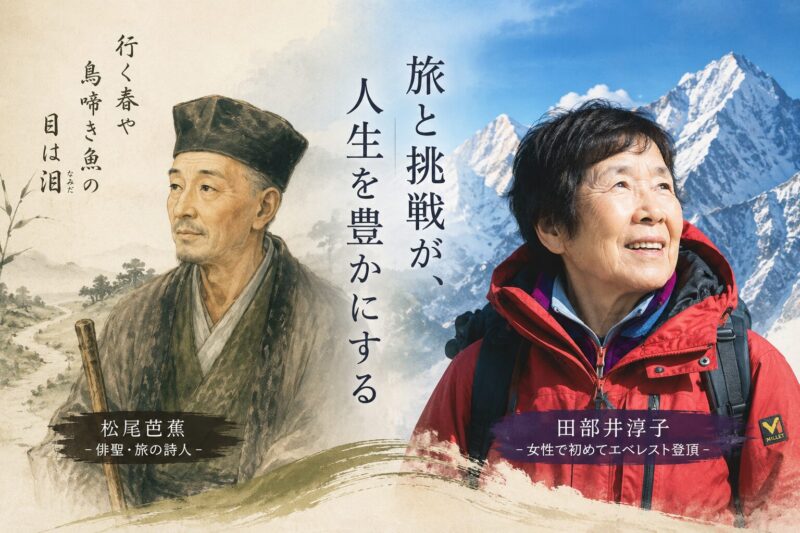
5月16日。今日は「旅の日」です。
1689年のこの日(旧暦3月27日)、江戸時代の俳人・松尾芭蕉が弟子の河合曾良とともに「おくのほそ道」の旅へと旅立ちました。
「ただの旅行記でしょ?」と思っているあなた——この旅は芭蕉が死を覚悟して出発した、人生最後の大冒険でした。そしてその同行者が「急遽の代打」だったことも、あまり知られていません。
今日はそんな旅の日の物語と、同じ5月16日に女性として初めてエベレストに登頂した田部井淳子さんの話もお届けします。
5月16日の記念日まとめ
📖 5月16日の主な記念日・出来事
・旅の日——1689年5月16日(旧暦3月27日)、松尾芭蕉が「おくのほそ道」の旅へ出発
・女性初エベレスト登頂(1975年)——田部井淳子が世界で初めて女性としてエベレスト山頂に立った
・第1回アカデミー賞(1929年)——ハリウッドで第1回アカデミー賞授賞式が開催された
・光の国際デー——UNESCOが制定。光科学技術の重要性を考える日
・平和に共存する国際デー——国連が制定。多様性の中で共存することを考える日
・抗疲労の日——「こう(5)ひ(1)ろう(6)」の語呂合わせ
「旅に死せるあり」——死を覚悟した46歳の旅立ち
1689年5月16日(旧暦3月27日)、江戸・深川から一艘の舟が出発しました。乗っていたのは松尾芭蕉(46歳)と弟子の河合曾良(40歳)。目的地は東北・北陸の名所旧跡——約2,400kmに及ぶ長旅の始まりです。
当時の日本人の平均寿命は約50歳とされていました。46歳の芭蕉にとって、これは「死ぬまでにやり遂げたい夢の旅」でした。
おくのほそ道の冒頭、芭蕉はこう書き記しています。
📜 おくのほそ道・冒頭の言葉
「月日は百代の過客にして、行きかふ年も又旅人也」
(時は永遠の旅人であり、過ぎゆく年もまた旅人のようなものだ)
さらに「古人も多く旅に死せるあり」と記し、尊敬する西行法師や中国の李白・杜甫と同じように、自分も旅の中で死んでもよいという覚悟を示しています。
なぜ、そこまで追い詰められたように旅に出たのか。実は旅立ちの直前、芭蕉は苦難の時期を迎えていました。芭蕉庵の焼失・故郷の母の死・大飢饉——心痛が重なり、残り少ない人生で俳諧の完成を目指そうと、決意して旅立ったのです。
実は同行者は「急遽の代打」だった
芭蕉の旅のパートナーとして知られる河合曾良ですが、実は最初から曾良が予定されていたわけではありませんでした。
当初の同行予定者は、句づくりに長けた弟子・八十村路通でした。ところが——路通には旅の相棒として「性格に問題」があり、直前になって急遽河合曾良が抜擢されたのです。
🧭 曾良が選ばれた理由
・俳句の腕前は路通に及ばないが、神道・地理・全国の神社仏閣に詳しい
・几帳面で信頼できる性格
・訪問先に事前に書簡を送り、芭蕉が行きたい場所・会いたい人・食べたいものを手配
→「曾良なくして奥の細道は生まれなかった」とも言われる縁の下の力持ち
俳句の才能より「几帳面さと段取り力」が旅のパートナーを決めた——これ、現代のチーム作りにも通じる話ですよね。
奥の細道は「フィクション」だった!?
実は「おくのほそ道」は単なる旅の記録ではありません。曾良が書いた詳細な旅日記と比較すると、芭蕉が書いた「おくのほそ道」には人名・日付・ルート・天候に多くの食い違いがあることがわかっています。
「人里離れた道で宿に困った」という描写も実際は脚色がほとんど。芭蕉は旅から帰った後、3年以上かけて推敲に推敲を重ね、実体験をもとに「文学作品」として仕上げたのです。
📖 おくのほそ道の真実
・旅:1689年春〜秋(約150日・2,400km)
・執筆・推敲:帰還後3年以上
・出版:芭蕉の死後(1702年)
・芭蕉の死:旅の5年後、51歳で大阪にて
・辞世の句:「旅に病んで夢は枯野をかけめぐる」
旅に生き、旅の夢を見ながら旅の中で死んだ——芭蕉の人生そのものが、最高の俳句だったかもしれません。
同じ5月16日——田部井淳子、女性初のエベレスト登頂
1975年5月16日。芭蕉が旅立ったのと同じ5月16日に、もうひとつの歴史的な「旅」が完結しました。
福島県出身の登山家・田部井淳子(当時35歳)が、女性として世界で初めてエベレスト(標高8,849m)の山頂に立ったのです。
しかしその道のりは、想像を絶するものでした。
🏔️ 田部井淳子のエベレスト挑戦
・1969年(30歳):女性だけの海外遠征登山隊を設立
・「女性にエベレストは登れない」という偏見と戦い続けた
・1975年5月4日:6,500m地点でテントごと雪崩に巻き込まれ13人が重軽傷
・新聞には「女性初登頂は絶望的」と報道される
・それでも計画を続行——5月16日、山頂へ
「女性にエベレストは登れない」という世間の偏見の壁、そして登頂直前の雪崩——二度の「絶望」を乗り越えた先に頂上がありました。
その後も田部井さんは女性登山家として活動を続け、1992年には世界7大陸最高峰すべてを女性として世界初踏破。晩年はがんと闘いながら、東日本大震災で被災した学生たちとの登山にも参加し続けました。2016年10月、77歳でその生涯を閉じました。
「一番高い山のてっぺんは男も女も同じです」——田部井さんのこの言葉に、すべてが詰まっています。
まとめ——5月16日は「旅立つ勇気」を思い出す日
46歳で死を覚悟してみちのくへ旅立った芭蕉。「絶望的」と報じられてもエベレストへ向かった田部井さん。どちらも「それでも行く」という覚悟が、歴史を変えました。
日常に追われていると、「旅」は遠いものに感じます。でも旅とは必ずしも遠くへ行くことではなく、「今とは違う自分」に会いに行くことかもしれません。
📝 まとめ
- 5月16日は「旅の日」——1689年のこの日、松尾芭蕉が「おくのほそ道」の旅へ出発
- 46歳の芭蕉は死を覚悟して旅立った。「古人も多く旅に死せるあり」の言葉に決意が宿る
- 同行者・曾良は「急遽の代打」——俳句の才より几帳面な段取り力が選ばれた理由
- おくのほそ道は実は3年以上推敲した文学作品。旅日記と食い違いが多数ある
- 芭蕉は51歳で大阪にて死去。辞世の句は「旅に病んで夢は枯野をかけめぐる」
- 同じ5月16日1975年、田部井淳子が女性初のエベレスト登頂に成功。雪崩と偏見を乗り越えて
- 田部井さんは後に世界7大陸最高峰を女性として世界初踏破。2016年77歳で逝去
最後まで読んでくださってありがとうございました😊
今日は少しだけ「旅」について考えてみてください。芭蕉も田部井さんも、最初の一歩を踏み出したから、歴史が動きました。
因みに、沖縄で一番高い山は石垣島にある「於茂登岳」。高さは、526mです。
小学生の課外学習で登ったりするほど、初心者にもやさしい山となっております。
機会があればぜひ登ってみて下さい。
於茂登岳は登山道も整備されているので、重装備は必要ないですがおすすめの登山グッズ貼っときますね。
おススメ登山グッズ
登山靴【全天候防水対応】トレッキングシューズ 防水 登山靴 ハイキングシューズ ハイカット メンズ レディース メンズ アウトドア キャンプ 山登り 富士山 軽量 防滑 初心者
[ナイガイ] メッシュハット 登山 ランニング トレイルランニング キャンプ アウトドア サファリハット 帽子 オールシーズン メッシュ サイズ調整 タレ付き ユニセックス
THERMOS(サーモス) 山専用ステンレスボトル900ml FFX-901
では、よい一日をお過ごしください。
see you soon.
What Day Is May 16th? “Many Before Me Have Died on the Road” — The 46-Year-Old Who Left Prepared to Die, and the Woman Who First Stood on Top of the World
May 16th. Today is “Travel Day” (Tabi no Hi) in Japan.
On this day in 1689 (the 27th day of the 3rd month by the old lunar calendar), the Edo-period haiku poet Matsuo Bashō set off on his journey along the Narrow Road to the Deep North — “Oku no Hosomichi” — accompanied by his disciple Kawai Sora.
“Isn’t it just a travel diary?” you might think. But this journey was Bashō’s final great adventure — one he departed fully prepared to die. And the fact that his companion was a last-minute stand-in is a detail that rarely gets told.
Today, let’s explore the story behind Travel Day — and the tale of another historic “journey” that reached its peak on this same May 16th, when Junko Tabei became the first woman to summit Everest.
May 16th Commemorative Days at a Glance
📖 Main Events & Commemorative Days on May 16th
· Travel Day (Tabi no Hi) — May 16th, 1689 (lunar calendar): Matsuo Bashō set off on the Oku no Hosomichi journey
· First Female Everest Summit (1975) — Junko Tabei became the first woman in the world to reach the top of Everest
· 1st Academy Awards (1929) — The first Academy Awards ceremony was held in Hollywood
· International Day of Light — UNESCO-designated day to reflect on the role of light in science and culture
· International Day of Living Together in Peace — UN-designated day to celebrate coexistence amid diversity
· Anti-Fatigue Day — Wordplay on “Kō (5) Hi (1) Rō (6)” (抗疲労 = anti-fatigue)
“Many Before Me Have Died on the Road” — A 46-Year-Old’s Journey into Death’s Shadow
On May 16th, 1689, a small boat slipped away from Fukagawa in Edo (present-day Tokyo). On board were Matsuo Bashō, age 46, and his disciple Kawai Sora, age 40. Their destination: the historic sites of the Tōhoku and Hokuriku regions — the beginning of a journey covering some 2,400 kilometers.
The average life expectancy in Japan at the time was around 50 years. For a 46-year-old Bashō, this was the journey he had always dreamed of completing before he died.
In the opening lines of Oku no Hosomichi, Bashō wrote:
📜 The Opening Words of Oku no Hosomichi
“Tsuki hi wa hyakudai no kakaku ni shite, yukikau toshi mo mata tabibito nari.”
(“The months and days are the travelers of eternity. The years that come and go are also voyagers.”)
He also wrote: “Many great poets before me have died on the road” — expressing his wish to live and die as a traveler, just as he admired the monk-poet Saigyō, and the Chinese masters Li Bai and Du Fu had done.
Why did he feel so driven to leave? In the period just before the journey, Bashō had endured a convergence of hardships: the burning of his Bashō-an hut, the death of his mother in his hometown, and a great famine. Weighed down by these losses and sensing that his years were running short, he resolved to complete his life’s work in haiku — and set out.
The Companion Was Actually a Last-Minute Stand-In
Kawai Sora is remembered as Bashō’s faithful travel companion — but he was never the first choice.
The original plan was for a disciple named Yasomura Rotsū — a skilled poet — to make the journey. But Rotsū had a “problem with his character” as a travel partner, and at the last moment, Kawai Sora was drafted as a replacement.
🧭 Why Sora Was Chosen
· His haiku was not as strong as Rotsū’s — but he had deep knowledge of Shinto, geography, and shrines and temples across Japan
· He was meticulous, reliable, and trustworthy
· He sent letters ahead to each destination, making arrangements for where Bashō wanted to go, who he wanted to meet, and what he wanted to eat
→ It’s said that “without Sora, Oku no Hosomichi would never have been born” — the ultimate unsung hero of the journey
Poetic talent lost out to reliability and organizational skill. That feels like a lesson modern teams could still learn from.
Oku no Hosomichi Was Actually Fiction?
Oku no Hosomichi is not a straightforward travel record. When compared with Sora’s own detailed travel diary, Bashō’s account is found to contain numerous discrepancies in names, dates, routes, and weather.
Passages describing hardship on remote roads — struggling to find lodging in the wilderness — turn out to be largely embellished. After returning, Bashō spent more than three years revising and refining the text, transforming his lived experience into a deliberate work of literary art.
📖 The Truth Behind Oku no Hosomichi
· The journey: Spring–Autumn 1689 (~150 days, ~2,400 km)
· Writing and revision: More than 3 years after returning
· Publication: After Bashō’s death (1702)
· Bashō’s death: 5 years after the journey, at age 51, in Osaka
· Death poem: “Tabi ni yande / yume wa kareno wo / kakemeguru” — “Sick on a journey, my dreams wander over withered fields”
He lived for travel, dreamed of travel as he lay dying, and breathed his last during yet another journey. Perhaps Bashō’s life itself was the finest haiku he ever composed.
Same Day, Different Mountain — Junko Tabei Summits Everest
May 16th, 1975. On the very same date that Bashō had set out on his journey 286 years earlier, another historic journey reached its peak.
Junko Tabei (田部井淳子), a mountaineer from Fukushima Prefecture — then 35 years old — became the first woman in the world to reach the summit of Mount Everest (8,849 meters).
But the road to that summit had been anything but straightforward.
🏔️ Junko Tabei’s Path to Everest
· 1969 (age 30): Founded Japan’s first all-female overseas mountaineering expedition team
· Faced constant skepticism: “Women can’t climb Everest”
· May 4th, 1975: At 6,500 meters, an avalanche buried their tents — 13 climbers sustained injuries, including Tabei
· Newspapers reported: “First female summit now looking impossible”
· She continued the climb — and on May 16th, she stood on top of the world
The wall of prejudice — “women can’t do this” — and an avalanche that should have ended everything. Two moments of apparent impossibility, overcome one after another.
Tabei continued climbing throughout her life, and in 1992 she became the first woman in the world to complete the Seven Summits — all seven of the highest peaks on each continent. In her later years, even while battling cancer, she continued joining expeditions with students who had been affected by the 2011 Great East Japan Earthquake. She passed away in October 2016 at the age of 77.
“The summit of the world’s highest mountain is the same for men and women.” Everything is in those words.
Closing Thoughts — May 16th Is a Day to Remember the Courage to Set Out
Bashō, who left at 46 prepared to die on the road. Tabei, who kept climbing after being declared all but finished. Both of them changed history because they chose to go — no matter what.
In the rush of daily life, “travel” can feel like a distant luxury. But travel doesn’t have to mean going far. It might simply mean setting out to meet a version of yourself that doesn’t exist yet.
📝 Summary
- May 16th is Travel Day (Tabi no Hi) — on this day in 1689, Matsuo Bashō departed on the Oku no Hosomichi journey
- At 46, Bashō was prepared to die on the road. His words — “many before me have died on the road” — carry the full weight of that resolve
- Kawai Sora, the companion, was a last-minute stand-in — chosen not for poetic skill but for meticulous planning and reliability
- Oku no Hosomichi was refined over more than 3 years after the journey — a literary work, not a straight record
- Bashō died at 51 in Osaka. His death poem: “Sick on a journey, my dreams wander over withered fields”
- On May 16th, 1975, Junko Tabei became the first woman to summit Everest — overcoming both an avalanche and a world that said she couldn’t
- Tabei later completed the Seven Summits as the world’s first woman to do so. She passed away in 2016 at age 77
By the way — the highest mountain in Okinawa is Omoto-dake (於茂登岳) on Ishigaki Island, standing at 526 meters. It’s gentle enough for elementary school excursions, so if you ever get the chance, it’s well worth the climb! 🏔️
Thank you so much for reading all the way to the end 😊
Today, take a moment to think about your next journey — wherever it leads. Bashō and Tabei both changed history by simply taking that first step.
Have a wonderful day.
See you soon.


コメント