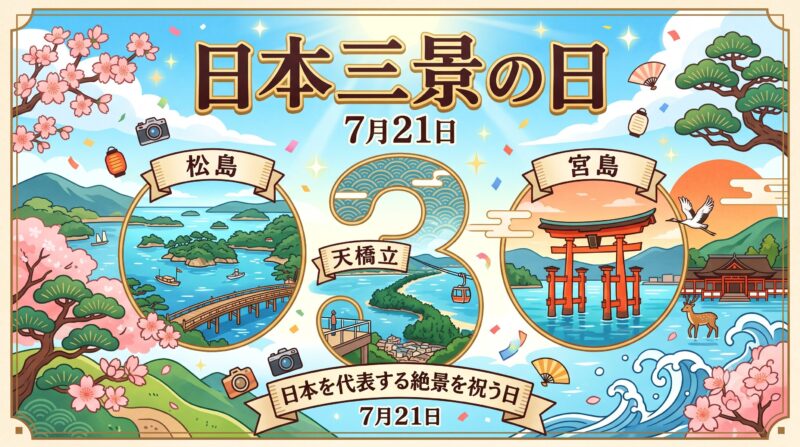
今日7月21日は、江戸時代の学者が絶賛した絶景にちなむ「日本三景の日」と、日本の伝統的な結婚式スタイルの原点「神前結婚式の日」が重なります。
景色の美しさと、人生の門出の美しさ——今日は「日本らしい美意識」を感じる一日ですね。
日本三景の日——一人の学者が決めた「日本一の景色」
「日本三景」といえば、宮城県の松島、京都府の天橋立、広島県の宮島(厳島)。この3つを選んだのは、江戸時代の儒学者林春斎でした。
林春斎は諸国を旅する中でこの3つの景勝地を著書で絶賛し、これが評判となって「日本三景」という呼び名が定着したと言われています。日本三景観光連絡協議会は、林春斎の誕生日(1618年7月21日)にちなみ、この日を「日本三景の日」に制定しました。
松の生い茂る島々が浮かぶ松島、天に架かる橋のような砂州が美しい天橋立、海に浮かぶ朱色の大鳥居が印象的な宮島——それぞれ全く異なる魅力を持ちながら、どれも「水」と「緑」が織りなす日本ならではの美しさが共通しています。夏の青い海とのコントラストが特に映える季節ですね。
神前結婚式の日——実は「たった120年」の伝統だった!
1900年(明治33年)7月21日、当時の皇太子・のちの大正天皇のご成婚が皇居内の賢所で行われました。この皇室の結婚儀式にならい、日比谷大神宮(現・東京大神宮)が一般向けの神前結婚式を考案・普及させたことが、「神前結婚式の日」の由来です。
「和婚」として今や日本の伝統文化のように定着している神前結婚式ですが、実はその歴史はわずか120年ほど。それ以前の日本では、結婚式は自宅で行う「祝言」が主流で、神社で式を挙げる文化そのものが存在しませんでした。
皇室のご成婚をきっかけに生まれた新しい様式が、あっという間に日本中に広まり、今では「和婚といえば神社」というイメージが定着している——伝統というものは、案外新しく作られることもあるんですね。
自然公園の日——豊かな自然を未来へつなぐ法律
1957年(昭和32年)7月21日、「自然公園法」が制定されました。これを記念して「自然公園の日」も制定されています。
この法律により、日本各地に国立公園・国定公園・都道府県立自然公園が指定され、貴重な自然環境を守りながら人々が楽しめる仕組みが整えられました。日本三景も、その多くがこうした自然公園の一部として大切に保護されています。
7月21日のその他の出来事
- 1654年:江戸の飲料水不足を解消するため建設された「玉川上水」が全線開通。四谷〜虎ノ門間の完成により、全長約43kmの人工用水路が完成しました。
- 1969年:日本時間の午前11時56分、アポロ11号のアームストロング船長が人類初の月面第一歩を刻みました(アメリカ時間では前日の7月20日)。
- 1983年:南極のボストーク基地で氷点下89.2℃を記録。観測史上、地上で記録された最低気温です。
✍️ 今日のまとめ
一人の学者が見出した絶景、皇室から広まった新しい伝統、法律が守った豊かな自然——今日は「美しいものを見つけ、守り、伝えていく」ことの大切さを感じる一日ですね。
日本には素敵なところ多いですよね。近くの漁港でボーと波を見ているだけでも癒されたりしますが、やはり絶景と言われる場所に行くと違うゾクゾク感というかエネルギーをもらえることもありますよね。是非、新しい自分に会える素敵な場所を探してみて下さい。
本日も良い一日をお過ごしください。
See you soon.
Today, July 21st, brings together “Nihon Sankei Day” — honoring the breathtaking views once praised by an Edo-period scholar — and “Shinzen Wedding Day,” marking the origin of Japan’s traditional Shinto wedding style.
The beauty of scenery, and the beauty of a new beginning in life — today is a day for reflecting on a distinctly Japanese sense of beauty.
Nihon Sankei Day — “Japan’s Three Best Views,” Chosen by a Single Scholar
When people speak of Japan’s “Three Great Views” (Nihon Sankei), they mean Matsushima in Miyagi Prefecture, Amanohashidate in Kyoto Prefecture, and Miyajima (Itsukushima) in Hiroshima Prefecture. The person who selected these three was the Edo-period Confucian scholar Hayashi Shunsai.
While traveling across the country, Hayashi Shunsai praised these three scenic spots so highly in his writings that the name “Nihon Sankei” (Japan’s Three Views) took hold and became widely recognized. The Nihon Sankei Tourism Liaison Council designated this day in honor of Hayashi Shunsai’s birthday (July 21, 1618).
Matsushima, with its islands blanketed in pine trees; Amanohashidate, with its striking sandbar resembling a bridge to heaven; Miyajima, with its iconic vermilion torii gate floating on the sea — each offers an entirely different kind of beauty, yet all three share that distinctly Japanese harmony of water and greenery. This is exactly the season when the contrast against the deep blue summer sea makes them shine brightest.
Shinzen Wedding Day — A Tradition That’s Actually Only 120 Years Old!
On July 21, 1900 (Meiji 33), the wedding of the Crown Prince at the time — later Emperor Taisho — was held at the Kashikodokoro shrine within the Imperial Palace. Following this imperial ceremony as a model, Hibiya Daijingu (now Tokyo Daijingu) devised and popularized a Shinto wedding ceremony for the general public — and this is the origin of “Shinzen Wedding Day.”
The Shinto wedding ceremony — now firmly established as “wakon” (Japanese-style weddings) and thought of almost as an ancient tradition — actually has a history of only about 120 years. Before this, weddings in Japan were typically held at home in a ceremony called “shūgen,” and the very concept of holding a wedding at a shrine simply didn’t exist.
A new style, born from an imperial wedding, spread across Japan almost overnight and became so deeply ingrained that today, “Japanese-style wedding” is virtually synonymous with “shrine wedding.” Traditions, it turns out, can sometimes be surprisingly recently invented.
Nature Park Day — A Law That Carries Rich Nature into the Future
On July 21, 1957 (Showa 32), the “Natural Parks Act” was enacted. “Nature Park Day” was established to commemorate this legislation.
This law led to the designation of national parks, quasi-national parks, and prefectural natural parks across Japan, creating a system that protects precious natural environments while allowing people to enjoy them. Much of Japan’s Three Great Views are, in fact, protected as part of these very same nature parks.
Other Events on July 21st
- 1654: The Tamagawa Josui, an aqueduct built to resolve Edo’s drinking water shortage, was completed along its full length. With the final section between Yotsuya and Toranomon finished, this roughly 43-kilometer artificial waterway was complete.
- 1969: At 11:56 AM Japan time, Apollo 11 Commander Neil Armstrong took humanity’s first step onto the lunar surface (this corresponds to July 20th, U.S. time).
- 1983: A temperature of -89.2°C was recorded at Vostok Station in Antarctica — the coldest surface air temperature ever officially observed.
Today’s Takeaway ✍️
A breathtaking view discovered by a single scholar. A new tradition that spread from the imperial family. A rich natural landscape protected by law. Today feels like a day for reflecting on the importance of discovering, protecting, and passing down what is beautiful.
Japan really does have so many wonderful places. Even just gazing absentmindedly at the waves from a nearby fishing port can be surprisingly healing — but there’s a different kind of thrill, a different energy you get from visiting a place truly known as a “breathtaking view.” I hope you’ll go out and find a wonderful place where you can meet a new version of yourself.
Have a wonderful day today.
See you soon.


コメント