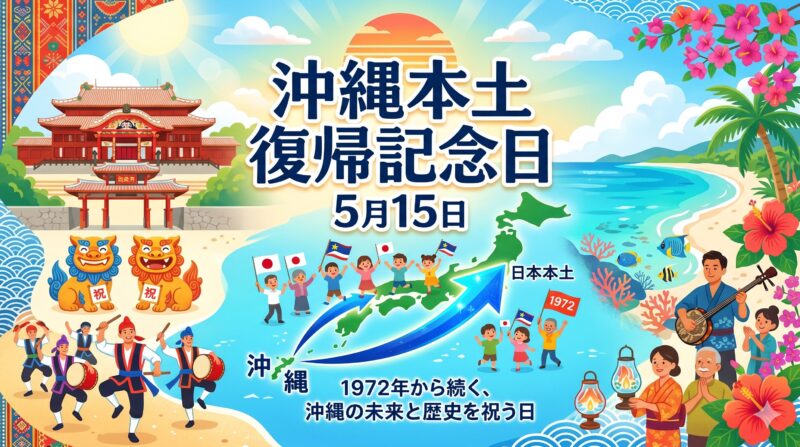
5月15日。今日は沖縄に生きる人々にとって、特別な意味を持つ日です。
1972年5月15日午前0時——27年間にわたってアメリカの統治下に置かれていた沖縄が、日本に返還されました。
歓喜の涙を流した人々がいた。一方で、式典会場のすぐ隣で抗議の声を上げた人々もいた。同じ「復帰」という出来事を前に、沖縄の人々の思いは複雑に交錯していました。
今日はその歴史の重みと、5月15日に重なるさまざまな記念日をお届けします。
5月15日の記念日まとめ
5月15日の主な記念日・出来事
・沖縄本土復帰記念日——1972年5月15日、沖縄が日本に返還
・Jリーグの日——1993年5月15日、日本プロサッカーリーグが開幕
・ヨーグルトの日——ヨーグルトの健康効果を研究したメチニコフ博士の誕生日
・ストッキングの日——1940年5月15日、デュポン社がナイロンストッキングを全米発売
・国際家族デー——国連が制定した家族の大切さを考える日
・テリヤキバーガーの日——1973年5月15日、モスバーガーがテリヤキバーガーを初販売
・葵祭(賀茂祭)——京都・下鴨神社・上賀茂神社の例祭
沖縄本土復帰——「祖国復帰」か「沖縄処分」か
沖縄が今の「沖縄県」になったのは、54年前の今日のことです。
1945年、太平洋戦争末期の沖縄戦で日米両軍の激戦地となった沖縄。終戦後、沖縄はアメリカの統治下に置かれ、「琉球政府」が設置されました。日本本土がサンフランシスコ講和条約で独立を回復した1952年以降も、沖縄だけはアメリカの統治が続きました。
沖縄返還までの道のり
・1945年——沖縄戦終結。米軍が沖縄を占領
・1952年——サンフランシスコ講和条約発効。日本は独立するが沖縄は米統治継続
・1960年代——「祖国復帰」を求める運動が本格化
・1969年——佐藤首相とニクソン大統領が「1972年返還」で合意
・1971年——沖縄返還協定に調印
・1972年5月15日午前0時——沖縄が日本に返還、沖縄県が誕生
屋良朝苗知事の言葉——悲願と複雑な思いが交錯した式典
1972年5月15日、那覇市民会館で開かれた沖縄復帰記念式典。初代沖縄県知事となった屋良朝苗は式典でこう宣言しました。
屋良朝苗知事の言葉
「鉄石のような厚い壁を乗り越え、険しい山をよじ登り、イバラの障害を踏み分けてついに——ここに沖縄県が発足したことを高らかに宣言いたします」
しかし屋良知事はこの式典で、喜びだけを語りませんでした。「沖縄県民のこれまでの要望と心情に照らして復帰の内容をみますと、必ずしも私どもの切なる願望が入れられたとはいえないことも事実であります」——その言葉が示すように、「祖国復帰」は県民全員が手放しで喜べるものではありませんでした。
式典会場の隣で「抗議」していた人々——歓喜と怒りが交錯した1日
復帰記念式典が行われた那覇市民会館のすぐ隣の与儀公園では、復帰に抗議する人々が結集していました——土砂降りの雨の中で。
当初、沖縄の人々が望んでいたのは「核も基地もない、平和な島としての復帰」でした。しかし実際の返還では、30以上の米軍基地がそのまま残されました。全県面積の約12%を占める米軍基地——「復帰したのに何も変わっていない」という思いを抱いた人々も少なくありませんでした。
島袋秀光(沖縄テレビ元キャスター)の言葉
「ものすごい土砂ぶりでしたよ。人々の悲しみと怒りの涙でしょう。外の雨は……」
一方で、復帰実現に尽力した初代沖縄開発庁長官・山中貞則はこう語っています。
山中貞則(初代沖縄開発庁長官)の言葉
「汽笛の海面に鳴り響く音は一生忘れんですね。感無量でした。ああ……この瞬間をどれだけ苦労して待ったかという気持ちがこみ上げてきて涙が流れたんですよね」
歓喜の涙と、悲しみの涙。同じ一日に、沖縄にはその両方があふれていました。これが「沖縄返還」の現実でした。
「ドルから円へ」——一夜にして変わった沖縄の日常
復帰によって、沖縄の人々の日常は文字通り一夜にして変わりました。
🔄 返還で変わったこと
・通貨:ドル → 円(1ドル=305円で交換)
・距離:マイル → キロメートル
・電話:アメリカの市外局番 → 日本の市外局番
・学校:アメリカ式教育 → 日本の学習指導要領
・道路:右側通行 → 左側通行(変更は1978年7月30日「730」)
通貨が変わることで物価も大きく動き、復帰直後はインフレが急速に進み多くの県民が生活苦に直面しました。復帰を「よかった」と感じる県民の割合は、返還直後の1972年に約51%、翌1973年には約38%まで落ち込みました。
それでも、その後急ピッチで進んだインフラ整備と観光業の成長により県民の暮らしは豊かになり、2022年の返還50周年調査では「よかった」とする割合は75%以上に達しています。
Jリーグの日——1993年5月15日、あの開幕の感動
1993年5月15日は、日本プロサッカーリーグ「Jリーグ」が開幕した日でもあります。
開幕戦はヴェルディ川崎(現・東京ヴェルディ)vs横浜マリノス(現・横浜F・マリノス)。国立競技場は超満員で、日本中がサッカー熱に沸きました。
⚽ Jリーグ豆知識
・1993年開幕時のチーム数:10チーム
・現在(2026年):J1・J2・J3の3リーグ、全国38都道府県にクラブが存在
・「Jリーグの日」は日本プロサッカーリーグが制定
・2050年FIFAワールドカップ優勝を目標に掲げ、着実に成長中
33年前の開幕から始まった物語は、今もピッチの上で続いています。
5月15日は「沖縄の今」について考える日
沖縄に生きる私たちにとって、今日5月15日はひとつの出発点です。27年間の悲願が叶った日であり、同時に新たな課題が始まった日でもありました。
歓喜も、抗議も、複雑な思いも——すべてが「沖縄の今」につながっています。
まとめ
- 1972年5月15日午前0時、沖縄が日本に返還され「沖縄県」が誕生。戦後27年ぶりの本土復帰
- 初代沖縄県知事・屋良朝苗は「鉄石のような厚い壁を乗り越え」と悲願をかみしめながら、基地問題への複雑な思いも語った
- 式典会場の隣では抗議集会。歓喜の涙と怒りの涙が同じ日に沖縄に存在した
- 復帰で通貨・距離単位・教育制度が一夜にして変わった。復帰直後はインフレで生活苦に直面した県民も多かった
- 復帰を「よかった」とする割合は復帰直後の38%から現在は75%以上に
- Jリーグの日——1993年5月15日開幕。10チームから全国38都道府県へと成長した
- 「730(ナナサンマル)」——道路の右左通行切り替えは1978年7月30日。沖縄の人にとって忘れられない日
最後まで読んでくださってありがとうございました😊
今日5月15日、沖縄に生きる私たちが「どんな沖縄を次の世代に渡したいか」を考えるきっかけになれば嬉しいです。
では、よい一日をお過ごしください。
see you soon.
What Day Is May 15th? Okinawa Reversion Day — “Through Walls of Iron and Stone” — The Joy, the Tears, and the Complicated Truth of the Day Okinawa Came Home
May 15th. For the people of Okinawa, today carries a weight unlike any other day of the year.
At midnight on May 15th, 1972 — after 27 years under American administration — Okinawa was returned to Japan.
Some wept with joy. Others raised their voices in protest, just steps away from the ceremony hall. Faced with the same moment of “reversion,” the people of Okinawa felt it in profoundly different ways.
Today, let’s sit with the weight of that history — and explore the other commemorative days that fall on May 15th.
May 15th Commemorative Days at a Glance
📖 Main Events & Commemorative Days on May 15th
· Okinawa Reversion Day — May 15th, 1972: Okinawa was returned to Japan
· J.League Day — May 15th, 1993: Japan’s professional soccer league kicked off
· Yogurt Day — Birthday of Dr. Metchnikoff, who researched yogurt’s health benefits
· Stocking Day — May 15th, 1940: DuPont launched nylon stockings nationwide in the U.S.
· International Day of Families — A UN-designated day to reflect on the importance of family
· Teriyaki Burger Day — May 15th, 1973: MOS Burger sold its first teriyaki burger
· Aoi Matsuri (Kamo Festival) — Annual festival at Shimogamo and Kamigamo Shrines in Kyoto
The Return of Okinawa — “Homecoming” or “Another Okinawa Disposition”?
It was 54 years ago today that Okinawa became what it is now — Okinawa Prefecture.
In 1945, Okinawa was the site of one of the most devastating battles of the Pacific War, fought between American and Japanese forces. After the war ended, Okinawa was placed under American administration, governed by the “Government of the Ryukyu Islands.” Even after Japan regained its independence under the San Francisco Peace Treaty in 1952, Okinawa alone remained under American control.
The Road to Reversion
· 1945 — The Battle of Okinawa ends. U.S. military occupies Okinawa
· 1952 — San Francisco Peace Treaty takes effect. Japan regains independence — but Okinawa remains under U.S. administration
· 1960s — The “Return to the Homeland” movement gains momentum
· 1969 — Prime Minister Sato and President Nixon agree on “reversion by 1972”
· 1971 — The Okinawa Reversion Agreement is signed
· Midnight, May 15th, 1972 — Okinawa is returned to Japan. Okinawa Prefecture is born.
Governor Yara’s Words — Joy and Anguish at the Same Ceremony
On May 15th, 1972, at the Naha City Civic Hall, Chōbyō Yara — who became Okinawa’s first governor — made the following declaration at the reversion ceremony:
Governor Yara’s Words
“Climbing over walls as hard as iron and stone, scaling steep mountains, pushing through thickets of thorns — we have finally arrived. I hereby proudly declare the establishment of Okinawa Prefecture.”
But Governor Yara did not speak only of joy. He also said: “When we look at the content of this reversion against the wishes and feelings that Okinawa’s people have long expressed, it is a fact that our heartfelt desires were not fully honored.” His words made clear that “the return to the homeland” was not something all Okinawans could celebrate without reservation.
The Protesters Next Door — A Day of Both Joy and Rage
At Yogi Park — just steps from the ceremony hall — people gathered in protest. In the pouring rain.
What Okinawa’s people had originally hoped for was a return that was “free of nuclear weapons and military bases — a peaceful island.” But the actual reversion left more than 30 U.S. military bases in place, occupying roughly 12% of the entire prefecture. For many people, the feeling was: “We came back to Japan, but nothing has changed.”
Hidemitsu Shimabukuro (former OTV anchor)
“The rain was torrential. That rain was the tears of people’s grief and anger, I think.”
And yet, for those who had fought to make reversion happen, the emotion was entirely different. Sadanori Yamanaka, the first director of the Okinawa Development Agency, recalled:
Sadanori Yamanaka (first Director of the Okinawa Development Agency)
“The sound of those ship horns echoing across the water — I’ll never forget it as long as I live. I was overwhelmed. The thought of how hard we had worked for this moment — it welled up inside me and the tears just came.”
Tears of joy. Tears of grief and anger. On the very same day, Okinawa held both. That was the reality of “reversion.”
“From Dollars to Yen” — How Okinawa’s Daily Life Changed Overnight
Reversion transformed the everyday lives of Okinawa’s people — literally overnight.
🔄 What Changed with Reversion
· Currency: U.S. dollars → Japanese yen (exchanged at ¥305 per dollar)
· Distance: miles → kilometers
· Phone numbers: U.S. area codes → Japanese area codes
· Schools: American-style curriculum → Japan’s national curriculum
· Road traffic: right-hand side → left-hand side (switched on July 30th, 1978 — “730”)
The currency change triggered rapid inflation, and many Okinawan families found themselves struggling financially in the immediate aftermath of reversion. The share of residents who felt reversion had been “a good thing” fell to around 51% immediately after the return in 1972 — and dropped further to approximately 38% the following year in 1973.
But over the following decades, rapid infrastructure development and a booming tourism industry improved life for most residents. By the 50th anniversary survey in 2022, those who considered reversion “a good thing” had risen to over 75%.
J.League Day — The Kickoff That Changed Japanese Soccer Forever
May 15th, 1993 was the day Japan’s professional soccer league — the J.League — played its first match.
The opening game was Verdy Kawasaki (now Tokyo Verdy) vs. Yokohama Marinos (now Yokohama F. Marinos), played before a packed National Stadium. The whole country was caught up in soccer fever.
⚽ J.League Fun Facts
· Teams at launch (1993): 10
· Now (2026): Three divisions (J1, J2, J3); clubs in 38 of Japan’s 47 prefectures
· “J.League Day” was established by the Japan Professional Football League
· Japan’s national team has set a goal of winning the FIFA World Cup by 2050
The story that began with that first kickoff 33 years ago is still being written, on pitches across Japan today.
Closing Thoughts — May 15th Is a Day to Think About Okinawa’s Future
For those of us who live in Okinawa, May 15th is both an ending and a beginning. It was the day a 27-year dream was finally realized — and the day a new set of challenges began.
The joy, the protests, the complicated feelings — all of it connects directly to the Okinawa we live in today.
Summary
- At midnight on May 15th, 1972, Okinawa was returned to Japan and Okinawa Prefecture was born — 27 years after the end of the war
- First Governor Chōbyō Yara declared the moment with words of hard-won triumph, while also acknowledging that Okinawa’s deepest wishes had not been fully met
- Next to the ceremony hall, a protest was underway. Tears of joy and tears of grief existed in Okinawa on the same day
- Reversion changed currency, units of measurement, phone systems, and education overnight. Many residents struggled with inflation in the immediate aftermath
- Those who felt reversion was “a good thing” fell to 38% in 1973 — and has since risen to over 75% today
- J.League Day — Japan’s professional soccer league launched on May 15th, 1993, growing from 10 clubs to teams in 38 prefectures across the country
- “730” (Nana-san-maru) — Traffic switched from right-hand to left-hand driving on July 30th, 1978 — a date no Okinawan forgets
Thank you so much for reading all the way to the end 😊
On this May 15th, may it be a moment to ask ourselves: what kind of Okinawa do we want to pass on to the next generation?
Have a wonderful day.
See you soon.

コメント