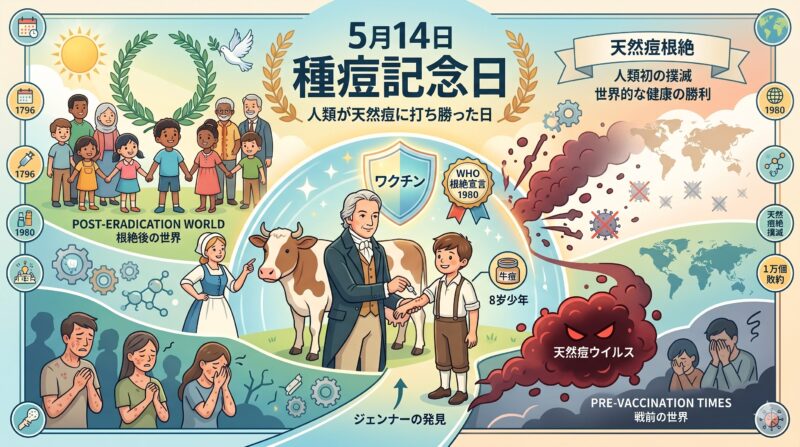
5月14日。今日は「すべてのワクチンの始まり」となった日です。
1796年のこの日、イギリスの医師エドワード・ジェンナーが、8歳の少年の腕に牛の病気の膿を塗りつけるという、前代未聞の「人体実験」を行いました。
その出発点となったのが、農村に伝わる不思議な言い伝え——「乳搾りの女性には天然痘にかからない美人が多い」というものでした。
今日はその感動の物語と、5月14日に重なる記念日をお届けします。
5月14日の記念日まとめ
📖 5月14日の主な記念日
・種痘記念日——1796年5月14日、ジェンナーが世界初の種痘接種に成功
・温度計の日——水銀温度計を発明したファーレンハイトの誕生日(1686年)
・けん玉の日——1919年5月14日、現代けん玉の原型「日月ボール」が実用新案登録
・マーマレードの日——オレンジデー(4/14)の1ヶ月後
・ごいしの日——「ご(5)い(1)し(4)」の語呂合わせ
・紀尾井坂の変(1878年)——大久保利通が暗殺された日
・イスラエル建国宣言(1948年)——第一次中東戦争勃発のきっかけとなった日
「乳搾り女性は美人が多い」——農村の言い伝えが世界を救った
今から230年前、天然痘はヨーロッパだけで毎年約60万人の命を奪う恐怖の病でした。感染すると全身に化膿性の発疹が広がり、助かった人もほとんどが「あばた面」になりました。当時、天然痘は「不治の病」「悪魔の病気」と恐れられていたのです。
そんな時代に、イギリスの田舎医師エドワード・ジェンナー(1749〜1823年)は農村でこんな言い伝えを耳にしました。
農村に伝わる不思議な言い伝え
「乳搾りの女性は天然痘にかかりにくい。だから美人が多い」
当時、天然痘にかかって顔にあばたが残ることは珍しくありませんでした。しかし確かに、乳搾りの女性たちの顔はきれいな人が多かった——。
ジェンナーはその理由を考えました。乳搾りの女性は仕事柄、牛の病気「牛痘(ぎゅうとう)」に感染する機会が多い。牛痘は症状が軽く、感染しても手に水疱ができる程度。そして牛痘にかかった人は、なぜか天然痘にかからない——。
「牛痘にかかれば、天然痘を予防できるのではないか?」
ジェンナーはこの仮説を持ち、なんと20年間研究と観察を続けました。
8歳の少年フィップスと「前代未聞の人体実験」
1796年5月14日——ジェンナーは仮説を検証する実験を決行しました。
牛痘にかかった乳搾り女性・サラ・ネルムズの手の水疱から膿を採取し、自分の家の庭師の息子である8歳のジェームズ・フィップスの両腕に浅い切り傷を作り、その膿を塗りつけたのです。
⚠️ 当時の実験の意味
安全性が100%担保されていない、仮説に基づく人体実験でした。現代なら医療訴訟を起こされても何の不思議もない行為です。しかしジェンナーは実行しました——天然痘で苦しむ人類を救いたいという強い信念のもとで。
接種から7日後、フィップスは腕に不快感を訴えます。しかし症状は軽く、すぐに回復しました。そしてジェンナーは次の決定的な一手を打ちます——今度は同じフィップスに天然痘そのものを接種したのです。
結果——フィップスは天然痘を発症しませんでした。
ジェンナーの仮説は証明されました。「弱い病気(牛痘)で免疫を作れば、強い病気(天然痘)を防げる」——これがすべてのワクチンの原理の始まりです。
学会に無視され、貧しい人々に無料接種を続けた孤独な戦い
しかし道は平坦ではありませんでした。
ジェンナーが論文をロンドンの王立協会に提出すると、「実験例が少なすぎる」「牛の病気を人間に植え込むとは非常識だ」と拒絶されます。「牛の膿を打たれたら人間が牛になる」という風刺画まで描かれ、世間からの嘲笑を受けました。
それでもジェンナーは諦めませんでした。故郷のバークリーに戻り、貧しい人々に無料で種痘を接種し続けたのです。
接種を重ねるごとに有効性のデータが積み上がり、少しずつ認められていきます。1802年にはイギリス議会から功績を称えられ、最終的に種痘法は世界中に広まっていきました。
そしてジェンナーの実験から183年後の1979年、WHO(世界保健機関)は「天然痘の地球上からの根絶」を宣言。人類史上、感染症を完全に撲滅した唯一の例となりました。
実験台になった少年フィップスへの「生涯無償コテージ」
ここが読者の心に最も刺さるポイントかもしれません。
人体実験の被験者となった8歳のジェームズ・フィップス。彼はその後もジェンナー家に仕え続け、結婚後も同地に暮らしました。
ジェンナーは感謝の気持ちとして、フィップスに家(コテージ)を建て、生涯無償で提供し続けました。
そしてフィップスが亡くなった後——彼はジェンナーが眠るバークリーの聖メアリー教会墓地に埋葬されました。ジェンナーは自分のそばで、この少年を永遠に迎え入れたのです。
現在、フィップスが暮らしたそのコテージはジェンナー博物館となり、世界中から訪問者が訪れています。
けん玉の日——実は日本生まれじゃなかった?意外なけん玉の歴史
1919年5月14日に、現代のけん玉の原型となる「日月ボール」を広島県呉市の江草濱次氏が考案し実用新案登録したことにちなんで、今日はけん玉の日でもあります。
実はけん玉の起源は日本ではなく、16世紀のフランスにあるとされています。当時は「bilboquet(ビルボケ)」と呼ばれ、フランス王アンリ3世も愛好したといわれる貴族の遊びでした。
けん玉豆知識
・起源は16世紀フランスの「ビルボケ」——アンリ3世も愛好した貴族の遊び
・日本には江戸時代(17世紀頃)に伝わったとされる
・現代の形(剣・玉・糸)は1919年に江草濱次氏が考案
・今や世界大会が開催されるほどの国際スポーツに成長
・「KENDAMA」として英語でもそのまま通じる世界語に
江戸時代の輸入品が、令和の時代に「KENDAMA」として世界に逆輸出されている——文化の旅って面白いですね。
5月14日は「勇気ある一歩が世界を変える」ことを思い出す日
農村の言い伝えを信じ、20年間研究を続け、学会に無視されながらも、貧しい人々に無料で接種を続けたジェンナー。その一歩が、230年後の今も「ワクチン」という形で人類を守り続けています。
「笑われても、否定されても、正しいと信じることを続ける」——今日はそんな勇気をもらえる日です。
まとめ
- 5月14日は種痘記念日——1796年、ジェンナーが8歳の少年フィップスに世界初の種痘接種を行った
- 出発点は「乳搾り女性は天然痘にかかりにくく美人が多い」という農村の言い伝え
- ジェンナーは20年間研究を続け、仮説を検証。学会には拒絶されたが、貧しい人々に無料接種を続けた
- 実験台になった少年フィップスに、ジェンナーは生涯無償のコテージを提供。同じ墓地に眠る
- 種痘の普及から183年後の1979年、天然痘は人類史上初めて地球上から根絶された
- 「ワクチン(vaccine)」の語源はラテン語で「牛(vacca)」——ジェンナーの牛痘研究に由来する
- けん玉の日——起源は16世紀フランスの貴族遊び。今や「KENDAMA」として世界語に
最後まで読んでくださってありがとうございました😊
今日、ワクチンを打ったことがある方は、その注射の中にジェンナーと8歳のフィップスの物語が詰まっていると思うと、少し感慨深くなりませんか?
では、よい一日をお過ごしください。
see you soon.
What Day Is May 14th? “Milkmaids Are Beautiful” — The Rural Legend That Saved the World and the Untold Story Behind Every Vaccine
May 14th. Today marks the birthday of every vaccine in existence.
On this day in 1796, an English country doctor named Edward Jenner performed an unprecedented “human experiment” — smearing pus from a cow’s disease onto the arm of an 8-year-old boy.
And the spark that set it all in motion? A curious old saying passed around in farming villages: “Milkmaids don’t get smallpox — that’s why they’re so pretty.”
Today, let’s explore that remarkable story — along with the other commemorative days that fall on May 14th.
May 14th Commemorative Days at a Glance
📖 Main Commemorative Days on May 14th
· Vaccination Day — May 14th, 1796: Jenner successfully performs the world’s first vaccination
· Thermometer Day — Birthday of Fahrenheit, inventor of the mercury thermometer (1686)
· Kendama Day — May 14th, 1919: the prototype of the modern kendama, the “Nichigetsudama,” was registered as a utility model
· Marmalade Day — One month after Orange Day (April 14th)
· Go Stone Day — Wordplay on “Go (5) I (1) Shi (4)” (碁石 = go stone)
· Kioi-zaka Incident (1878) — The assassination of Ōkubo Toshimichi
· Israeli Declaration of Independence (1948) — The event that triggered the First Arab-Israeli War
“Milkmaids Are Beautiful” — The Folk Legend That Changed the World
Two hundred and thirty years ago, smallpox was one of the most terrifying diseases on earth — killing an estimated 400,000 people in Europe alone every year. Those who survived were often left permanently scarred by the characteristic pockmarks that gave the disease its name. Smallpox was called “the incurable disease,” “the devil’s plague,” and it was feared by everyone.
Into this world came Edward Jenner (1749–1823), a country doctor in rural England, who heard an unusual piece of local folklore:
The Village Legend
“Women who milk cows don’t get smallpox — that’s why so many of them have beautiful skin.”
At the time, it was common for smallpox survivors to carry permanent pockmarks on their faces. But it was true — milkmaids, as a group, did tend to have remarkably clear complexions.
Jenner began to think about why. Milkmaids were regularly exposed, through their work, to “cowpox” — a mild disease that caused small blisters on the hands but nothing more serious. And people who caught cowpox seemed, inexplicably, to be protected from smallpox.
“What if catching cowpox could prevent smallpox?”
Jenner held onto this hypothesis — and spent the next 20 years researching and observing before he felt ready to act.
James Phipps, Age 8 — The Unprecedented Human Experiment
On May 14th, 1796, Jenner carried out the experiment that would change history.
He took pus from the cowpox blisters on the hands of a milkmaid named Sarah Nelmes, made two shallow scratches on the arms of 8-year-old James Phipps — the son of his gardener — and rubbed the pus into the wounds.
⚠️ What This Experiment Really Meant
This was a human experiment with no guarantee of safety — conducted on the basis of a hypothesis alone. By modern standards, it would almost certainly invite a medical lawsuit. And yet Jenner did it — driven by a profound belief that this was the way to save humanity from smallpox.
Seven days later, James developed mild discomfort in his arm. But the symptoms were minor and he recovered quickly. Then Jenner made his decisive next move: he deliberately inoculated James with smallpox itself.
James did not develop smallpox.
The hypothesis was confirmed. “A mild disease (cowpox) can build immunity against a deadly one (smallpox)” — this was the founding principle of every vaccine that has ever existed.
Rejected by the Academy, He Vaccinated the Poor for Free
But the path forward was anything but smooth.
When Jenner submitted his findings to the Royal Society in London, they rejected the paper. “Too few cases.” “Putting cow disease into a human being is preposterous.” Satirical cartoons circulated showing people growing horns and tails after receiving the cowpox inoculation. The public laughed at him.
Jenner did not stop. He returned to his hometown of Berkeley and continued — vaccinating the poor, for free, one person at a time.
Case by case, the evidence mounted. Slowly, reluctantly, the medical world began to take notice. In 1802, the British Parliament formally recognized his contribution, and vaccination spread around the world.
Then, 183 years after Jenner’s first experiment, the World Health Organization declared the global eradication of smallpox in 1979 — the only infectious disease in human history to have been completely eliminated from the face of the earth.
A Cottage for Life — What Jenner Did for the Boy Who Changed Everything
This may be the part of the story that stays with you longest.
James Phipps — the 8-year-old who had been the subject of that uncertain experiment — went on to serve the Jenner household throughout his life. After marrying, he continued to live in the same area.
In gratitude, Jenner built James a cottage and allowed him to live in it rent-free for the rest of his life.
When James passed away, he was buried in the churchyard of St. Mary’s in Berkeley — the same churchyard where Jenner himself rests. The man who had changed medical history chose to keep the boy who made it possible close to him, forever.
Today, the cottage where James Phipps lived has become the Jenner Museum, visited by people from around the world.
Kendama Day — It Didn’t Actually Start in Japan
May 14th, 1919 was the day Egusa Hamanji of Kure City, Hiroshima, registered a utility model for the “Nichigetsudama” — the prototype of the modern kendama. That’s why today is Kendama Day, established to spread kendama culture internationally.
But here’s the surprise: the origins of kendama are not Japanese at all. They trace back to 16th-century France, where the game was known as “bilboquet” — a toy said to have been enjoyed by King Henry III himself, a pastime of the aristocracy.
🪀 Kendama Fun Facts
· Origins: the “bilboquet” of 16th-century France — reportedly a favorite of King Henry III
· It is believed to have reached Japan during the Edo Period (17th century)
· The modern form (sword, ball, string) was designed by Egusa Hamanji in 1919
· Today, international kendama competitions are held around the world
· “KENDAMA” is now understood in English exactly as it sounds — a true global word
A French aristocratic toy, imported to Edo-period Japan, refined into something new — and now exported back to the world as “KENDAMA.” The journey of culture never quite goes where you’d expect.
Closing Thoughts — May 14th Is a Day to Remember That One Brave Step Can Change the World
Jenner believed in a folk legend. He spent 20 years pursuing it. He was laughed at and rejected by the scientific establishment. And he kept going anyway — vaccinating the poor, for free, one by one.
That single act of stubborn, compassionate belief now lives inside every vaccine ever administered — protecting billions of people across generations.
“Even when people laugh at you, even when they say you’re wrong — keep going if you believe it’s right.” May 14th is a day that gives us the courage to do exactly that.
Summary
- May 14th is Vaccination Day — in 1796, Jenner performed the world’s first vaccination on 8-year-old James Phipps
- It all began with a village legend: “Milkmaids don’t get smallpox — that’s why they’re beautiful”
- Jenner spent 20 years researching the idea, was rejected by the Royal Society, and vaccinated the poor for free until the evidence was undeniable
- As a lifelong thank-you, Jenner gave James Phipps a rent-free cottage for life — and they rest in the same churchyard today
- 183 years after Jenner’s experiment, smallpox was declared eradicated by the WHO in 1979 — the only disease ever eliminated from the earth
- The word “vaccine” comes from the Latin word for cow, vacca — a direct tribute to Jenner’s cowpox research
- Kendama Day — the toy’s roots are in 16th-century France; today “KENDAMA” is recognized worldwide
Thank you so much for reading all the way to the end 😊
The next time you get a vaccine, remember: inside that needle is the story of Edward Jenner, an 8-year-old boy named James, and a milkmaid’s beautiful skin.
Have a wonderful day.
See you soon.


コメント