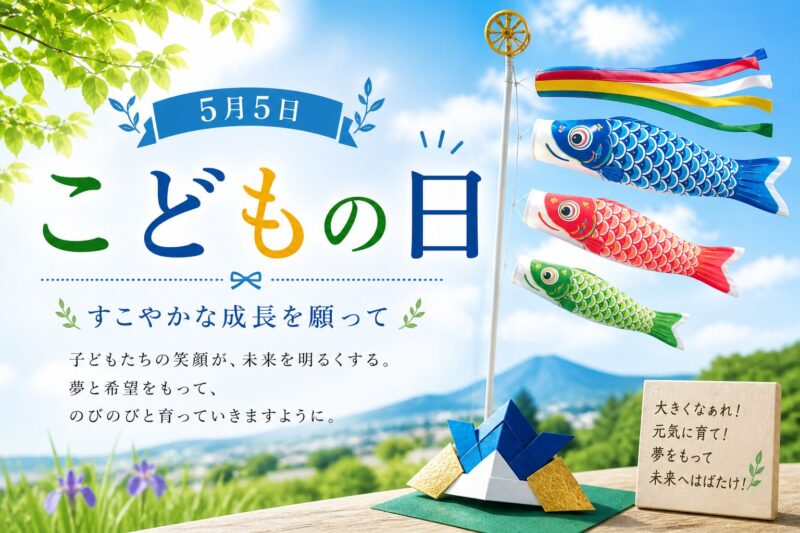
5月5日、GW最終日の「こどもの日」。
「男の子のお祝いでしょ?うちは女の子だから関係ないかな……」
……実は、それ大きな誤解なんです!
こどもの日の本当の意味を知ると、「え、そうだったの?」と思うこと間違いなし。今日は神戸の子どもたち27,000人の署名から始まったこの祝日の、知られざる誕生秘話をお届けします。
こどもの日とは?基本からおさらい
こどもの日は「こどもの人格を重んじ、こどもの幸福をはかるとともに、母に感謝する」ことを目的として1948年(昭和23年)に制定された国民の祝日です。
ここで「あれ?」と思いませんでしたか?
そうです。こどもの日には「母に感謝する」という一文が法律にしっかり入っているんです。子どもだけじゃなく、お母さんにも感謝する日——それがこどもの日の本来の姿です。
📖 ポイント整理
・日付:毎年5月5日
・制定:1948年(昭和23年)7月20日
・趣旨:こどもの人格を重んじ、こどもの幸福をはかるとともに、母に感謝する
・別名:端午の節句(たんごのせっく)
【驚きのエピソード①】27,000人の子どもの署名が生んだ祝日
こどもの日が5月5日に決まった背景には、感動的な歴史があります。
1948年、戦後の新しい祝日を国会で議論していたとき、衆議院議員の松澤兼人が国会でこう紹介しました——「神戸市内の児童約27,000名の署名」による「こどもの日」制定の請願を。
戦争で多くのものを失った子どもたちが、自分たちの日を作ってほしいと署名を集めた。その声が国を動かし、法律になったのです。
さらにこんな議論もありました。
💬 当時の国会審議より(昭和23年)
「祝祭日には草餅・ちまき・柏餅・そうめんなど、食べ物が加わると大変なごやかなものが生まれてくる」
「やはり春から初夏にかけての時期を選びたい」
食べ物の話も出るあたり、なんとも人間らしくて温かい議論ですね(笑)。こうして「なごやかで、春から初夏の気持ちいい季節」という理由で5月5日が選ばれたのです。
ちなみに候補日は3月3日(桃の節句)・4月1日・5月5日・11月15日(七五三)などいくつかありましたが、5月3日が憲法記念日になることが決まっていたため、自然と5月5日に絞られていきました。
「母に感謝する」一文が加わった理由——女性議員たちの訴え
こどもの日に「母に感謝する」という一文が入ったのには、理由があります。
法制定の過程で、女性議員などから「こどもの日を3月3日の桃の節句にしてほしい」という意見が上がりました。「5月5日は男の子の節句。女の子のことも考えてほしい」という思いからでした。
その声を汲み取る形で「母に感謝する」という一文が加えられ、こどもの日は男の子だけでなくすべての子どもと、その子どもを育てた母親を祝う日として制定されたのです。
こどもの日は、女性たちの声が形になった祝日でもあるんですね。
端午の節句とこどもの日——実は別物!
混同されがちですが、この2つは別物です。
| こどもの日 | 端午の節句 | |
|---|---|---|
| 種類 | 国民の祝日(法律) | 伝統的な年中行事 |
| 対象 | すべての子ども(男女)+母 | 男の子 |
| 始まり | 1948年(戦後) | 奈良時代〜 |
| 意味 | 子どもの幸福・母への感謝 | 男の子の健やかな成長祈願 |
端午の節句の歴史は奈良時代まで遡ります。もともとは中国から伝わった邪気払いの行事でした。香りの強い菖蒲を軒先に飾り無病息災を祈るものでしたが、鎌倉時代に武家が台頭すると「菖蒲(しょうぶ)」と「尚武(しょうぶ=武を尊ぶ)」の読みが同じことから、男の子の節句へと変化していきました。
【驚きのエピソード②】鯉のぼりは「激流を登った鯉が竜になる」伝説から
こどもの日といえば鯉のぼり。でもなぜ鯉なのか、知っていますか?
中国の古い伝説にこんな話があります。黄河の上流には「竜門」と呼ばれる激流の難所がありました。多くの魚がそこを登ろうと挑戦しましたが、登り切れたのは鯉だけ。そしてその鯉は竜となり、天に昇ったというのです。
これが「登竜門」という言葉の由来です。「困難を乗り越えて成功する」という意味で今も使われていますね。
「どんな激流も乗り越えて、竜のように大きくなってほしい」——そんな親心が鯉のぼりに込められていたんです。
🎏 鯉のぼりの色の意味
・黒(真鯉)=お父さん
・赤(緋鯉)=お母さん
・青・緑(子鯉)=子どもたち
・五色の吹き流し=魔除け(五行説の木・火・土・金・水を表す)
鯉のぼりは家族全員を表していたんですね。空を泳ぐ鯉のぼりが、なんだかいつもより温かく見えてきませんか?
【驚きのエピソード③】ちまきの由来は2500年前の政治家の悲しい物語
こどもの日に食べるちまき。実はこの食べ物にも、胸を打つ物語があります。
今から約2500年前の中国。「屈原(くつげん)」という政治家がいました。国王の側近として人々から強い信頼を得ていた屈原でしたが、陰謀によって国を追われてしまいます。
祖国の行く末を深く憂えた屈原は、5月5日に川に身を投げて命を絶ちました。
人々は屈原の死を悲しみ、5月5日の命日に川へちまきを投げ入れて供養しようとしました。しかし川の竜がちまきを奪ってしまい届かない。そこで竜が苦手とする楝樹(れんじゅ)の葉でちまきを包み、邪気払いの五色の糸で結んで投げ入れたところ、ついに屈原のもとへ届いたという話です。
その後この風習が日本へ伝わり、こどもの日の定番となりました。一方、柏餅は日本独自の食べ物。柏の葉は「新芽が育つまで古い葉が落ちない」特性から、「家系が絶えない=子孫繁栄」の象徴とされています。
菖蒲湯に入る理由——奈良時代から続く1000年の厄払い
こどもの日に菖蒲湯に入る風習は、奈良時代から続く実に1000年以上の歴史ある習慣です。
菖蒲の香りには邪気を払う力があると信じられており、薬草としても使われていました。端午の節句がちょうど季節の変わり目で体調を崩しやすい時期だったことから、菖蒲を入れたお風呂で健康を願う習慣が生まれたとされています。
また「菖蒲(しょうぶ)」が「勝負」や「尚武(武を重んじる)」に通じることから、子どもの強さや健康を願う意味も込められています。今年はぜひ家族で菖蒲湯を試してみてください😊
まとめ——こどもの日は「命をつなぐすべての人」への感謝の日
27,000人の子どもの署名、女性議員たちの訴え、竜門を登った鯉、屈原の悲しい物語——こどもの日にはこんなにも多くの人々の思いが詰まっていました。
お子さんがいる方も、いない方も、かつて誰もが子どもだった。そして誰かのお母さん、お父さんに育てられてきた。
今日はそんなことを思いながら、身近な人に「ありがとう」を伝えてみてはいかがでしょうか。
📝 まとめ
- こどもの日は毎年5月5日、1948年制定の国民の祝日
- 趣旨は「こどもの人格を重んじ、幸福をはかるとともに、母に感謝する」
- 神戸の子どもたち27,000人の署名が制定を後押しした
- 「母に感謝する」の一文は女性議員たちの声が形になったもの
- こどもの日と端午の節句は別物。こどもの日は男女すべての子どもの日
- 鯉のぼりは「登竜門」の伝説から。家族全員を表している
- ちまきの由来は2500年前の中国の政治家・屈原の物語
- 菖蒲湯は奈良時代から続く1000年以上の厄払いの風習
最後まで読んでくださってありがとうございました😊
GW最終日、ゆっくり過ごしながら、そっとお母さんに感謝の気持ちを伝えてみてください。きっと喜ばれますよ。
では、よい一日をお過ごしください。
see you soon.
What Is Children’s Day? “It’s Actually a Day to Thank Mothers Too” — The Surprising Truth About May 5th
May 5th — the last day of Golden Week — is “Children’s Day.”
“Isn’t it a celebration for boys? We only have girls, so I guess it doesn’t really apply to us…”
…Actually, that’s a big misconception!
Once you learn the true meaning of Children’s Day, you’ll find yourself saying, “Wait — really?” Today, let’s explore the little-known origin story of this holiday — one that began with the signatures of 27,000 children in Kobe.
What Is Children’s Day? A Quick Overview
Children’s Day is a national holiday established in 1948 (Showa 23) with the purpose of “respecting the individuality of children, pursuing their happiness, and giving thanks to mothers.“
Did you catch that?
That’s right — the phrase “giving thanks to mothers” is written right there in the law. Children’s Day isn’t just for kids — it’s also a day to appreciate mothers. That is the true nature of this holiday.
📖 Key Facts
· Date: May 5th every year
· Established: July 20, 1948 (Showa 23)
· Purpose: To respect children’s individuality, pursue their happiness, and give thanks to mothers
· Also known as: Tango no Sekku (端午の節句) — the Boys’ Festival
【Surprising Episode ①】The Holiday That 27,000 Children’s Signatures Made Happen
The story of how May 5th became Children’s Day is genuinely moving.
In 1948, as the post-war government was debating new national holidays, a member of the House of Representatives named Kaneto Matsuzawa introduced a petition to the Diet — one backed by the signatures of approximately 27,000 children from the city of Kobe — calling for the establishment of a “Children’s Day.”
Children who had lost so much to the war had gathered signatures asking for a day of their own. Their voices moved a nation — and became law.
There were also some wonderfully human moments in the debate that followed:
💬 From the Diet proceedings (1948)
“When food like grass mochi, chimaki, kashiwa mochi, and somen are part of a holiday, it creates such a warm and cheerful atmosphere.”
“We’d like to choose a time from spring into early summer.”
The fact that food came up in a legislative debate is endearingly human, isn’t it? (laughs) And so May 5th was chosen for being a time of warmth, cheer, and the pleasant transition from spring into early summer.
Other dates were considered — March 3rd (the Doll Festival), April 1st, May 5th, and November 15th (Shichi-Go-San) — but since May 3rd had already been designated as Constitution Memorial Day, May 5th naturally rose to the top.
Why “Thanks to Mothers” Was Added — The Female Legislators Who Spoke Up
The phrase “giving thanks to mothers” didn’t appear in the law by accident. It was the result of women’s voices being heard.
During the legislative process, female Diet members and others raised the opinion that “Children’s Day should be March 3rd — the Doll Festival.” Their reasoning: “May 5th is the Boys’ Festival. What about the girls?”
In response to these concerns, the phrase “giving thanks to mothers” was added, and Children’s Day was established as a holiday for all children — boys and girls — and for the mothers who raised them.
Children’s Day is, in part, a holiday shaped by the voices of women.
Children’s Day vs. Tango no Sekku — They’re Actually Different Things
These two are often confused, but they are distinct observances.
| Children’s Day | Tango no Sekku (Boys’ Festival) | |
|---|---|---|
| Type | National Holiday (law) | Traditional seasonal observance |
| For | All children (boys & girls) + mothers | Boys |
| Origin | 1948 (post-war) | Nara Period (8th century) onward |
| Meaning | Children’s happiness & gratitude to mothers | Prayers for boys’ healthy growth |
The history of Tango no Sekku stretches back to the Nara Period. It originated as a purification ritual brought over from China — people hung fragrant iris (shobu) from the eaves of their homes and prayed for good health. When the warrior class rose to prominence in the Kamakura Period, the word “shobu” (iris) connected with “shobu” (尚武, meaning to honor martial spirit), and the festival gradually transformed into a celebration specifically for boys.
【Surprising Episode ②】Koinobori: Born From a Legend of a Carp That Became a Dragon
Children’s Day and koinobori (carp streamers) go hand in hand — but do you know why carp?
There’s an ancient Chinese legend that goes like this. High up the Yellow River was a treacherous stretch of rapids known as the “Dragon’s Gate.” Many fish tried to swim upstream through it, but only one succeeded — a single carp. And when that carp made it through, it transformed into a dragon and ascended to the heavens.
This is the origin of the phrase “tōryūmon” (登竜門) — “passing through the Dragon’s Gate” — still used today to mean overcoming a great challenge on the path to success.
“May you overcome every current life throws at you, and rise like a dragon” — that is the parental wish woven into every koinobori.
🎏 What the Colors of Koinobori Mean
· Black (magoi) = Father
· Red (higoi) = Mother
· Blue/Green (kogoi) = Children
· Five-colored streamers (fukinagashi) = Protection from evil (representing the five elements: wood, fire, earth, metal, water)
Koinobori represent the whole family. Doesn’t that make the carp streamers swimming in the sky feel a little warmer and more personal?
【Surprising Episode ③】Chimaki’s Origin: A 2,500-Year-Old Story of a Tragic Statesman
The chimaki (sweet rice dumplings) eaten on Children’s Day also carry a deeply moving story.
About 2,500 years ago in ancient China, there lived a statesman named Qu Yuan (屈原). A trusted advisor to the king and deeply respected by the people, Qu Yuan was nonetheless driven from his homeland through a court conspiracy.
Overcome with grief for his country’s future, Qu Yuan threw himself into a river on the 5th day of the 5th month, ending his life.
The people mourned him deeply. On the anniversary of his death, they threw chimaki into the river to offer them to his spirit — but a dragon living in the river kept stealing them before they could reach him. So the people wrapped the chimaki in leaves from the chinaberry tree, which dragons feared, and bound them with five-colored threads to ward off evil. This time, the offering reached Qu Yuan.
This tradition eventually made its way to Japan, where chimaki became a staple of Children’s Day. Kashiwa mochi (rice cakes wrapped in oak leaves), on the other hand, is uniquely Japanese. Since oak leaves don’t fall until new buds grow, they became a symbol of unbroken lineage and family continuity.
Why We Take Iris Baths — A Tradition Over 1,000 Years Old
The custom of bathing in iris-scented water (shobu-yu) on Children’s Day dates back to the Nara Period — a tradition spanning more than 1,000 years.
The strong scent of iris was believed to drive away evil spirits, and the plant was used medicinally as well. Since Tango no Sekku falls at a seasonal turning point when illness tends to rise, bathing in iris-infused water became a way to pray for health and protection.
The word “shobu” (iris) also sounds like “shobu” (勝負, meaning contest or match) and connects to “shobu” (尚武, meaning to honor martial courage) — adding a wish for strength and vitality. If you haven’t tried it before, this year might be the perfect occasion for a family iris bath! 😊
Closing Thoughts — Children’s Day Is a Day of Gratitude for Everyone Who Passes Life Forward
Twenty-seven thousand signatures from children. The voices of female legislators. A carp that climbed the Dragon’s Gate. The sorrowful story of Qu Yuan. Children’s Day holds within it the wishes and struggles of so many people across so many ages.
Whether you have children or not, every one of us was once a child. And every one of us was raised by someone — a mother, a father, someone who cared.
Today, maybe take a quiet moment to say “thank you” to someone close to you.
📝 Summary
- Children’s Day is every May 5th, established as a national holiday in 1948
- Its purpose: to respect children’s individuality, pursue their happiness, and give thanks to mothers
- A petition signed by 27,000 children in Kobe helped bring this holiday into being
- The phrase “thanks to mothers” was added thanks to the advocacy of female legislators
- Children’s Day and Tango no Sekku are different things — Children’s Day is for all children, boys and girls
- Koinobori come from the “Dragon’s Gate” legend — and each carp represents a family member
- Chimaki trace back to the 2,500-year-old story of Chinese statesman Qu Yuan
- Iris baths (shobu-yu) are a purification tradition over 1,000 years old, dating to the Nara Period
Thank you so much for reading all the way to the end 😊
On this last day of Golden Week, take it slow — and maybe find a quiet moment to tell your mom you’re grateful. It’ll mean more than you think.
Have a wonderful day.
See you soon.

コメント