5月7日、GWが完全に終わって最初の本格的な平日です。
「さあ、仕事モードに切り替えなきゃ……」
そんな今日こそ、仕事への情熱が湧いてくる話をひとつ。
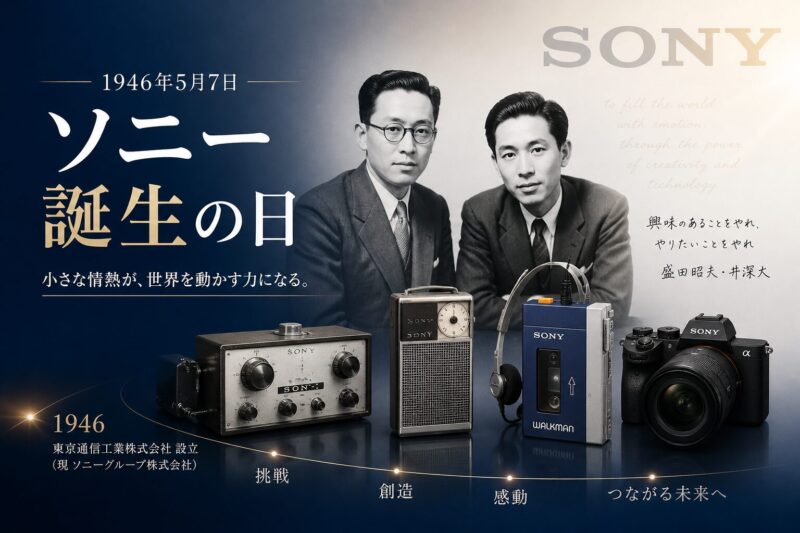
1946年の今日、5月7日——焼け野原の東京・日本橋のデパートの一室で、たった20人ほどの仲間が集まり、資本金19万円でひとつの会社を立ち上げました。その会社の名前は「東京通信工業株式会社」。後の世界的企業、ソニーです。
今日はそのソニー誕生秘話と、5月7日に重なる面白い記念日をお届けします。
1946年5月7日——ソニーが生まれた日
終戦からわずか9ヶ月。東京はまだ焼け跡が残る1946年5月7日、井深大と盛田昭夫の2人が中心となり、東京通信工業株式会社を設立しました。
📖 創業時のソニー(東京通信工業)
・創業日:1946年5月7日
・創業地:東京・日本橋の白木屋デパート3階
・資本金:19万円
・社員数:約20人
・初代社長:前田多門(元文部大臣)
・井深大:専務(技術担当)
・盛田昭夫:取締役(営業担当)
資本金19万円というのは、現在の価値に換算するとおよそ数百万円程度。「世界のソニー」の出発点が、これほどに小さなものだったとは、驚きですよね。
「思想の井深、実行の盛田」—12歳差の二人三脚
井深と盛田の出会いは、太平洋戦争中のことでした。海軍の新型レーダー開発グループで、12歳差のふたりは出会います。当時、井深35歳・盛田23歳。
夜な夜な語り合ったのは「戦争が終わったら、技術をどう世に広めるか」という夢でした。
終戦後、盛田には大きな選択が待っていました。愛知県の老舗造り酒屋の長男として、家業を継ぐことが求められていたのです。しかし父親は言いました。
盛田の父の言葉
「お前は自分の一番好きなことをやりなさい」
この一言が盛田の背中を押し、井深との創業へと踏み出させました。さらに井深は盛田の実家まで出向き、父親に「何としても口説くとの決死の覚悟」で参画を訴えたといいます。
こうして生まれたふたりの役割は見事に補い合うものでした。「思想の井深、実行の盛田」—技術と夢を描く井深と、それを世界に売り込む盛田。この二人三脚がなければ、ソニーは生まれなかったでしょう。
「日本製品は粗悪品」——盛田がアメリカに移住してまで戦った理由
創業当初のソニーは苦難の連続でした。1950年に日本初のテープレコーダーの開発に成功しましたが、高価すぎて売れない。試行錯誤の末に小型化し、ようやく事業が軌道に乗り始めます。
次の壁は「世界」でした。
「SONY」のブランド名でアメリカ市場に乗り込んだとき、当時の日本製品は「粗悪品の代名詞」として扱われていました。自社ブランドでの販売は困難を極めます。
そこで盛田は、経営者でありながら自らアメリカに移住し、家族とともにニューヨークに住んで販路を開拓していきます。トランジスタラジオとマイクロテレビが世界中でヒットし、「ジャパン・ブランド」の名声を確立していきました。
晩年、あるインタビュアーが盛田に「あなたの経営哲学とは何ですか?」と尋ねると、盛田はこう答えたといいます。
盛田昭夫の言葉
「わしには哲学や思想といったものはないんだよ。これまでずっと井深さんの思想を実現することだけをやってきたんだから」
自分には哲学がない、とキッパリ言い切った盛田。しかしその言葉こそが、最も深い哲学だったのかもしれません。
「会長のクビをかけて」—ウォークマン誕生の舞台裏
世界的大ヒット商品となったウォークマンにも、ドラマがありました。
井深のアイデアから生まれたウォークマンの開発を、盛田が社内の強い反対を押し切って承認します。当時の社内では「録音できない機械など売れない」という意見が大勢を占めていました。
しかし盛田は「もし売れなければ会長を辞める」と自らのクビをかけて開発を決断。1979年の発売後、ウォークマンは世界中で爆発的にヒットし、「歩きながら音楽を聴く」という新しいライフスタイルを生み出しました。
焼け跡のデパートの一室から、世界の文化を変えるまで—ソニーはまさに「夢と実行力」の結晶です。
コナモンの日—たこ焼き・お好み焼きに隠された「粉の革命」
「コ(5)ナ(7)」の語呂合わせから、5月7日は「コナモンの日」です。2003年に日本コナモン協会が設立された日でもあります。
コナモンとは、小麦粉などの粉を主原料とした食品のこと。たこ焼き・お好み焼き・うどん・ラーメン・餃子など、私たちの食卓に欠かせないものばかりです。
🍳 知ってた?コナモン豆知識
・小麦の栽培は約1万年前に始まったとされ、人類最古の食文化のひとつ
・うどんは奈良時代に中国から伝わったとされる(遣唐使が持ち帰った説あり)
・たこ焼きは1935年(昭和10年)大阪で誕生。発明者は屋台の店主・遠藤留吉氏
・お好み焼きのルーツは江戸時代の「一銭洋食」という屋台料理とも言われる
コナモンは関西文化の象徴として語られることが多いですが、実は世界共通の食文化。ピザもパスタもパンも、みんな「粉もの」仲間です。国境を越える「粉の力」、改めてすごいですね。
博士の日。「大博士」という幻の学位があった!
1888年(明治21年)5月7日、植物学者の伊藤圭介・数学者の菊池大麓・物理学者の山川健次郎ら25人の学者に日本初の博士号が授与されました。これが「博士の日」の由来です。
ここに、ちょっと面白い裏話があります。
当時の博士号は、論文を提出して取得するものではなく、教育への貢献を評価された名誉博士的なものでした。論文による本格的な博士が生まれたのは、それから3年後のことです。
さらに驚きなのが、当時は「博士の上に大博士という学位があった」ということ。博士よりすごい「大博士」—しかし該当者が誰もいなかったため、1898年に廃止されてしまいました。
「博士でも足りないくらいの人材を求めていた」という明治の志の高さ、なんだか微笑ましくもあります。
5月7日は「夢と実行」を考える日
焼け跡から世界へ飛び立ったソニーの創業者たち。「思想」を描く人と「実行」する人が組み合わさることで、歴史は動いていく、そんなことを教えてくれる日です。
GWが終わって仕事モードに戻る今日、自分の「思想」と「実行」を少し見つめ直してみるのもいいかもしれません。
📝 まとめ
- 1946年5月7日、ソニーの前身・東京通信工業が創業。資本金19万円・社員20人からのスタート
- 「思想の井深、実行の盛田」——12歳差の二人三脚が世界企業を生んだ
- 盛田は自らアメリカに移住して「粗悪品」のイメージを覆し、ジャパン・ブランドを確立
- ウォークマンは盛田が「会長のクビをかけて」社内反対を押し切って生み出した
- コナモンの日——たこ焼き・うどん・お好み焼きなど粉もの文化を祝う日
- 博士の日——1888年に日本初の博士号が授与。「大博士」という幻の学位も存在した
最後まで読んでくださってありがとうございました😊
GW明け最初の平日、ソニーの創業者たちの情熱を思いながら、一歩踏み出してみてください!
では、よい一日をお過ごしください。
see you soon.
What Day Is May 7th? It’s Actually the Birthday of Sony — The Miraculous Story of a World-Changing Company Born in the Ruins of Postwar Tokyo
May 7th — the first real weekday after Golden Week is fully over.
“Okay… time to switch back into work mode…”
On a day like today, here’s a story that just might reignite your passion for work.
On this day in 1946 — May 7th — in a single room inside a department store in the bombed-out ruins of Tokyo’s Nihonbashi district, about twenty people gathered together and founded a company with a starting capital of just 190,000 yen. That company was called Tokyo Tsushin Kogyo Kabushiki Kaisha — Tokyo Telecommunications Engineering Corporation. You know it today as Sony.
Today, let’s explore the untold story of Sony’s birth — along with some other fascinating observances that fall on May 7th.
May 7th, 1946 — The Day Sony Was Born
Just nine months after the end of World War II, with Tokyo still scarred by air raids, Masaru Ibuka and Akio Morita co-founded Tokyo Telecommunications Engineering Corporation on May 7th, 1946.
📖 Sony at Its Founding (Tokyo Tsushin Kogyo)
· Founded: May 7th, 1946
· Location: 3rd floor of the Shirokiya Department Store, Nihonbashi, Tokyo
· Starting capital: ¥190,000
· Number of employees: approximately 20
· First president: Tamon Maeda (former Minister of Education)
· Masaru Ibuka: Executive Managing Director (technology)
· Akio Morita: Director (sales)
In today’s terms, ¥190,000 at the time translates to roughly a few million yen — the equivalent of a very small startup fund. It’s hard to believe that “the world’s Sony” began somewhere so modest.
“The Vision of Ibuka, the Execution of Morita” — A Partnership Across 12 Years
Ibuka and Morita first met during World War II, on a navy research team developing new radar technology. Ibuka was 35; Morita was 23 — twelve years apart in age.
Night after night, the two talked about a shared dream: “When the war ends, how do we bring technology to the world?”
After Japan’s surrender, Morita faced a major crossroads. As the eldest son of a long-established sake brewery in Aichi Prefecture, he was expected to take over the family business. But his father said something unexpected:
💬 Words from Morita’s Father
“Do whatever it is you love most.”
Those words gave Morita the push he needed. And Ibuka went even further — he traveled to Morita’s family home in person, resolved, as he later put it, to make his case “with everything I had.” He was determined to bring Morita on board, no matter what.
The partnership that followed was a perfect complement. “The vision of Ibuka, the execution of Morita” — one man dreamed and invented, the other sold those dreams to the world. Without both of them, Sony would never have existed.
“Japanese Products Are Junk” — Why Morita Moved His Family to America
Sony’s early days were far from easy. In 1950, the company succeeded in developing Japan’s first tape recorder — but it was too expensive to sell. After extensive work to miniaturize it, the business finally found its footing.
Then came the next wall: the world.
When Sony entered the American market under the “SONY” brand name, Japanese products were widely regarded as cheap and unreliable. Selling under their own brand name was an enormous struggle.
Morita’s response? He moved his entire family to New York — a sitting company executive, living abroad to build Sony’s sales network from the ground up. His persistence paid off. The transistor radio and micro-television became global hits, and Sony played a pivotal role in establishing the reputation of Japan’s manufacturing quality worldwide.
Near the end of his life, when an interviewer asked Morita what his management philosophy was, he gave a surprising answer:
💬 Akio Morita’s Words
“I don’t really have a philosophy or a set of ideas. All I’ve ever done is try to make Ibuka’s vision a reality.”
He said it plainly, without hesitation: he had no philosophy. And yet, perhaps those very words were the deepest philosophy of all.
“I’ll Stake My Position on It” — The Story Behind the Walkman
Even the Walkman — one of the most iconic products in history — has a dramatic origin story.
When Ibuka’s idea for a personal stereo player reached the boardroom, Morita pushed the development forward over strong internal opposition. The prevailing view at the time was simple: “A machine that can’t record? Nobody will buy it.”
Morita disagreed — so strongly that he staked his position on it, reportedly saying he would resign as chairman if the product failed. When the Walkman launched in 1979, it became a global phenomenon, creating an entirely new culture of personal, portable music.
From a single room in a bombed-out department store to changing the culture of the entire world — Sony is truly the crystallization of vision and the will to act.
Konamon Day — The “Flour Revolution” Behind Takoyaki and Okonomiyaki
The wordplay “Ko (5) Na (7)” gives us Konamon Day on May 7th — also the anniversary of the founding of the Japan Konamon Association in 2003.
“Konamon” (粉もん) refers to foods made primarily from flour or other powders. Takoyaki (octopus balls), okonomiyaki (savory pancakes), udon, ramen, gyoza — these are all konamon, and they’re all staples of everyday Japanese life.
🍳 Konamon Fun Facts
· Wheat cultivation is thought to have begun around 10,000 years ago — one of humanity’s oldest food traditions
· Udon is said to have been brought to Japan from China during the Nara Period, possibly by members of imperial missions
· Takoyaki was born in Osaka in 1935 (Showa 10), invented by street vendor Tomekichi Endo
· Okonomiyaki’s roots may trace back to “Issen Yoshoku” — a cheap street food from the Edo Period
Konamon is often thought of as a symbol of Kansai food culture, but it’s really a universal human tradition. Pizza, pasta, bread — they’re all flour-based too. The power of powder truly knows no borders.
Doctor’s Day — There Was Once a Degree Even Higher Than “Doctor”!
On May 7th, 1888 (Meiji 21), Japan’s first doctoral degrees were awarded to 25 scholars, including botanist Keisuke Ito, mathematician Dairoku Kikuchi, and physicist Kenjiro Yamakawa. This is the origin of “Doctor’s Day.”
Here’s a fun detail that doesn’t get much attention:
These early doctorates weren’t awarded based on submitted research — they were honorary degrees, recognizing contributions to education. The first research-based doctoral degrees wouldn’t come until three years later.
And here’s the really surprising part: at the time, there was actually a degree above “Doctor” — called “Dai-Hakushi” (Grand Doctor). But since no one qualified for it, the rank was abolished in 1898 without ever being awarded.
There’s something endearing about a Meiji-era government that set the bar so high it couldn’t find anyone to reach it.
Closing Thoughts — May 7th Is a Day to Think About Vision and Action
The founders of Sony rose from the ruins of a bombed city to change the world. Their story is a reminder that history moves when someone with a vision meets someone with the drive to make it real.
As you switch back into work mode after Golden Week, maybe take a moment to reflect on your own vision — and your next step toward it.
📝 Summary
- On May 7th, 1946, Sony’s predecessor Tokyo Tsushin Kogyo was founded — ¥190,000 in capital, 20 employees
- “The vision of Ibuka, the execution of Morita” — a 12-year age gap, a perfect partnership, a world-class company
- Morita moved his family to America to personally dismantle the “Made in Japan = cheap” stereotype
- The Walkman was born because Morita staked his chairmanship on it and overruled internal opposition
- Konamon Day — a celebration of flour-based foods: takoyaki, udon, okonomiyaki, and more
- Doctor’s Day — Japan’s first doctorates were awarded in 1888; a mysterious “Grand Doctor” rank existed but was never given to anyone
Thank you so much for reading all the way to the end 😊
On this first real workday after Golden Week, let the passion of Sony’s founders inspire you to take one bold step forward!
Have a wonderful day.
See you soon.


コメント