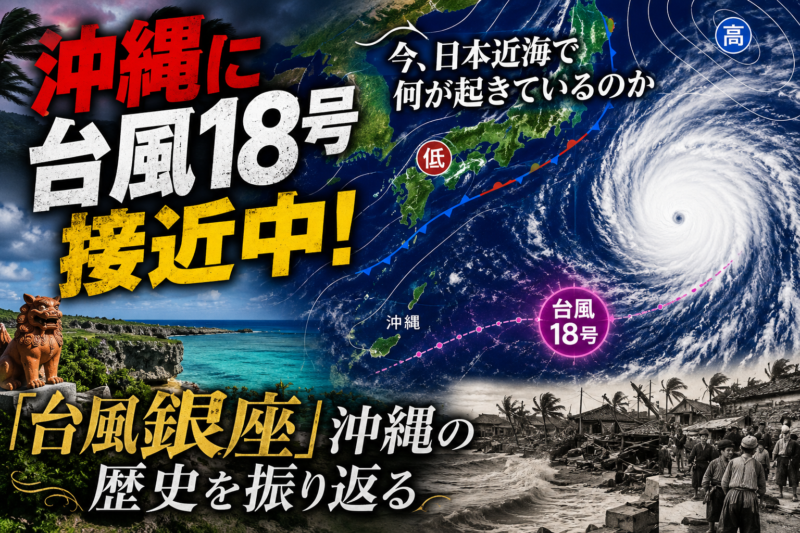
今週の沖縄は、台風18号の接近によって厳重な警戒が必要な状況が続いています。しかも現在、日本近海には台風18号・19号・20号・21号と、実に4つもの台風が同時に発生するという珍しい事態に。今日は最新の台風情報と、あわせて沖縄が経験してきた台風の歴史を振り返ってみたいと思います。
台風18号(ソウデル)の最新動向
8月19日に発生した台風18号は、発達しながら北西へ進み、非常に強い勢力を維持したまま日本の南を進んでいます。8月24日午前6時時点で、中心気圧950ヘクトパスカル、中心付近の最大風速45メートル、最大瞬間風速60メートルという、まさに「非常に強い」台風です。
気象庁の予報によると、台風18号は8月25日(火)に大東島地方を通過した後、26日(水)頃には沖縄本島地方に、27日(木)頃には先島諸島へ接近する見込みです。台風の進行速度が次第に遅くなるとみられており、影響が長引く恐れがあります。
沖縄本島地方や大東島地方では、一部の住宅が倒壊するような猛烈な風が吹くおそれがあるとして、暴風への厳重な警戒に加え、うねりを伴う高波・高潮、大雨にも十分な注意が呼びかけられています。
なぜ今「4つの台風」が同時発生しているのか
8月24日時点で、日本周辺では台風18号・19号・20号に加え、新たに台風21号(アッサニー)も発生し、同時に4つの台風が存在する「クアドラプル台風」という珍しい状況になっています。さらにフィリピンの東には新たな熱帯低気圧(台風の卵)も控えており、熱帯の海洋活動が非常に活発になっていることが分かります。
ただし、台風19号はトンキン湾付近、台風20号は台湾海峡付近を進んでおり、これらが日本へ直接的な影響を及ぼす可能性は小さいとみられています。日本、特に沖縄への直接的な影響が懸念されているのは、主に台風18号です。今年は平成以降で最多ペースの台風発生数となっており、エルニーニョ現象の影響で秋以降もさらに台風が発達しやすい傾向にあるとの指摘もあります。
なぜ沖縄は「台風銀座」と呼ばれるのか
沖縄・琉球諸島は古くから「台風の道」として知られ、毎年8〜10回ほどの台風が影響を及ぼすとされています。海に囲まれた地形と、台風の主な進路にあたる地理的な位置から、沖縄は日本の中でも特に台風の通過が多い地域として「台風銀座」と呼ばれてきました。
沖縄が経験してきた、歴代の記録的な台風
ここで、沖縄がこれまで経験してきた、特に大きな爪痕を残した台風の歴史を振り返ってみましょう。
第2宮古島台風(1966年)——観測史上第2位の最大瞬間風速
1966年9月4日〜6日、宮古島(当時の平良市)を襲ったこの台風は、沖縄観測史上最大となる最大瞬間風速85.3メートルを記録しました。これは日本の観測史上でも歴代2位という記録的な数値です(時速に換算すると約307km、新幹線「はやぶさ」の最高速度に迫るほどの速さです)。
台風が宮古島付近をゆっくりと進んだため、長時間にわたり強風と大雨が続き、宮古島では半数以上の住宅が損壊、さとうきびの7割が収穫不能となるなど、甚大な被害をもたらしました。
台風21号(2015年)——49年ぶりに風速80メートル超え
2015年9月28日、与那国島に接近した台風21号は最大瞬間風速81.1メートルを記録。1966年の第2宮古島台風以来、実に49年ぶりに風速80メートルを超えた台風となりました。
与那国島では窓ガラスが割れたり、電柱や街路樹が倒れたりする被害が発生。石垣市・竹富町・与那国町合わせて最大5,900戸が停電し、与那国町では町内すべての世帯にあたる約1,000戸が停電。携帯電話やインターネットも不通となり、島全体が一時「孤立」状態に陥りました。
台風13号(2006年)——西表島で観測史上最強を記録
2006年9月16日、石垣島地方を直撃した台風13号は、西表島において同地点で観測史上最も強い最大瞬間風速69.9メートルを記録。先島諸島全域の約半数にあたる26,100世帯が停電し、石垣市では家屋2棟が倒壊、窓ガラスの破損によるけが人も出ました。
今、私たちにできる備え
過去の記録を振り返ると、沖縄の台風がいかに大きな脅威となり得るかがよく分かります。台風18号の接近に備え、今のうちにできる備えを見直しておきましょう。
- ベランダや屋外に置いてあるものを室内へ移動、または固定する
- 窓ガラスに飛散防止フィルムを貼る、または雨戸・シャッターを閉める
- 断水・停電に備え、飲料水・食料・モバイルバッテリーなどを備蓄する
- 最新の気象情報・避難情報をこまめに確認する
- 不要不急の外出は避け、暴風域に入る前に安全な場所へ移動する
✍️ 今日のまとめ
4つの台風が同時に発生するという珍しい状況の中、沖縄には非常に強い台風18号が接近しています。過去の歴史を振り返ると、沖縄はこれまでも幾度となく大きな台風による被害を経験し、そのたびに乗り越えてきました。
今回の台風も、決して侮ることなく、できる限りの備えをして過ごしましょう。沖縄にお住まいの皆さん、そしてご家族が沖縄にいらっしゃる方も、どうか安全第一でお過ごしください。
最新の台風情報は、気象庁や日本気象協会(tenki.jp)などの公式情報を随時ご確認ください。
本日も良い一日をお過ごしください。
See you soon.
This week in Okinawa, strict caution remains necessary as Typhoon No. 18 continues to approach. What’s more, right now, the seas around Japan are experiencing a rare situation: four separate typhoons — No. 18, 19, 20, and 21 — active at the same time. Today, let’s go over the latest typhoon information and take a look back at the history of typhoons that Okinawa has weathered.
The Latest on Typhoon No. 18 (Sopdeh)
Typhoon No. 18 formed on August 19th and has been developing while moving northwest, maintaining an extremely powerful intensity as it passes south of Japan. As of 6 AM on August 24th, it had a central pressure of 950 hectopascals, maximum sustained winds near the center of 45 meters per second, and maximum gusts of 60 meters per second — truly qualifying as an “extremely strong” typhoon.
According to the Japan Meteorological Agency’s forecast, after passing near the Daito Islands region on Tuesday, August 25th, the typhoon is expected to approach the main Okinawa Island region around Wednesday, August 26th, and the Sakishima Islands around Thursday, August 27th. Its forward speed is expected to gradually slow, raising concerns that its effects could linger for an extended period.
In the main Okinawa Island region and the Daito Islands, there are warnings of potentially violent winds strong enough to collapse some homes, and residents are being urged to exercise strict caution against powerful winds, as well as high waves and storm surges accompanied by swells, and heavy rain.
Why Are Four Typhoons Occurring Simultaneously Right Now?
As of August 24th, in addition to Typhoons No. 18, 19, and 20, a new Typhoon No. 21 (Assani) has also formed near Japan, creating a rare situation with four typhoons active at once — a so-called “quadruple typhoon” event. On top of that, a new tropical depression (a potential typhoon in formation) has emerged east of the Philippines, indicating extremely active tropical ocean conditions.
That said, Typhoon No. 19 is moving near the Gulf of Tonkin, and Typhoon No. 20 is near the Taiwan Strait, and both are expected to have minimal direct impact on Japan. The primary concern for Japan, and Okinawa in particular, is Typhoon No. 18. This year has seen typhoon formation at the fastest pace since the Heisei era began, with some pointing to El Niño conditions as a factor that may continue to favor typhoon development into autumn.
Why Is Okinawa Called “Typhoon Alley”?
Okinawa and the Ryukyu Islands have long been known as a “typhoon highway,” affected by an estimated 8 to 10 typhoons each year. Due to its ocean-surrounded geography and its position along the main paths typhoons tend to follow, Okinawa has come to be known within Japan as “Typhoon Alley” — a region that experiences an especially high number of typhoon passages.
Historic and Record-Breaking Typhoons Okinawa Has Endured
Let’s take a moment to look back at some of the most devastating typhoons in Okinawa’s history.
The 2nd Miyako Island Typhoon (1966) — The 2nd Highest Peak Gust Ever Recorded
Striking Miyako Island (then Hirara City) from September 4th to 6th, 1966, this typhoon recorded a peak gust of 85.3 meters per second — the strongest ever measured in Okinawa’s observation history, and the second highest ever recorded in all of Japan. (Converted to speed, that’s roughly 307 km/h — nearly matching the top speed of the Hayabusa Shinkansen, Japan’s fastest train.)
Because the typhoon moved slowly near Miyako Island, strong winds and heavy rain continued for an extended period, causing devastating damage: more than half of all homes on the island were damaged, and 70% of the sugarcane crop became unharvestable.
Typhoon No. 21 (2015) — Winds Over 80 m/s for the First Time in 49 Years
Approaching Yonaguni Island on September 28, 2015, Typhoon No. 21 recorded a peak gust of 81.1 meters per second — the first time winds had exceeded 80 m/s in Okinawa since the 2nd Miyako Island Typhoon in 1966, a gap of 49 years.
On Yonaguni Island, windows shattered and utility poles and roadside trees were knocked down. Across Ishigaki City, Taketomi Town, and Yonaguni Town, up to 5,900 households lost power, with Yonaguni Town experiencing a complete blackout affecting all roughly 1,000 households on the island. Mobile phones and internet service were also cut off, temporarily leaving the entire island isolated.
Typhoon No. 13 (2006) — The Strongest Ever Recorded on Iriomote Island
Directly striking the Ishigaki Island region on September 16, 2006, Typhoon No. 13 recorded a peak gust of 69.9 meters per second on Iriomote Island — the strongest ever measured at that location. Approximately 26,100 households, roughly half of all households across the entire Sakishima Islands, lost power. In Ishigaki City, two houses collapsed, and people were injured and taken to the hospital after windows shattered.
What We Can Do to Prepare Right Now
Looking back at these past records makes clear just how serious a threat Okinawa’s typhoons can be. As Typhoon No. 18 approaches, now is a good time to review what preparations you can make.
- Bring items from your balcony or outdoor areas inside, or secure them firmly
- Apply shatter-resistant film to windows, or close storm shutters
- Stock up on drinking water, food, and portable battery chargers in case of water or power outages
- Check the latest weather and evacuation information regularly
- Avoid unnecessary outings, and move to a safe location before the storm’s wind field arrives
Today’s Takeaway
Amid the rare occurrence of four simultaneous typhoons, an extremely powerful Typhoon No. 18 is now approaching Okinawa. Looking back at history, Okinawa has weathered devastating typhoons time and time again — and has overcome each one.
Please don’t underestimate this typhoon either, and take whatever precautions you can. To everyone living in Okinawa, and to anyone with family here, please stay safe above all else.
For the latest typhoon updates, please check official sources such as the Japan Meteorological Agency or the Japan Weather Association (tenki.jp).
Have a wonderful day today.
See you soon.

コメント