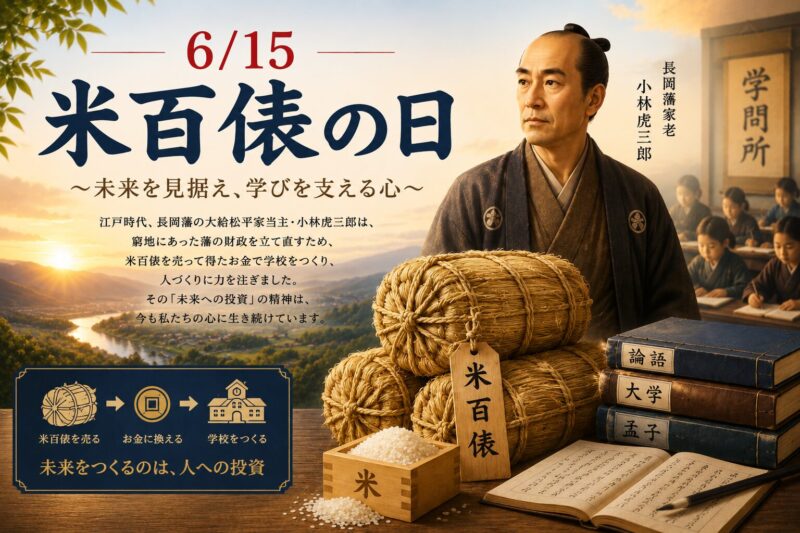
今日は新潟県長岡市が制定した「米百俵の日」です。
1870年(明治3年)6月15日——戊辰戦争に敗れ、焼け野原となった長岡藩に、ある学校の新校舎が完成しました。その建設資金は、藩の財政が壊滅状態だった中で、支藩から見舞いとして贈られた「米百俵」を売却したお金でした。
その日、藩士たちは「今日明日の食べ物さえない」状況でした。米百俵が届いたとき、彼らは当然「米を分けてくれ」と訴えました。しかし、藩の実権を握っていた一人の男が、その願いを拒みます。
「この米を、一日や二日で食いつぶして、あとに何が残るのだ」
6月15日の記念日まとめ
6月15日の主な記念日・出来事
・米百俵の日——1870年6月15日、長岡藩の国漢学校新校舎が開校した日(新潟県長岡市制定)
・スタジオジブリ設立記念日——1985年6月15日、株式会社スタジオジブリが設立
・PDFの日——1993年6月15日、Adobeが「PDF」を正式発表した日
・オウム・インコの日——「オウム(06)イ(1)ンコ(5)」の語呂合わせ
・信用金庫の日——1951年6月15日、信用金庫法が公布された日
・暑中見舞いはがきの日——1950年6月15日、郵政省が初めて「暑中見舞用郵便葉書」を発売
・千葉県民の日・栃木県民の日——両県とも明治時代の県の合併・確定にちなむ
「米を分けろ」と詰め寄る藩士たちに、彼は何と答えたか
1868年(慶応4年)、戊辰戦争(北越戦争)で激戦地となった長岡藩は、城下町のほとんどが焼け野原となりました。藩の財政は完全に破綻し、士族たちは1日3度の「かゆ」すら口にできない状況に陥っていました。
そんな中、長岡藩の窮状を知った支藩・三根山藩から、見舞いとして「米百俵」が届けられます。
当時、藩の大参事(実質的なリーダー)だったのが小林虎三郎でした。米百俵の分配を任された虎三郎は、藩士たちの予想を裏切る決断を下します。
小林虎三郎の言葉(戯曲「米百俵」より)
「この米を、一日や二日で食いつぶして、あとに何が残るのだ。国がおこるのも、ほろびるのも、まちが栄えるのも、衰えるのも、ことごとく人にある。食えないからこそ、学校を建て、人物を養成するのだ」
米を分配すれば、藩士たちの飢えは一時的にしのげます。しかし虎三郎は、その米を売却し、その代金で学校(国漢学校)の建設資金にあてることを決断したのです。
当然、藩士たちは猛反発しました。「今日食う米さえないのに、なぜ学校なのか」——その声は当然のものでした。それでも虎三郎は、自身の信念を押し通しました。
「象山門下の二虎」——小林虎三郎という男の生涯
小林虎三郎(1828〜1877年)は、幼少期に疱瘡(天然痘)を患い、左目を失明しています。それでも長岡藩の藩校・崇徳館で学び、若くして助教(教師)を務めるほどの俊英でした。
23歳のとき、藩の命令で江戸へ遊学。兵学・洋学で名高い佐久間象山の門下に入ります。この時、同じ門下に長州藩の吉田寅次郎——のちの吉田松陰がいました。
🎓 「象山門下の二虎」
佐久間象山は、虎三郎と吉田松陰の二人をこう評したと伝えられています。
「天下、国の政治を行う者は、吉田であるが、わが子を託して教育してもらう者は小林のみである」
吉田松陰は「政治を動かす人材」、小林虎三郎は「人を育てる教育者」——象山はこの二人の異なる才能を見抜いていました。「象山門下の二虎」と並び称されたほどの俊英が、その後の人生を「教育」に捧げることになるのです。
左目を失いながらも学問を究め、「人を育てること」に生涯を捧げた男。その信念が、焼け野原の長岡で「米百俵」という決断につながりました。
「富強の本ただ人民の知識を開く外なし」——国漢学校に込めた思い
虎三郎が設立した「国漢学校」には、それまでの藩校とは違う、画期的な特徴がありました。
国漢学校の革新性
・従来の藩校:武士の子弟のみが対象
・国漢学校:農民や町人の子弟の入学も認めた
・虎三郎の方針:「富強の本、ただ人民の知識を開く外なし」(国を富ませ強くする根本は、人々の知識を開くことしかない)
・新校舎開校:1870年(明治3年)6月15日、坂之上町(現・長岡市大手通)
・後に新政府の学制に組み込まれ、現在の新潟県立長岡高校などにつながっていく
身分に関係なく、すべての子どもに教育の機会を——焼け野原の中で、虎三郎はすでに「次の時代」を見ていました。
「米百俵賞」——155年後の今も続く精神
虎三郎自身は、その後も病に苦しみながら生涯を送り、1877年に50歳で亡くなりました。彼の決断は一時、藩士たちの恨みを買うものでもありました。
しかし、その精神——「苦しい時こそ、人づくりが必要だ」——は、文豪・山本有三が戯曲「米百俵」として書き下ろしたことで全国に広まりました。
「米百俵の精神」は今も生きている
・長岡市は1996年(市制90周年)に6月15日を「米百俵の日」と制定
・長岡市米百俵財団が毎年6月15日、人材育成に貢献した個人・団体に「米百俵賞」を贈呈
・「人づくりはまちづくり」というスローガンとして、現在も長岡市政の根幹に
・2001年、小泉純一郎首相(当時)が国会で「米百俵の精神」を引用し、全国的に再注目された
スタジオジブリ設立記念日——1985年6月15日、吉祥寺で始まった物語
1985年6月15日——株式会社スタジオジブリが、東京・吉祥寺駅近くのビルで設立されました。2026年の今日で41周年です。
「風の谷のナウシカ」の成功を受けて設立されたスタジオジブリ。以来、宮崎駿・高畑勲監督らの作品は、日本だけでなく世界中で愛され続けています。
まとめ——6月15日は「苦しい時こそ何に投資するか」を考える日
今日食べる米さえない時に、その米を学校に変える——それは美談として語られがちですが、当事者にとっては地獄のような苦しい決断だったはずです。それでも虎三郎は「人」に投資しました。156年後の今日、その精神は「米百俵賞」として今も続いています。
まとめ
- 6月15日は米百俵の日——1870年6月15日、長岡藩の国漢学校新校舎が開校
- 戊辰戦争で焼け野原となった長岡藩に届いた見舞いの米百俵を、小林虎三郎が学校建設資金に転用
- 虎三郎の言葉:「食えないからこそ、学校を建て、人物を養成するのだ」
- 虎三郎は幼少期に左目を失明。佐久間象山門下で吉田松陰と並び「象山門下の二虎」と称された
- 国漢学校は農民や町人の子弟の入学も認めた画期的な学校だった
- 長岡市は1996年に「米百俵の日」を制定。毎年「米百俵賞」を人材育成功労者に贈呈
- 1985年6月15日、スタジオジブリ設立——2026年で41周年
最後まで読んでくださってありがとうございました😊
今日は「苦しい時、何に時間やお金を使うか」を、少し考えてみてください。156年前のある決断が、今も長岡の街に生き続けています。
では、よい一日をお過ごしください。
see you soon.
What Day Is June 15th? “What’s Left After You Eat It in a Day or Two?” — The Story of a Man Who Turned Famine Relief Rice into a School, Against the Furious Objections of His Own People
Today is “Komebyappyo no Hi” (The Day of the Hundred Bales of Rice), a commemorative day established by Nagaoka City in Niigata Prefecture.
On June 15th, 1870 (Meiji 3), in the domain of Nagaoka — defeated in the Boshin War and reduced to scorched earth — a new school building was completed. The funds for its construction came from selling one hundred bales of rice, sent as relief aid from a neighboring domain, at a time when the domain’s finances had completely collapsed.
On the day that rice arrived, the domain’s samurai had no food for today or tomorrow. Naturally, they demanded the rice be distributed immediately. But the man who held real power in the domain refused.
“What’s left after you eat this rice up in a day or two?”
June 15th Commemorative Days at a Glance
Main Events & Commemorative Days on June 15th
· Komebyappyo no Hi (Hundred Bales of Rice Day) — June 15th, 1870: the new building of the Kokukan School in Nagaoka opens (established by Nagaoka City)
· Studio Ghibli Founding Day — June 15th, 1985: Studio Ghibli Inc. was established
· PDF Day — June 15th, 1993: Adobe officially announced the “PDF” format
· Parrot and Parakeet Day — Wordplay on “Ōmu (06) i (1) nko (5)” (オウム・インコ = parrot/parakeet)
· Shinkin Bank Day — June 15th, 1951: Japan’s Shinkin Bank Act was promulgated
· Summer Greeting Postcard Day — June 15th, 1950: Japan’s Ministry of Posts and Telecommunications issued the first “summer greeting” postcards
· Chiba Prefecture Day / Tochigi Prefecture Day — Both mark Meiji-era mergers that finalized each prefecture’s current borders
The Samurai Demanded “Give Us the Rice” — What Did He Say in Response?
In 1868 (Keiō 4), the domain of Nagaoka became one of the major battlegrounds of the Boshin War (the Hokuetsu War). Nearly the entire castle town was burned to the ground. The domain’s finances were utterly ruined, and its samurai families couldn’t even manage three bowls of rice porridge a day.
It was at this point that the neighboring domain of Mineyama, having learned of Nagaoka’s dire situation, sent one hundred bales of rice as relief.
The man serving as the domain’s senior councilor — its de facto leader — at the time was Kobayashi Torasaburō. Entrusted with distributing the rice, he made a decision no one expected.
Kobayashi Torasaburō’s Words (from the play “A Hundred Bales of Rice”)
“What’s left after you eat this rice up in a day or two? Whether a nation rises or falls, whether a town flourishes or withers — it all comes down to its people. It is precisely because we cannot eat that we must build a school, and raise the people who will build our future.“
Distributing the rice would have eased the samurai’s hunger — temporarily. Instead, Torasaburō decided to sell the rice and use the proceeds to fund the construction of a school — the Kokukan School.
The samurai’s outrage was immediate and understandable: “We don’t even have food for today — why a school?” And yet Torasaburō held his ground.
“The Two Tigers of Sakuma Shōzan’s School” — The Life of Kobayashi Torasaburō
Kobayashi Torasaburō (1828–1877) lost the sight in his left eye to smallpox as a child. Despite this, he excelled at the Nagaoka domain school, Sūtokukan, becoming an assistant teacher at a remarkably young age.
At 23, he was sent by the domain to study in Edo, where he became a student of Sakuma Shōzan — renowned for his expertise in military science and Western learning. Among his fellow students was Yoshida Torajirō — later known to history as Yoshida Shōin.
“The Two Tigers of Shōzan’s School”
Sakuma Shōzan is said to have evaluated his two most promising students this way:
“The one who will run the nation’s politics is Yoshida. But the only one I would trust to educate my own child is Kobayashi.“
Yoshida Shōin: a man who would shape the politics of a nation. Kobayashi Torasaburō: a man born to educate. Shōzan saw these two very different gifts clearly. Both were called “the two tigers” of his school — and Torasaburō went on to devote his entire life to education.
A man who lost the sight of one eye, who mastered scholarship despite it, and devoted his life to raising people. That conviction is what led him, in the burned-out ruins of Nagaoka, to the decision known as “the Hundred Bales of Rice.”
“The Only Foundation for a Strong Nation Is to Open the Minds of Its People” — The Vision Behind the Kokukan School
The school Torasaburō founded — the Kokukan School — had a feature that broke sharply with the domain schools of the past.
What Made the Kokukan School Revolutionary
· Traditional domain schools: open only to the children of samurai families
· The Kokukan School: open to the children of farmers and merchants as well
· Torasaburō’s guiding principle: “The only foundation for a strong and prosperous nation is to open the minds of its people”
· New building opened: June 15th, 1870 (Meiji 3), in Sakanoue-chō (present-day Ōtedōri, Nagaoka)
· Later absorbed into the new national school system, eventually connecting to institutions including present-day Niigata Prefectural Nagaoka High School
Educational opportunity for every child, regardless of social rank — in the middle of a burned city, Torasaburō was already looking toward the next era.
The Komebyappyo Prize — A Spirit Still Alive 155 Years Later
Torasaburō himself spent the rest of his life in poor health, and died in 1877 at the age of 50. For a time, his decision earned him the resentment of the very samurai he had refused to feed.
But that spirit — “it is in the hardest times that we most need to invest in people” — spread across Japan when the celebrated author Yamamoto Yūzō dramatized the story in his play, A Hundred Bales of Rice.
“The Spirit of the Hundred Bales of Rice” Lives On
· In 1996 (Nagaoka’s 90th anniversary as a city), June 15th was officially designated “Komebyappyo no Hi”
· Every June 15th, the Nagaoka Komebyappyo Foundation awards the “Komebyappyo Prize” to individuals and organizations who have contributed to developing human talent
· The phrase “building people is building a city” remains central to Nagaoka’s civic philosophy today
· In 2001, then-Prime Minister Koizumi Jun’ichirō quoted “the spirit of the hundred bales of rice” in a speech to the Diet, bringing the story back into the national spotlight
Studio Ghibli Founding Day — June 15th, 1985: A Story That Began in Kichijōji
On June 15th, 1985, Studio Ghibli Inc. was founded in a building near Kichijōji Station in Tokyo. Today, June 15th, 2026, marks its 41st anniversary.
Studio Ghibli was founded on the strength of the success of Nausicaä of the Valley of the Wind. Since then, the films of directors Hayao Miyazaki and Isao Takahata have been beloved not only in Japan but around the world.
Closing Thoughts — June 15th Is a Day to Ask: What Do We Invest in When Times Are Hardest?
Turning rice you desperately need into a school — it’s often told as an inspiring story, but for the people living through it, the decision must have felt unbearable. And yet Torasaburō chose to invest in people. 156 years later, that spirit lives on every year as the Komebyappyo Prize.
Summary
- June 15th is Komebyappyo no Hi — on June 15th, 1870, the new building of the Kokukan School in Nagaoka opened
- After the Boshin War left Nagaoka in ruins, Kobayashi Torasaburō used 100 bales of relief rice to fund the school’s construction instead of distributing it
- His words: “It is precisely because we cannot eat that we must build a school, and raise the people who will build our future”
- Torasaburō lost the sight of his left eye as a child; under Sakuma Shōzan, he and Yoshida Shōin were called “the two tigers” of their teacher’s school
- The Kokukan School was groundbreaking for admitting the children of farmers and merchants, not just samurai families
- Nagaoka City established “Komebyappyo no Hi” in 1996 and awards the Komebyappyo Prize every year to those who contribute to developing people
- On June 15th, 1985, Studio Ghibli was founded — celebrating its 41st anniversary in 2026
Thank you so much for reading all the way to the end 😊
Today, take a moment to think about what we invest in when times are hardest. A decision made 156 years ago is still alive in the streets of Nagaoka today.
Have a wonderful day.
See you soon.


コメント