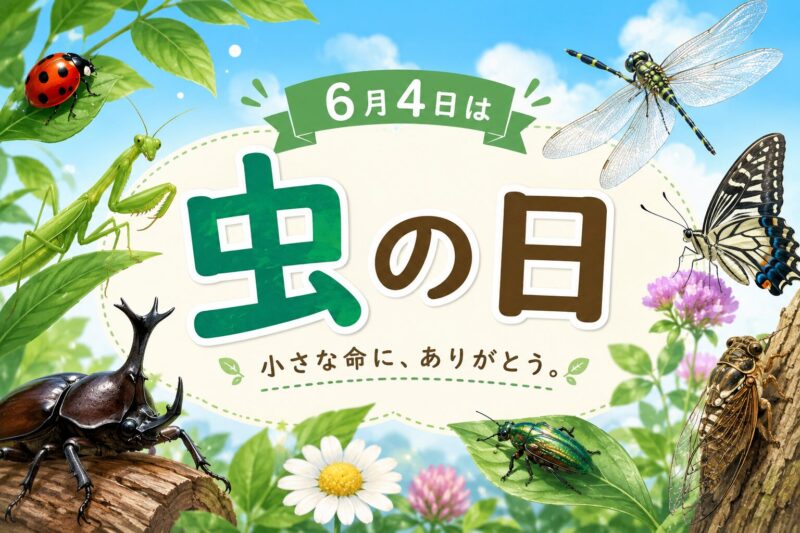
6月4日。今日は「む(6)し(4)」の語呂合わせから生まれた記念日が2つ重なる一日です。
「虫の日」と「歯と口の健康週間(むし歯予防デー)」——どちらも「むし」ですが、全く違う方向を向いた記念日です。
今日はその「虫の日」の生みの親・手塚治虫と、現代の「虫塚」を作った養老孟司さんの、昆虫愛にまつわる感動の物語をお届けします。
6月4日の記念日まとめ
6月4日の主な記念日・出来事
・虫の日(ムシの日)——「む(6)し(4)」の語呂合わせ。手塚治虫らの呼びかけで設立された日本昆虫クラブが制定(1988年)
・歯と口の健康週間(むし歯予防デー)——6月4日〜10日。「む(6)し(4)歯」の語呂合わせ
・蒸しパンの日——「む(6)し(4)パン」の語呂合わせ
・侵略による罪のない幼児犠牲者の国際デー——国連が制定。世界の子どもの権利を守る誓いを新たにする日
・天安門事件(1989年)——中国・北京の天安門広場で民主化運動を求める学生らへの武力鎮圧が行われた日
・虫の日(建長寺・虫塚)——養老孟司が設計を隈研吾に依頼、2015年に鎌倉・建長寺に「虫塚」を建立した日
ペンネームは「オサムシ」から——昆虫少年だった手塚治虫
「手塚治虫」というペンネーム、なぜ「虫」がついているのかご存知ですか?
手塚治虫(本名・手塚治)は1928年大阪府豊中市生まれ。幼い頃から昆虫が大好きで、家の広い庭や周囲の田園地帯を駆け回りながら昆虫採集に夢中になっていました。
そして小学3〜4年生のとき——友人から借りた昆虫図鑑で「オサムシ」という甲虫に出会います。
「オサムシ」との出会い
・オサムシ(学名:Carabus japonicus)は日本に生息する地上性の甲虫
・光を反射してきらめく、美しい色彩を持つ
・手塚少年は「オサムシ」の「おさむ」が自分の名前「治(おさむ)」と同じ読みであることに気づく
→ 本名の「治(おさむ)」に「虫」をつけて「治虫」というペンネームが誕生
昆虫への愛から生まれたペンネームが、やがて「漫画の神様」を象徴する名前になるとは——少年の手塚治は想像していたでしょうか。
3000点の標本を作った昆虫少年——手塚治虫の「もうひとつの顔」
手塚治虫の昆虫愛は生涯を通じて本物でした。
小学生時代には約3,000点もの昆虫標本を作り、13歳のときには自ら「昆虫戦線記」「昆虫の身の上ばなし」などの昆虫エッセイを書いています。16歳のときには「昆蟲つれづれ草」「研究記録雑話 春の蝶類」を自費出版するほどの熱の入れようでした。
昆虫少年・手塚治虫の記録
・小学生時代:約3,000点の昆虫標本を作製
・13歳:昆虫に関するエッセイを執筆
・16歳:昆虫研究記録を自費出版
・ファーブルの昆虫記を愛読し「日本のファーブル」と呼ばれることも
・後年、医学博士号も取得(漫画家でありながら本物の医師・科学者でもあった)
「虫の短い命から生命の尊さを学んだ」——この幼少期の体験が、のちに「鉄腕アトム」「ブラック・ジャック」「火の鳥」など「命と生きること」をテーマにした作品群へとつながっていきます。昆虫少年の観察眼は、漫画の神様の「命の哲学」の出発点でした。
虫の日を作った手塚治虫——「昆虫が住める街づくり」を夢見て
1988年、手塚治虫は自ら働きかけて「日本昆虫クラブ(現・日本昆虫倶楽部)」の設立に尽力しました。そしてこのクラブが「昆虫が住める街づくり」を目的として「虫の日(6月4日)」を制定したのです。
しかし翌1989年2月9日、手塚治虫は胃がんのため60歳で逝去。「虫の日」の最初の6月4日を迎えることなく、この世を去りました。
手塚治虫の最後の言葉(諸説あり)
「頼むから、仕事をさせてくれ」
入院中も漫画の連載を続けようとしていた手塚らしい言葉として語り継がれています。
虫の日を作った男は、初めての虫の日を生きることができませんでした。しかし今日もこの記念日は続いています。
養老孟司と「虫塚」——隈研吾が設計した「命の慰霊碑」
手塚治虫が作った「虫の日」を現代に受け継ぐ人物として、解剖学者で昆虫愛好家の養老孟司(「バカの壁」著者)がいます。
養老さんは長年にわたり人体の解剖と昆虫採集を通じて「命」に向き合い続けてきました。そして2015年の虫の日(6月4日)——鎌倉の建長寺(自身が幼少期に虫採りをしていた場所)に、「虫塚」を建立しました。
「虫塚」のデータ
・建立:2015年6月4日(虫の日)
・場所:鎌倉市・建長寺(境内の竹林の奥)
・設計:建築家・隈研吾(「虫かご」をイメージしたデザイン)
・目的:命を奪われた昆虫への感謝と供養
・養老孟司のメッセージ:「人体の解剖の次は、虫を標本にしている。同時に、いまは、たくさんの虫が住処を奪われているんだな」
世界的建築家・隈研吾が設計した「虫かご」の形をした慰霊碑。昆虫採集で命を奪ってきた人間が、その命に手を合わせる場所——「小さな命への感謝」がここに宿っています。
歯と口の健康週間——「むし(6・4)歯」から始まった100年の歴史
6月4日〜10日は「歯と口の健康週間」です。その始まりは、「む(6)し(4)歯」の語呂合わせから。1928年(昭和3年)に日本歯科医師会が「6月4日をむし歯予防デー」として始めたのが最初で、今年で98年目という長い歴史を持ちます。
歯と口の健康週間の歴史
・1928年:日本歯科医師会が「むし歯予防デー(6月4日)」を始める
・1938年:第二次世界大戦の影響で一時中止
・1949年:「口腔衛生週間」として復活
・1958年:「歯の衛生週間」に改称
・2013年:現在の「歯と口の健康週間」に改称
・現在:全国各地の歯科医院・学校で歯科健診・啓発イベントを実施
まとめ——6月4日は「小さな命に目を向ける日」
オサムシという小さな甲虫との出会いが「手塚治虫」を生み、昆虫への愛が「命の哲学」となって「鉄腕アトム」を生んだ。養老孟司は小さな虫のために慰霊碑を建てた。どちらも「小さな命を見つめることが、大きな何かへつながる」ことを教えてくれます。
まとめ
- 6月4日は虫の日——「む(6)し(4)」の語呂合わせ。1988年、手塚治虫の呼びかけで設立された日本昆虫クラブが制定
- 手塚治虫のペンネームは甲虫「オサムシ」から。小学生時代に自分の名前と同じ「おさむ」と読む虫に出会って命名
- 小学生時代に約3,000点の昆虫標本を作り、16歳で昆虫研究記録を自費出版した本物の昆虫少年だった
- 虫の日を制定した手塚治虫は、翌年の1989年2月に逝去。最初の虫の日を見ずに旅立った
- 2015年の虫の日、養老孟司が鎌倉・建長寺に「虫塚」を建立。設計は隈研吾。小さな命への感謝を込めた慰霊碑
- 6月4日〜10日は歯と口の健康週間——「む(6)し(4)歯」の語呂合わせから1928年に始まり今年で98年目
最後まで読んでくださってありがとうございました😊
今日、道ばたに虫を見かけたら、手塚少年が3,000匹の虫と向き合っていたことを少しだけ思い出してみてください。
では、よい一日をお過ごしください。
see you soon.
What Day Is June 4th? “Osamu-shi” — How a Beetle Gave Japan’s Greatest Manga Artist His Name, and the Story of a Memorial Built for Insects
June 4th. Today is a day where two commemorations share the same Japanese sound.
In Japanese, “6” can be read as “mu” and “4” as “shi” — giving us the syllables “mu-shi” (虫), which means both insect and cavity (tooth decay).
So today is simultaneously Mushi no Hi (Insect Day) and the start of Teeth and Oral Health Week (Mushiba = cavity prevention) — two completely different commemorations built from the same sound.
Today, let’s explore the story behind Insect Day — and the remarkable legacy of the insect-obsessed boy who grew up to become the god of manga.
June 4th Commemorative Days at a Glance
Main Events & Commemorative Days on June 4th
· Mushi no Hi (Insect Day) — “Mu (6) shi (4)” wordplay; established in 1988 by the Japan Insect Club, founded at Osamu Tezuka’s initiative
· Teeth and Oral Health Week (Cavity Prevention Day) — June 4th–10th; wordplay on “Mu (6) shi (4) ba” (むし歯 = tooth cavity)
· Steamed Bun Day (Mushipan no Hi) — “Mu (6) shi (4) pan” wordplay (蒸しパン = steamed bun)
· International Day of Innocent Children Victims of Aggression — UN-designated international day to reaffirm the protection of children’s rights
· Tiananmen Square Massacre (1989) — The day Chinese authorities suppressed student-led pro-democracy protests in Beijing
· Mushi-zuka (Insect Monument) Day — On June 4th, 2015, author Yoro Takeshi dedicated the “Mushi-zuka” monument at Kenchō-ji Temple in Kamakura, designed by architect Kengo Kuma
A Pen Name Born from a Beetle — The Insect Boy Who Became Japan’s Greatest Manga Artist
Why does the name “Tezuka Osamu” contain the character for “insect” (虫)?
Tezuka Osamu (born Tezuka Osamu, without the character) was born in 1928 in Toyonaka, Osaka. From earliest childhood, he was passionate about insects — roaming the wide garden of his family home and the surrounding countryside, collecting every specimen he could find.
Then, in around his third or fourth year of elementary school, he encountered a beetle in a borrowed insect encyclopedia: the Osamu-shi.
The Discovery of the Osamu-shi
· The Osamu-shi (学名: Carabus japonicus) is a ground-dwelling beetle native to Japan
· It has a beautifully iridescent carapace that shimmers in the light
· The young Tezuka noticed that “Osamu-shi” began with “Osamu” — the exact reading of his own given name
→ He combined his given name “Osamu” (治) with the character for “insect” (虫) to create his pen name: Tezuka Osamu (手塚治虫)
A pen name born from love of a beetle — that name would go on to become one of the most recognized in the history of Japanese popular culture. Did the boy who chose it have any idea?
3,000 Specimens — The Other Face of Tezuka Osamu
Tezuka’s passion for insects was entirely genuine, and it lasted a lifetime.
As an elementary school student, he assembled approximately 3,000 insect specimens. At 13, he wrote insect essays with titles like “Insect Battlefield Chronicles” and “Tales of Insect Lives.” At 16, he privately published research notebooks on spring butterflies and general entomological observations.
The Record of Tezuka the Insect Boy
· Elementary school: assembled approximately 3,000 insect specimens
· Age 13: wrote entomological essays
· Age 16: self-published insect research records
· He read Fabre’s “Souvenirs Entomologiques” obsessively and was sometimes called “Japan’s Fabre”
· He later earned a doctoral degree in medicine — a manga artist who was also a genuine scientist
“From the brief lives of insects, I learned the preciousness of life.” This childhood experience with living and dying creatures became the philosophical bedrock of works like Astro Boy, Black Jack, and Phoenix — all built on questions about what it means to be alive. The insect boy’s observing eye was the beginning of the manga god’s philosophy of life.
Tezuka Created Insect Day — Then Never Lived to See It
In 1988, Tezuka Osamu worked to establish the Japan Insect Club (Nihon Konchū Kurabu), which designated June 4th as Mushi no Hi (Insect Day) — with the goal of “building cities where insects can live.”
But on February 9th, 1989 — before the first Insect Day had ever arrived — Tezuka died of stomach cancer at the age of 60.
Tezuka’s Reported Last Words (accounts vary)
“Please, let me keep working.”
Even from his hospital bed, he had been trying to continue his manga serializations. These words, true to everything he was, have been passed down ever since.
The man who created Insect Day never lived to see the first one arrive. And yet the day he established is still observed every year, today included.
Yoro Takeshi and the Mushi-zuka — A Memorial for Insects, Designed by Kengo Kuma
The person who carries Tezuka’s Insect Day forward in the contemporary era is anatomist and lifelong insect enthusiast Yoro Takeshi — author of the bestselling Baka no Kabe (The Wall of Stupidity).
Yoro has spent his career facing questions of life and death through both human anatomy and insect collecting. On June 4th, 2015 — Insect Day — he dedicated a monument called the “Mushi-zuka” (Insect Mound) at Kenchō-ji Temple in Kamakura, the very place where he had caught insects as a child.
The Mushi-zuka — Key Facts
· Dedicated: June 4th, 2015 (Insect Day)
· Location: Kenchō-ji Temple, Kamakura (deep in the bamboo grove on the temple grounds)
· Design: architect Kengo Kuma — modeled on the shape of an insect cage (mushi-kago)
· Purpose: gratitude and memorial offering to insects whose lives have been taken
· Yoro’s message: “After dissecting human bodies, I turn to making insect specimens. And at the same time, I notice — so many insects have lost their homes.”
A memorial shaped like an insect cage, designed by one of the world’s most celebrated architects. A place for human beings — who have spent their lives collecting and pinning insects — to press their hands together in gratitude for what was taken. “Giving thanks for a small life” lives here.
Teeth and Oral Health Week — Nearly 100 Years of “Mushiba” Prevention
June 4th through 10th is Teeth and Oral Health Week in Japan — built on the wordplay “Mu (6) shi (4) ba” (むし歯, meaning tooth cavity). The Japan Dental Association began “Cavity Prevention Day” on June 4th, 1928 — making this its 98th year.
History of Teeth and Oral Health Week
· 1928: Japan Dental Association establishes “Cavity Prevention Day” (June 4th)
· 1938: Suspended due to the Second World War
· 1949: Revived as “Oral Hygiene Week”
· 1958: Renamed “Dental Health Week”
· 2013: Renamed to current “Teeth and Oral Health Week”
· Today: dental checkups and awareness events held at clinics and schools nationwide
Closing Thoughts — June 4th Is a Day to Look at the Small Lives Around Us
A chance encounter with a small beetle gave us the pen name “Tezuka Osamu.” A love of insects became a philosophy of life that gave the world Astro Boy. Yoro Takeshi built a monument so that the insects whose lives were taken would have somewhere to be remembered. Both stories say the same thing: looking closely at small lives leads somewhere much larger.
Summary
- June 4th is Mushi no Hi (Insect Day) — “Mu (6) shi (4)” wordplay; established in 1988 by the Japan Insect Club at Tezuka Osamu’s initiative
- Tezuka’s pen name came from the beetle Osamu-shi — discovered in elementary school, sharing the reading of his own given name
- As an elementary schooler, he assembled approximately 3,000 insect specimens and published insect research records at age 16 — a genuine entomologist
- Tezuka died in February 1989 — before the first Insect Day he had helped create ever arrived
- On Insect Day 2015, Yoro Takeshi dedicated the “Mushi-zuka” monument at Kenchō-ji Temple in Kamakura — designed by Kengo Kuma as a memorial for insect lives taken
- June 4th–10th is Teeth and Oral Health Week — built on “Mu (6) shi (4) ba” (cavity) wordplay; this year marks its 98th anniversary
Thank you so much for reading all the way to the end 😊
Today, if you notice an insect on the roadside — take just a moment to think of the boy who collected 3,000 of them, and the name he gave himself because of one.
Have a wonderful day.
See you soon.


コメント