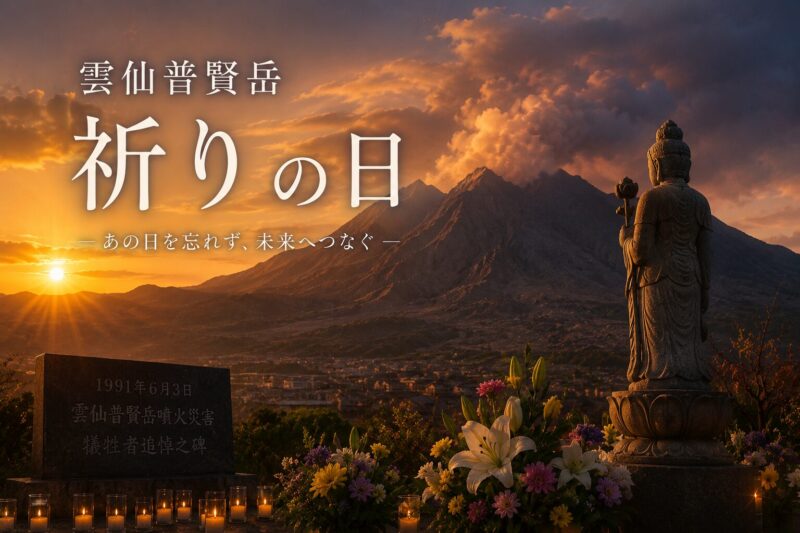
6月3日。今日は長崎県島原市が制定した「いのりの日(雲仙普賢岳祈りの日)」です。
1991年6月3日午後4時8分——雲仙普賢岳で史上最大規模の大火砕流が発生し、43人の命が失われました。
犠牲者の中には、消防団員・警察官・火山学者だけでなく、20人もの報道関係者が含まれていました。「定点」と呼ばれる撮影ポイントにいたカメラマンや記者たちが、炎と灰の中に消えていったのです。
今日はその35年前の記憶と、6月3日に重なる記念日をお届けします。
6月3日の記念日まとめ
6月3日の主な記念日・出来事
・いのりの日(雲仙普賢岳祈りの日)——1991年6月3日、雲仙普賢岳大火砕流で43人が犠牲に
・測量の日——1949年6月3日、測量法が公布された日
・ウェストン祭——長野・上高地で毎年6月第1日曜日頃に行われる日本近代登山の父を偲ぶ祭り
・世界自転車デー——国連が制定。自転車の普及と環境への貢献を讃える日
・ローソンの日——「ロー(6)ソン(3)」の語呂合わせ
・レンタルなんもしない人の日——2018年6月3日にサービス開始したことにちなむ
・世界自転車デー——環境にやさしい交通手段・自転車の普及を訴える国連制定の国際デー
「定点」——1991年6月3日、炎の中に消えた43人
1990年11月に始まった雲仙普賢岳の噴火活動は、1991年に入ってから激しさを増していきました。小規模な火砕流が何度も発生し、周辺地区への避難指示が出されていました。
しかし報道各社は取材を続け、火砕流がよく見える「定点」と呼ばれる撮影ポイントに多くのカメラマン・記者が陣取っていました。消防団員も警戒活動を続けていました。
1991年6月3日午後4時8分——それまでと規模の異なる、史上最大の大火砕流が発生します。
1991年6月3日の大火砕流
・時刻:午後4時8分
・流速:時速100km以上(逃げることはほぼ不可能)
・温度:数百度(接触した物はすべて焼き尽くされた)
・犠牲者43人の内訳:
消防団員12人 / 警察官2人 / 外国人火山学者3人
報道関係者(タクシー運転手含む)20人 / 地元住民6人
・地元住民3人の遺体は最後まで発見されなかった
犠牲者の約半数が報道関係者だったことは、のちに「加熱取材」への批判を巻き起こしました。立入禁止区域に入って取材を続けていた報道陣の存在が、消防団員が警戒活動を続けた一因だったとも言われています。
「誰が悪かったのか」という単純な問いで片付けられない、複雑な痛みが35年後の今も残っています。
「定点」に立った遺族の娘——父の記憶はない、でも
大火砕流から30年が経った2021年春。東京在住の矢内美春さん(当時31歳)が、はじめて「定点」の地に立ちました。
父・万喜男さんは当時31歳のテレビカメラマン。美春さんがまだ1歳のとき、定点で大火砕流に巻き込まれて亡くなりました。
矢内美春さんの言葉(2021年・朝日新聞の取材より)
「父の記憶はありません。でも、この場所に立って、手を合わせることができた。孤立感が和らいだ気がした」
埋もれていた取材車両のタクシーが30年後に掘り出され、追悼碑が建てられたことで、遺族たちが初めてその場所で手を合わせることができた——この報道を読んだとき、時間がかかっても「場所」「形」「人」が揃うことの大切さを感じました。
犠牲になった火山学者夫妻——「危険を伝えるために命をかけた」
43人の犠牲者の中に、フランス人火山学者夫妻・モーリス・クラフトとカティア・クラフトがいました。
クラフト夫妻は世界約180か所の火山を調査・撮影してきた伝説的な火山研究者です。その映像は、のちに「ピナトゥボ火山噴火(1991年)」の前に住民を避難させるための説得材料として使われ、数万人の命を救ったともいわれています。
クラフト夫妻のエピソード
・世界180か所以上の火山を調査・記録した火山研究のパイオニア
・生前の言葉:「私たちの映像が、いつか誰かの命を救うことができれば、それが私たちの仕事の価値だ」
・普賢岳の火砕流で命を落としたのは、最前線で記録を続けた結果だった
・彼らの映像は現在も世界の火山防災教育に使われている
・2022年、ドキュメンタリー映画「Fire of Love(火の恋人)」として映画化。世界的に注目を集めた
「危険だとわかっていても、その現場に立ち続けなければ伝えられないものがある」——クラフト夫妻の生き方は、今も多くの科学者・ジャーナリストに影響を与え続けています。
測量の日——日本地図のルーツは伊能忠敬にある
1949年6月3日、「測量法」が公布されました。これを記念して6月3日は「測量の日」とされています。
測量といえば、日本人なら誰もが思い出す偉人がいます。江戸時代に日本全国を歩いて測量し、初めて精密な日本地図を作り上げた伊能忠敬です。
伊能忠敬の偉業
・測量開始:1800年(51歳)——定年後の年齢から地図づくりを始めた
・総歩行距離:約4万km(地球一周に相当)
・測量期間:17年間(1800〜1816年)
・完成した「大日本沿海輿地全図」:当時の最高技術で描かれ、欧米の地理学者を驚嘆させた
・完成を見ずに死去(1818年)。地図は弟子たちが完成させた
・江戸時代の地図が現代の地図とほぼ一致するという精度の高さで知られる
51歳から地球一周分を歩き、完成を見ずに逝った伊能忠敬——「遅すぎる始まりなどない」という言葉の最高の体現者かもしれません。
ウェストン祭——イギリス人宣教師が「日本アルプス」を世界に伝えた
長野県上高地では毎年6月の第1日曜日頃、「ウェストン祭」が開催されます。梓川河畔のウェストン碑の前で献花・記念講演・合唱が行われる、日本近代登山の祖を偲ぶ祭りです。
ウォルター・ウェストン(1861〜1940年)はイギリス人宣教師として明治時代に来日し、槍ヶ岳・穂高岳など日本アルプスの山々を次々と登頂。著書「日本アルプスの登山と探検」(1896年)で日本の山岳の素晴らしさを英語で世界に紹介し、「日本アルプス」という呼び名を広めた人物です。
ウェストンの功績
・日本アルプス(北・中・南)の多くの山に初登頂または登頂記録を残した
・1902年に日本山岳会(現在も続く)の設立に尽力
・「日本アルプス」の呼び名を世界に広めた
・沖縄に縁あるウェストン:同時期、琉球にも滞在し宣教活動を行った記録が残る
まとめ——6月3日は「命と記憶を次世代に伝える日」
35年前の今日、43人の命が炎の中に消えました。その記憶を「いのりの日」として島原市は刻み続けています。伊能忠敬は17年間歩き続けた地図を、自分の死後も弟子たちが受け継いで完成させました。ウェストンは日本の山の美しさを世界の言葉で伝えました。
「伝える」ことと「受け継ぐ」こと——今日はそんなことを考えながら過ごしてみてください。
まとめ
- 6月3日はいのりの日(雲仙普賢岳祈りの日)——1991年6月3日午後4時8分、大火砕流で43人が犠牲に
- 犠牲者の約半数(20人)が報道関係者——「定点」からの撮影中に巻き込まれた
- 大火砕流から30年後、遺族の娘が初めて「定点」に立ち、「孤立感が和らいだ気がした」と語った
- 犠牲者の中のフランス人火山学者クラフト夫妻——「映像が命を救う」という信念で最前線に立ち続けた。2022年に映画化
- 測量の日——1949年6月3日の測量法公布を記念。伊能忠敬は51歳から地球一周分を歩き、日本地図を作った
- ウェストン祭——イギリス人宣教師ウェストンが「日本アルプス」を世界に紹介。上高地の梓川河畔で毎年開催
- 今日6月3日午後4時8分、島原市ではサイレンが鳴り、市民が黙祷を捧げます
最後まで読んでくださってありがとうございました😊
今日の午後4時8分、どこにいても1秒だけ、35年前の43人のことを思い出してみてください。
では、よい一日をお過ごしください。
see you soon.
What Day Is June 3rd? “The Fixed Point” — At 4:08 PM on June 3rd, 1991, a Pyroclastic Flow Took 43 Lives. Today, We Remember.
June 3rd. Today is Inori no Hi — “Day of Prayer” — designated by Shimabara City in Nagasaki Prefecture.
At 4:08 PM on June 3rd, 1991, the most catastrophic pyroclastic flow in the recorded history of Mount Unzen erupted down the slopes — and 43 people lost their lives.
Among the dead were not only firefighters, police officers, and volcanologists — but also 20 members of the press. Photographers and reporters stationed at a location known as the “Teiten” (“Fixed Point”) — a well-known shooting spot with a clear view of the volcano — were consumed by fire and ash.
Today, 35 years on, let’s sit with that memory — and with the other commemorations that fall on June 3rd.
June 3rd Commemorative Days at a Glance
Main Events & Commemorative Days on June 3rd
· Inori no Hi (Day of Prayer / Mt. Unzen Fugendake Memorial Day) — June 3rd, 1991: the Mt. Unzen pyroclastic flow kills 43 people
· Surveying Day (Sokuryo no Hi) — June 3rd, 1949: the Surveying Act was promulgated
· Weston Festival — Held around the first Sunday of June each year in Kamikōchi, Nagano; honors the father of modern Japanese mountaineering
· World Bicycle Day — UN-designated international day promoting cycling as sustainable transport
· Lawson Day — Wordplay on “Rō (6) son (3)”; established by the convenience store chain
· Rental Do-Nothing Person Day — Marks the June 3rd, 2018 launch of the “Rental Do-Nothing Person” service
“The Fixed Point” — June 3rd, 1991: Forty-Three People Consumed by Fire
The eruption of Mount Unzen Fugendake began in November 1990 and intensified throughout 1991. Small-scale pyroclastic flows had already occurred repeatedly, and evacuation orders had been issued for surrounding areas.
Despite this, news organizations continued their coverage. Many photographers and journalists had set up at a location they called the “Teiten” (“Fixed Point”) — a spot that offered a clear view of the volcano’s activity. Volunteer firefighters were also maintaining their watch in the area.
Then, at 4:08 PM on June 3rd, 1991, a pyroclastic flow of an entirely different scale — the largest ever recorded — surged down the mountainside.
🌋 The June 3rd, 1991 Pyroclastic Flow
· Time: 4:08 PM
· Speed: over 100 km/h (escape was virtually impossible)
· Temperature: several hundred degrees Celsius (everything in its path was incinerated)
· Breakdown of the 43 victims:
12 volunteer firefighters / 2 police officers / 3 foreign volcanologists
20 members of the press (including taxi drivers hired by media organizations) / 6 local residents
· The remains of 3 local residents were never found
The fact that nearly half the victims were members of the press later sparked intense criticism of what some called “overheated coverage.” The continued presence of journalists inside restricted zones was cited as one reason why firefighters and police maintained their position in the danger area.
This is not a story that can be resolved with the simple question of “who was to blame.” The complicated grief of that day still lives on, 35 years later.
A Daughter Stands at the Fixed Point — No Memory of Her Father, But Still
In the spring of 2021 — thirty years after the disaster — a woman named Miharu Yanai, then 31, stood at the Teiten for the first time.
Her father, Yukio Yanai, had been a 31-year-old television cameraman. He died at the Fixed Point when Miharu was just one year old.
💬 Miharu Yanai’s Words (Asahi Shimbun, 2021)
“I have no memory of my father. But I was able to come to this place, and to press my hands together in prayer. I felt the sense of isolation begin to lift.”
Thirty years after the disaster, buried press vehicles and taxis were excavated from the ash, and a memorial marker was erected — allowing bereaved families to come to the place where their loved ones died and offer their prayers for the first time. When I read that account, I was struck by how much it matters — even after so many years — for a place, a form, and the people to finally come together.
The Volcanologist Couple Who Died to Keep Others Safe
Among the 43 victims were two French volcanologists: Maurice Krafft and Katia Krafft — a married couple.
The Kraffts had spent their careers documenting volcanoes at roughly 180 locations around the world. Their footage was later used to persuade communities to evacuate before the eruption of Mount Pinatubo in the Philippines in 1991 — an effort credited with saving tens of thousands of lives.
The Kraffts’ Story
· Pioneers of volcanic research who documented more than 180 volcanoes worldwide
· Maurice Krafft’s own words: “If our images can someday save even one life, then our work has meaning.”
· They died at Unzen because they remained at the front line — recording until the end
· Their footage continues to be used in volcanic disaster preparedness education around the world
· In 2022, they were the subject of the documentary film Fire of Love, which drew worldwide attention
“There are things that can only be communicated by staying in the field, even when you know it’s dangerous.” The Kraffts’ way of life continues to inspire scientists and journalists around the world.
Surveying Day — Japan’s Maps Trace Back to Ino Tadataka
On June 3rd, 1949, Japan’s Surveying Act (Sokuryo-hō) was promulgated. This is the origin of Surveying Day.
For Japanese people, surveying almost inevitably brings to mind one towering figure: Inō Tadataka — the Edo-period surveyor who spent 17 years walking the length and breadth of Japan and produced the country’s first accurate map.
The Achievements of Inō Tadataka
· Started his survey work in 1800, at the age of 51 — beginning after the age most people consider “retirement”
· Total distance walked: approximately 40,000 km — equivalent to one full circumference of the earth
· Survey period: 17 years (1800–1816)
· His completed work, the “Dai Nihon Enkai Yochi Zenzu,” astonished Western geographers with its accuracy
· He died before seeing the map completed (1818); his disciples finished it in his name
· The maps he produced using Edo-period instruments are remarkably close to modern maps
A man who started walking the entire country at 51, and died before seeing his life’s work completed — Inō Tadataka may be the finest proof that there is no such thing as too late a start.
The Weston Festival — The British Missionary Who Gave Japan’s Alps Their Name
Each year, around the first Sunday of June, a ceremony called the Weston Festival is held in Kamikōchi, Nagano Prefecture — at a stone monument on the banks of the Azusa River, with flower offerings, commemorative lectures, and choral singing in honor of the father of modern Japanese mountaineering.
Walter Weston (1861–1940) was a British missionary who came to Japan during the Meiji era and went on to summit many peaks across the Japanese Alps — including Yari-ga-take and the Hodaka range. His 1896 book Mountaineering and Exploration in the Japanese Alps introduced the beauty of Japan’s mountains to the English-speaking world and established the name “Japanese Alps” in international use.
Weston’s Legacy
· Made first ascents or significant recorded climbs on many peaks across the Northern, Central, and Southern Alps of Japan
· Played a key role in founding the Japanese Alpine Club in 1902 (still active today)
· Brought the name “Japanese Alps” into worldwide use
· A connection to Okinawa: records show that Weston also stayed in the Ryukyu Islands during this period for missionary work
Closing Thoughts — June 3rd Is a Day to Pass Memory Forward
Thirty-five years ago today, 43 people disappeared into fire and ash. Shimabara City keeps that memory alive every year as “Inori no Hi.” Inō Tadataka walked the equivalent of the earth’s circumference, and the map he couldn’t finish was completed by the people he left behind. Walter Weston gave Japan’s mountains a name the world could speak.
Passing things forward. Receiving what others began. Today is a good day to think about both.
Summary
- June 3rd is Inori no Hi (Day of Prayer) — at 4:08 PM on June 3rd, 1991, the Mt. Unzen pyroclastic flow killed 43 people
- Nearly half the victims (20 people) were members of the press — caught at the “Fixed Point” while covering the disaster
- Thirty years later, a daughter stood at the Fixed Point for the first time and said: “I felt the sense of isolation begin to lift”
- French volcanologists Maurice and Katia Krafft were among the dead — they died because they stayed to record; their footage went on to save tens of thousands of lives. Their story was made into the documentary Fire of Love in 2022
- Surveying Day — marks the 1949 Surveying Act; Inō Tadataka walked the equivalent of one earth circumference starting at age 51 to create Japan’s first accurate map
- Weston Festival — British missionary Walter Weston introduced the “Japanese Alps” to the world; the annual ceremony in Kamikōchi honors his legacy
- Today at 4:08 PM, sirens sound in Shimabara City and residents observe a moment of silence
Thank you so much for reading all the way to the end 😊
Today, at 4:08 PM — wherever you are — take just one moment to think of the 43 people who were lost 35 years ago.
Have a wonderful day.
See you soon.

コメント