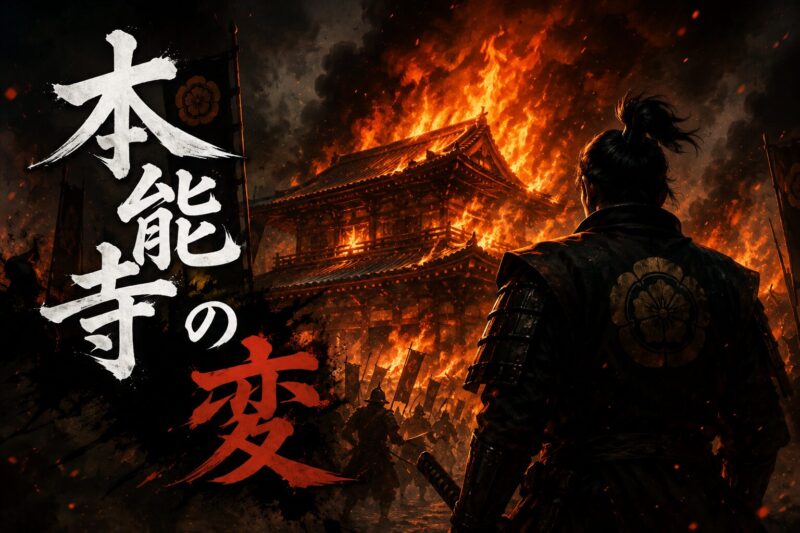
6月2日。今日は「裏切りの日」とも呼ばれる、日本史上最も劇的な朝の記念日です。
1582年6月2日(旧暦天正10年6月2日)午前4時頃——天下統一まで目前に迫っていた織田信長が、最も信頼していたはずの家臣・明智光秀に本能寺を急襲され、自害しました。
「敵は本能寺にあり」「是非に及ばず」「人間五十年、下天の内をくらぶれば」——この朝に生まれた言葉たちは、444年後の今も日本人の心に生き続けています。
そしてなぜ光秀は謀反を起こしたのか——その答えは、今日に至るまで「日本史最大のミステリー」として未解決のまま残っています。
6月2日の記念日まとめ
6月2日の主な記念日・出来事
・裏切りの日——1582年6月2日(旧暦)、本能寺の変で織田信長が明智光秀に討たれた日
・横浜港開港記念日・長崎港開港記念日——1859年6月2日、日米修好通商条約により両港が開港
・イタリア共和国記念日——1946年6月2日、国民投票でイタリアが共和国となった日
・ローズの日——「ロー(6)ズ(2)」の語呂合わせ
・オムレツの日——「オム(06)レツ(02)」の語呂合わせ
・甘露煮の日——「かんろ(6)に(2)」の語呂合わせ
・臨床工学技士の日——1987年6月2日、臨床工学技士が国家資格として公布
1582年6月2日午前4時——「敵は本能寺にあり」
天正10年(1582年)6月2日、未明。老ノ坂峠を越えた明智光秀率いる1万3千の兵が、京都市街へ静かに入っていきました。
行先を家臣たちに告げず、光秀はただ「本能寺へ向かえ」と命じます。多くの兵士は「徳川家康の討伐か」と思っていたといいます。
そして本能寺が見えたとき、光秀は言いました。
「敵は本能寺にあり」
※この言葉の史料的な根拠は弱く、後世の創作・誇張が含まれているとされますが、本能寺の変の象徴的な言葉として語り継がれています。
一方、本能寺で変を知った信長。わずか100人ほどの手勢しかいない中、弓矢で応戦し、弦が切れると太刀を振るって奮闘します。信長の奮戦ぶりに明智の兵もたじろいだといいます。
やがて炎が回ったとき、信長は有名な言葉を口にしながら舞い、そして自ら命を絶ちました。
信長の最後——「人間五十年、下天の内をくらぶれば夢幻の如くなり」
信長が生涯愛した幸若舞「敦盛」の一節。人間の一生50年も、天上の時間からすれば夢幻のようなものだ——その言葉とともに、信長は49歳で炎の中に消えました。
信長の遺体も、遺骨も、最後まで発見されませんでした。これもまた「本能寺の変」の謎のひとつです。
「是非に及ばず」——信長の最後の言葉が意味するもの
変の報を聞いた信長が発したとされる言葉「是非に及ばず」。
この言葉の意味について、さまざまな解釈がなされています。
「是非に及ばず」の解釈
・通説:「もはや是か非かを言う段階ではない。覚悟しろ」——戦いを促す言葉
・別の解釈:「光秀がやったなら仕方ない」——光秀の謀反を一瞬で受け入れた諦観
・深読み:天下人・信長でさえ、こんな死に方をするのが「人間五十年」——宿命を受け入れた言葉
たった5文字に、信長の49年間の生き様が凝縮されているようです。
ちなみに、変の直前まで信長は何をしていたのか——茶会の後、手勢わずかで本能寺に泊まっていたのは、完全に無防備な状態でした。天下を目前にした男の、あまりにも隙だらけな最期でした。
444年後の今も謎——「なぜ光秀は謀反を起こしたのか」
本能寺の変を語るうえで避けられないのが「光秀の動機」という大問題です。
444年が経過した今もなお、定説がなく「日本史最大のミステリー」とされています。
主な「謀反の動機」諸説
・怨恨説:信長に度重なる侮辱を受けた光秀の恨み(宴席での折檻、所領没収など)
・四国政策転換説:長宗我部元親との交渉役だった光秀が、信長の方針転換で立場を失ったため
・朝廷黒幕説:信長が朝廷を圧迫していたことへの対応として朝廷が光秀を動かした
・足利義昭黒幕説:信長に追放された元将軍・足利義昭が光秀を唆した
・秀吉黒幕説:変後に最も利益を得た秀吉が仕組んだ(「中国大返し」の速さが証拠とも)
・イエズス会黒幕説:信長のキリスト教政策の変化に対するイエズス会の陰謀
「光秀はなぜ謀反を起こしたのか」——この謎が解けない限り、本能寺の変は永遠に日本史最大のミステリーであり続けます。あなたはどの説が正しいと思いますか?
中国大返し——「本能寺の変」で最も得をしたのは誰か
本能寺の変の報を受けたとき、羽柴秀吉(後の豊臣秀吉)は備中高松城(岡山)を水攻めにしていました。
急報を受けた秀吉の行動の速さは、信じがたいものがありました。
中国大返し——秀吉の驚異的な行動力
・6月2日:本能寺の変(信長の死)
・6月4日:秀吉、毛利輝元と講和成立(わずか2日で!)
・6月6日:高松城から出発。約220kmの強行軍開始
・6月13日:山崎の合戦で明智光秀を撃破(変から11日後)
→ 「中国大返し」——220kmを8日間で走破した驚異のスピード
「本能寺の変で一番得をしたのは豊臣秀吉だ」——この中国大返しの速さが、秀吉黒幕説の根拠のひとつにもなっています。一方で「秀吉の天才的な判断力と行動力の証拠」とも解釈できます。
本能寺の変はその後、天下人・織田信長から天下人・豊臣秀吉へのバトンを渡す歴史の転換点となりました。
横浜港開港記念日——1859年6月2日、鎖国の終わりが始まった
1859年6月2日——日米修好通商条約に基づき、横浜港と長崎港が正式に開港しました。ペリーの黒船来航(1853年)から6年後のことです。
この開港が日本の近代化の出発点となりました。外国の商品・技術・文化が横浜から入り、日本人の生活が一変していきます。
横浜開港の豆知識
・開港当時の横浜の人口:わずか約100人の小さな漁村
・1年後:すでに外国人居留地が形成され、「西洋文化の玄関口」に
・横浜から日本に入ったもの:ガス灯・牛乳・新聞・バター・ビール・競馬など
・「ハマトラ」「横浜中華街」「山下公園」——今の横浜の文化的多様性は1859年に始まった
まとめ——6月2日は「歴史が動いた朝」を思い出す日
444年前の6月2日未明、天下人・信長が消え、歴史の歯車が大きく動きました。167年前の6月2日、横浜の小さな漁村が世界に開かれ、近代日本の扉が開きました。どちらも「ある朝」から始まった物語です。
まとめ
- 6月2日は「裏切りの日」——1582年6月2日(旧暦)、本能寺の変で織田信長が明智光秀に討たれた
- 「敵は本能寺にあり」「是非に及ばず」「人間五十年」——この朝に生まれた3つの言葉が歴史に残る
- 信長の遺体・遺骨は最後まで発見されなかった——これも本能寺の変の謎のひとつ
- 光秀の謀反の動機は「怨恨説」「四国政策説」「朝廷黒幕説」「秀吉黒幕説」など444年後の今も謎のまま
- 秀吉は変からわずか11日後に山崎の合戦で光秀を撃破。「中国大返し」220kmを8日で走破
- 1859年6月2日、横浜港・長崎港が開港。ペリー来航から6年、鎖国の時代が終わった
- 開港当時の横浜はわずか100人の漁村——そこから近代日本の文化の玄関口へ
最後まで読んでくださってありがとうございました😊
今日6月2日、444年前の未明に「敵は本能寺にあり」と言われた朝のことを、少しだけ想像してみてください。歴史は「ある朝の決断」から変わっていくのだと感じます。
では、よい一日をお過ごしください。
see you soon.
What Day Is June 2nd? “So Be It” — The Morning 444 Years Ago That Became Japan’s Greatest Unsolved Mystery
June 2nd. Today is known as “Betrayal Day” — the anniversary of one of the most dramatic mornings in all of Japanese history.
On June 2nd, 1582 (by the old lunar calendar, the 2nd day of the 6th month of Tenshō 10), in the early hours before dawn, Oda Nobunaga — the warlord who stood on the very edge of unifying Japan — was attacked at Honnō-ji Temple by his own trusted general, Akechi Mitsuhide, and took his own life.
“The enemy is at Honnō-ji.” “So be it.” “Fifty years of human life — compared to the age of heaven, it is but a dream and a phantom.” The words born on that morning 444 years ago still live in the hearts of the Japanese people today.
And why Mitsuhide did it — that question remains, to this day, Japan’s greatest historical mystery.
June 2nd Commemorative Days at a Glance
Main Events & Commemorative Days on June 2nd
· Betrayal Day (Uragiri no Hi) — June 2nd, 1582 (lunar calendar): the Honnō-ji Incident; Oda Nobunaga is killed by Akechi Mitsuhide
· Yokohama Port Opening Anniversary / Nagasaki Port Opening Anniversary — June 2nd, 1859: both ports officially opened under the Japan-US Treaty of Amity and Commerce
· Italian Republic Day — June 2nd, 1946: a national referendum made Italy a republic
· Rose Day — Wordplay on “Rō (6) zu (2)” (ローズ = rose)
· Omelette Day — Wordplay on “Omu (06) retsu (02)” (オムレツ = omelette)
· Amaro-ni Day — Wordplay on “Kanro (6) ni (2)” (甘露煮 = simmered in sweet syrup)
· Clinical Engineer Day — June 2nd, 1987: the clinical engineer qualification was established by law
June 2nd, 1582, 4:00 AM — “The Enemy Is at Honnō-ji”
In the predawn darkness of June 2nd, 1582, Akechi Mitsuhide led a force of 13,000 soldiers silently through the Ōnosaka Pass and into the streets of Kyoto.
He did not tell his men where they were going. He simply gave the order: advance toward Honnō-ji. Many of the soldiers assumed they were being sent to deal with the visiting warlord Tokugawa Ieyasu.
And then, as Honnō-ji Temple came into view, Mitsuhide reportedly spoke:
“The enemy is at Honnō-ji.” (Teki wa Honnō-ji ni ari)
※ Note: The historical documentation for this exact phrase is weak, and scholars believe it may be a later embellishment. But it has lived on as the defining line of the Honnō-ji Incident.
Inside Honnō-ji, Nobunaga — with only around a hundred attendants — learned what was happening. He took up his bow and fought back. When the bowstring snapped, he drew his sword and kept fighting. By all accounts, the ferocity of his resistance caused Mitsuhide’s troops to hesitate and pull back.
As the flames spread through the temple, Nobunaga spoke one last time — reciting a verse he had loved all his life — and then ended his own life.
Nobunaga’s Final Words — from the Kōwaka dance “Atsumori”
“Jinsei gojūnen, geten no uchi wo kurabure ba, yume maboroshi no gotoku nari.”
(“Fifty years of human life — compared to the age of heaven, it is but a dream and a phantom.”)
With these words, Nobunaga — who had brought Japan closer to unification than anyone before him — died at the age of 49, consumed by fire.
Neither Nobunaga’s body nor his remains were ever found. This too is one of the enduring mysteries of the Honnō-ji Incident.
“So Be It” — What Nobunaga’s Last Words Really Mean
When Nobunaga heard who was attacking him, his reported response was just five characters in Japanese: “Zehi ni oyobazu” — “So be it.”
Those words have been interpreted in very different ways:
Interpretations of “So Be It” (Zehi ni oyobazu)
· Traditional reading: “There is no longer any question of right or wrong — prepare to fight” — a command to his attendants to resist
· Alternative reading: “If it is Mitsuhide, then there is nothing to be done” — an instant, calm acceptance of the betrayal
· Deeper reading: Even the man who nearly unified Japan meets this kind of end — an embrace of fate, echoing the “fifty years of human life” he was about to recite
Five characters. Forty-nine years of a life lived at full force, compressed into a breath.
And what had Nobunaga been doing the night before? After a tea gathering, he was sleeping at Honnō-ji with almost no guard — completely exposed, at the very moment of his greatest triumph. The man who had outmaneuvered everyone met his end with his defenses entirely down.
444 Years Later, Still Unsolved — “Why Did Mitsuhide Do It?”
The question that has haunted historians for nearly four and a half centuries: what drove Akechi Mitsuhide to turn against his master?
There is still no settled answer. The Honnō-ji Incident remains, definitively, the greatest unsolved mystery in Japanese history.
The Major Theories Behind Mitsuhide’s Motive
· Grudge theory: Repeated humiliations by Nobunaga — public beatings at banquets, forced forfeiture of territory — drove Mitsuhide to the breaking point
· Shikoku policy theory: Mitsuhide had been Nobunaga’s key intermediary with the Chōsokabe clan; when Nobunaga suddenly reversed his Shikoku policy, Mitsuhide lost his position and purpose
· Imperial Court conspiracy theory: The court, threatened by Nobunaga’s increasingly aggressive stance, used Mitsuhide as an instrument to remove him
· Ashikaga Yoshiaki theory: The deposed shogun, exiled by Nobunaga, manipulated Mitsuhide from the shadows
· Toyotomi Hideyoshi conspiracy theory: The man who benefited most from Nobunaga’s death orchestrated the whole affair — the astonishing speed of the “Great Retreat” being the key evidence
· Jesuit conspiracy theory: The Society of Jesus, alarmed by shifts in Nobunaga’s religious policy, engineered the coup
Until the question of why Mitsuhide acted is answered, the Honnō-ji Incident will remain Japan’s greatest mystery. Which theory do you find most convincing?
The “Great Retreat” — Who Benefited Most from the Honnō-ji Incident?
When news of Nobunaga’s death reached Hashiba Hideyoshi (later Toyotomi Hideyoshi), he was in the middle of besieging Takamatsu Castle in Bitchū Province (present-day Okayama) using a flooding strategy.
What followed was one of the most extraordinary displays of strategic speed in Japanese history.
The “Great Retreat” — Hideyoshi’s Incredible Response
· June 2nd: The Honnō-ji Incident — Nobunaga dies
· June 4th: Hideyoshi concludes a peace agreement with Mōri Terumoto — in just two days
· June 6th: Departs Takamatsu Castle; begins a forced march of approximately 220 km
· June 13th: Defeats Akechi Mitsuhide at the Battle of Yamazaki — just 11 days after Nobunaga’s death
→ The “Chūgoku Ōgaeshi” (“Great Central Retreat”) — 220 km in 8 days
“The person who gained the most from the Honnō-ji Incident was Toyotomi Hideyoshi” — the sheer speed of the Great Retreat is one of the key pieces of evidence cited by those who believe Hideyoshi had prior knowledge. Others see it as simply the most spectacular demonstration of Hideyoshi’s genius for rapid decision-making. The Honnō-ji Incident marked the pivot of Japanese history — from the age of Oda Nobunaga to the age of Toyotomi Hideyoshi.
Yokohama Port Opening Day — June 2nd, 1859: The End of Sakoku Begins
On June 2nd, 1859, in accordance with the Japan-US Treaty of Amity and Commerce, Yokohama Port and Nagasaki Port officially opened to foreign trade — six years after Commodore Perry’s Black Ships first arrived in Japan.
This opening became the starting point for Japan’s modernization. Foreign goods, technology, and culture poured in through Yokohama, and Japanese daily life began to transform at remarkable speed.
Yokohama’s Opening — Fun Facts
· Population of Yokohama at the time of opening: approximately 100 people — a small fishing village
· One year later: a foreign settlement had already formed, and Yokohama was becoming the “gateway to Western culture”
· Things that entered Japan through Yokohama: gas lamps, milk, newspapers, butter, beer, horse racing, and more
· “Hamatora” fashion, Chinatown, Yamashita Park — the cultural diversity that defines Yokohama today all traces back to June 2nd, 1859
Closing Thoughts — June 2nd Is a Day to Remember That History Turns on a Single Morning
444 years ago, in the predawn hours of June 2nd, the man who almost unified Japan was gone — and the wheels of history lurched in an entirely new direction. 167 years ago, a tiny fishing village of a hundred people opened its gates to the world, and modern Japan began. Both stories started with a single morning.
Summary
- June 2nd is “Betrayal Day” — on June 2nd, 1582 (lunar calendar), the Honnō-ji Incident ended Oda Nobunaga’s life at the hand of Akechi Mitsuhide
- “The enemy is at Honnō-ji,” “So be it,” and “Fifty years of human life” — three phrases born that morning that have never left Japanese memory
- Nobunaga’s body and remains were never found — one of the enduring mysteries of the incident
- Mitsuhide’s motive — grudge, political conspiracy, court intrigue, or Hideyoshi’s shadow — remains unresolved 444 years later
- Hideyoshi defeated Mitsuhide at the Battle of Yamazaki just 11 days after Nobunaga’s death, after covering 220 km in 8 days in the “Great Retreat”
- On June 2nd, 1859, Yokohama and Nagasaki ports opened — six years after Perry’s arrival, the era of sakoku (isolation) was over
- Yokohama at the time of opening was a village of about 100 people — it would become the cultural gateway to modern Japan
Thank you so much for reading all the way to the end 😊
Today, June 2nd, take a moment to imagine that predawn morning 444 years ago — when a single decision, made in the dark, turned the course of Japanese history forever.
Have a wonderful day.
See you soon.
コメント