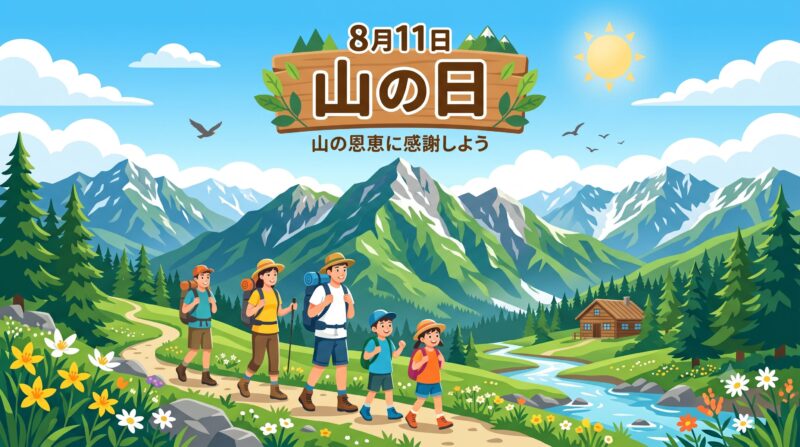
今日8月11日は、国民の祝日「山の日」。海の日(7月)に続いて、自然の恵みに感謝する祝日です。
山の日とは——「山に親しみ、感謝する」ために生まれた祝日
「山の日」は2014年(平成26年)に法律で制定され、2016年(平成28年)から施行された、日本の国民の祝日の中で最も新しい祝日です。趣旨は「山に親しむ機会を得て、山の恩恵に感謝する」こと。
日本の国土のおよそ75%は山地。山々は大気や水を生み出し、動植物を育み、木材や食料といった恵みをもたらしながら、長い歴史の中で日本人の暮らしを支え続けてきました。私たちが普段の生活で山の存在を意識することは少ないかもしれませんが、実は蛇口から出る水も、呼吸する空気も、山とは切っても切れない関係にあるんですね。
なぜ8月11日になったの?
日付の由来には諸説ありますが、代表的なのは「八」という漢字の形が山(の稜線)に見えること、そして「11」が木が並んで立っている様子に見えることから、というユニークな説です。
また、お盆前後の8月であれば夏休みとも重なりやすく、山に親しむ機会を作りやすいという実用的な理由もあったようです。ちなみに山の日は他の祝日と違い、ハッピーマンデー制度の対象外で、毎年8月11日に固定されています。そのため曜日によっては、必ずしも3連休になるとは限らないんですね。
全国各地で開催される「山の日」記念全国大会
2016年の制定以降、毎年8月10日・11日に「山の日」記念全国大会が全国各地で開催されています。第1回の長野県上高地を皮切りに、栃木・鳥取・山梨・大分・山形など、様々な地域を巡りながら開催地を変え、山の恵みと文化を伝えるシンポジウムやイベントが行われています。
実は国民の祝日になる以前から、全国12府県で条例による独自の「山の日」が制定されていたのだとか。国民の祝日制定は、こうした各地の思いが積み重なって実現したものなんですね。
✍️ 今日のまとめ
75%が山地という日本ならではの自然環境、そして「八」と「木」に見立てたユニークな日付の由来——今日は、当たり前のように受け取っている山の恵みに、あらためて感謝したくなる一日ですね。
本格的な登山でなくても、近くの山を散策したり、山の景色が見える場所に出かけてみたり。今日は少しだけ、山との距離を縮めてみるのはいかがでしょう。
本日も良い一日をお過ごしください。
See you soon.
Today, August 11th, is “Mountain Day,” a national holiday in Japan. Following Marine Day in July, this is another holiday dedicated to giving thanks for the blessings of nature.
What Is Mountain Day? — A Holiday Born to “Cherish and Appreciate the Mountains”
“Mountain Day” was established by law in 2014 (Heisei 26) and took effect in 2016 (Heisei 28), making it the newest of Japan’s national holidays. Its purpose is stated simply: “to gain opportunities to grow familiar with mountains, and to appreciate the blessings they provide.”
Roughly 75% of Japan’s land area is mountainous. Mountains generate the air and water we depend on, nurture countless plants and animals, and provide resources like timber and food — sustaining Japanese life throughout its long history. We rarely think about mountains in the course of daily life, but the water flowing from your tap and the very air you breathe are, in truth, inseparably connected to them.
Why August 11th?
There are several theories behind the choice of date, but one of the most popular and charming is this: the kanji character “八” (eight) resembles the shape of a mountain ridge, while the number “11” resembles trees standing side by side.
There was also a practical consideration — falling in August, around the Obon holiday period, made it easy to align with summer vacation and create real opportunities for people to spend time in the mountains. Incidentally, unlike other holidays, Mountain Day is not subject to the “Happy Monday” system, and remains fixed on August 11th every year. This means it doesn’t always turn into a three-day weekend, depending on which day of the week it falls on.
The National “Mountain Day” Commemorative Convention, Held Across the Country
Since its establishment in 2016, the National “Mountain Day” Commemorative Convention has been held every year on August 10th and 11th in a different location around Japan. Starting with the first convention in Kamikochi, Nagano Prefecture, the event has since traveled to Tochigi, Tottori, Yamanashi, Oita, Yamagata, and other regions, hosting symposiums and events that share the blessings and culture of the mountains.
Interestingly, even before it became a national holiday, twelve prefectures across Japan already had their own locally established “Mountain Day” through municipal ordinances. The national holiday, in a sense, came into being as a culmination of these accumulated regional efforts.
Today’s Takeaway ✍️
Japan’s distinctive natural landscape, where 75% of the land is mountains, and the charmingly unique story behind the date, built from “eight” and “trees” — today feels like a day for renewing our gratitude for the mountain blessings we so often take for granted.
You don’t need a full-scale hike — a stroll through a nearby mountain trail, or simply visiting somewhere with a mountain view, would do just fine. Maybe today’s a good day to close the distance between yourself and the mountains, even just a little.
Have a wonderful day today.
See you soon.


コメント