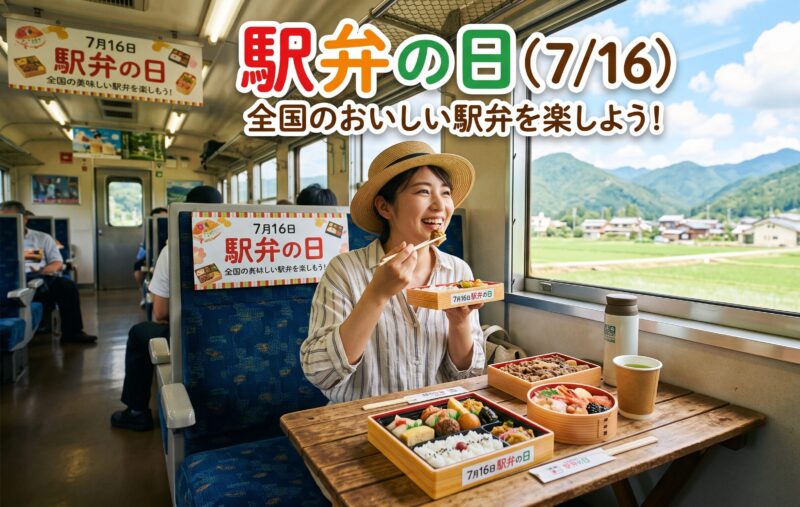
今日7月16日は、日本の鉄道文化を象徴する「駅弁記念日」と、人類が初めて月を目指した「アポロ11号打ち上げの日」が重なる一日です。
地上を走る旅と、宇宙への旅——スケールは全然違いますが、どちらも「人が新しい場所を目指す」というワクワク感が詰まっています。
駅弁記念日——日本初の駅弁は「おにぎり」だった!
1885年7月16日、栃木県の宇都宮駅で日本初の駅弁が販売されました。
その中身は意外にもシンプル。梅干し入りのおにぎり2個を竹の皮で包んだだけのもので、値段は5銭でした。今では地域の名産品を詰め込んだ豪華な駅弁が全国に数百種類以上ありますが、そのルーツはこんなにも素朴なものだったんですね。
ちなみに「弁」という漢字を分解すると、数字の「4」と漢数字の「十」に見えることから、4月10日も「駅弁の日」として制定されています。7月16日は「発祥」を、4月10日は「文字」を記念した、ダブルの駅弁記念日というわけです。
旅の楽しみのひとつである駅弁。次に電車に乗る機会があれば、その土地ならではの一品を探してみるのも良いですね。
アポロ11号打ち上げの日——「一歩」が人類の歴史を変えた
1969年7月16日、アメリカのケネディ宇宙センターからアポロ11号が打ち上げられました。乗組員はニール・アームストロング、バズ・オルドリン、マイケル・コリンズの3人。
ケネディ大統領が1961年に掲げた「1960年代のうちに人類を月に送る」という壮大な公約。その期限ぎりぎりとなる1969年、打ち上げから4日後の7月20日、アームストロング船長が人類史上初めて月面に降り立ちました。
「これは一人の人間にとっては小さな一歩だが、人類にとっては偉大な飛躍である」——この言葉は今も語り継がれる歴史的名言ですね。
打ち上げからわずか8年半で「絶対不可能」と言われた月面着陸を成し遂げたアメリカ。国家の威信をかけた壮大な挑戦は、今も人類最大の偉業のひとつとして語り継がれています。
「虹の日」——「7」と「16」が生む七色の語呂合わせ
「7(な)1(い)6(ろ)」の語呂合わせから、7月16日は「虹の日」にもなっています。梅雨明けが近づくこの時期、空に虹がかかることも増えてきますね。
ちなみに虹は日本では「七色」とされていますが、国や文化によって見える色の数は異なるとされ、アメリカでは6色、ドイツでは5色とする説もあります。同じ自然現象でも、文化によって捉え方が違うのは興味深いですね。
外国人力士の日——高見山、悲願の幕内優勝
1972年7月16日、大相撲名古屋場所でハワイ出身の高見山大五郎関が、外国人力士として史上初めて幕内優勝を果たしました。
この快挙は、後の曙・武蔵丸・小錦といったハワイ勢や、さらには外国出身力士全体の相撲界進出への大きな道を切り拓いたと言われています。異国の地で、異文化の伝統競技の頂点に立った高見山の功績は計り知れません。
✍️ 今日のまとめ
梅干しおにぎりから始まった駅弁文化、月を目指した人類の挑戦、異国の地での挑戦——今日は「新しい場所を目指す勇気」を感じる一日ですね。
おじーのオカンも駅のない石垣島に住んでいるせいか、駅弁がとても好きで、そういう機会があると目を輝かせてどれを食べようか選びます。まるで無邪気な子供のようにかわいいです。
東京駅構内に駅弁を売っているお店があるのですが、色んなご当地の駅弁も取り扱っていて、オカンでなくても心躍るはずです。
機会があれば行ってみて下さい。
今日はどこか新しい場所へ、小さな一歩を踏み出してみるのも良いかもしれませんね。
本日も良い一日をお過ごしください。
See you soon.
Today, July 16th, brings together “Ekiben Memorial Day” — celebrating a symbol of Japanese railway culture — and “Apollo 11 Launch Day,” marking humanity’s first journey toward the moon.
A journey across the land, and a journey into space — completely different in scale, yet both carry that same thrill of people setting out for somewhere new.
Ekiben Memorial Day — Japan’s First Train Station Bento Was Just Rice Balls!
On July 16, 1885, Japan’s very first “ekiben” (train station bento) went on sale at Utsunomiya Station in Tochigi Prefecture.
Its contents were surprisingly simple: just two rice balls with pickled plum, wrapped in bamboo sheath, priced at 5 sen. Today there are hundreds of elaborate ekiben varieties across the country, each stuffed with regional specialties — but to think it all began with something this humble is rather charming.
As a bit of trivia: the character “弁” (ben, as in “eki-ben”), when broken apart, resembles the numeral “4” combined with the kanji for “10” — which is why April 10th is also designated “Ekiben Day.” So July 16th commemorates the “origin,” while April 10th commemorates the “character” — giving ekiben a double celebration each year.
Ekiben is one of the true joys of train travel. Next time you find yourself on a train, it might be worth seeking out a bento unique to that particular region.
Apollo 11 Launch Day — When “One Step” Changed the Course of Human History
On July 16, 1969, Apollo 11 launched from the Kennedy Space Center in the United States, carrying three astronauts: Neil Armstrong, Buzz Aldrin, and Michael Collins.
It was the culmination of President Kennedy’s ambitious 1961 pledge to land a man on the moon before the decade was out. Cutting it close to that deadline, in 1969 — just four days after launch, on July 20th — Commander Armstrong became the first human being in history to set foot on the lunar surface.
“That’s one small step for man, one giant leap for mankind.” Those words remain one of history’s most enduring quotes.
Just eight and a half years after the goal was set — something once dismissed as utterly impossible — America pulled off the moon landing. This extraordinary national undertaking, staking its prestige on the mission, is still remembered as one of humanity’s greatest achievements.
“Rainbow Day” — A Wordplay Born from “7” and “16”
Based on the wordplay “7 (na) – 1 (i) – 6 (ro)” — echoing “niji,” the Japanese word for rainbow — July 16th is also “Rainbow Day.” As the rainy season nears its end, rainbows tend to appear in the sky more often around this time.
Interestingly, while rainbows are described as having “seven colors” in Japan, the number perceived varies by country and culture — some say six colors in America, others describe five in Germany. It’s fascinating how the same natural phenomenon can be understood so differently depending on where you’re from.
Foreign-Born Sumo Wrestler Day — Takamiyama’s Long-Awaited Championship
On July 16, 1972, at the Nagoya sumo tournament, Takamiyama Daigorō, a wrestler from Hawaii, became the first foreign-born rikishi in history to win a top-division championship.
This landmark achievement is said to have paved the way for later Hawaiian-born champions such as Akebono, Musashimaru, and Konishiki, and more broadly opened doors for wrestlers from overseas to enter the world of sumo. Takamiyama’s accomplishment — reaching the pinnacle of a deeply traditional sport in a foreign land and culture — is immeasurable.
Today’s Takeaway ✍️
A food culture that began with a simple pickled-plum rice ball, humanity’s reach toward the moon, one man’s triumph in a foreign land — today feels like a day that carries the courage to head toward somewhere new.
My own mother lives on Ishigaki Island, which doesn’t even have a train station, and maybe that’s exactly why she loves ekiben so much. Whenever the chance comes up, her eyes light up as she picks out which one to try — honestly, it’s adorable, like watching an innocent kid.
There’s a shop inside Tokyo Station that sells ekiben from all over the country — it’s the kind of place that would make anyone’s heart race with excitement, not just my mother. If you ever get the chance, it’s well worth a visit.
Maybe today is a good day to take a small step toward somewhere new.
Have a wonderful day today.
See you soon.
コメント