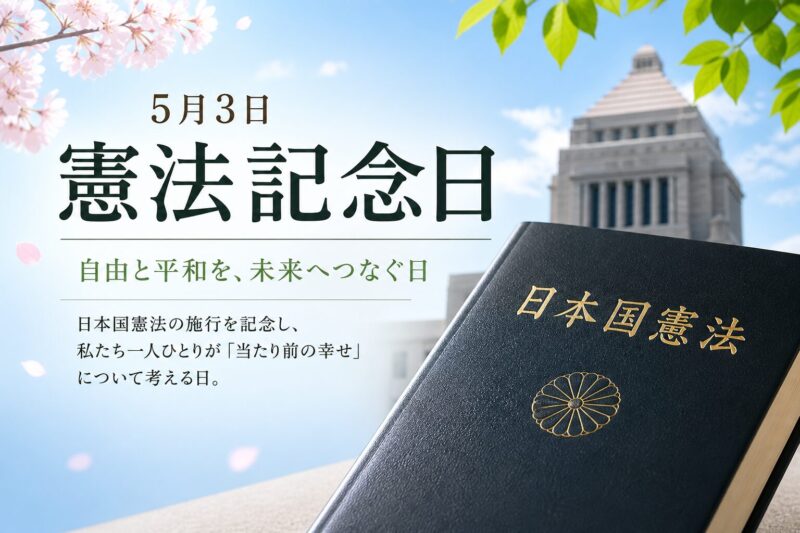
毎年5月3日、ゴールデンウィークのど真ん中にある「憲法記念日」。
「あ、休みだ!どこ行こう?」
……で終わっていませんか?(笑)
実はこの憲法記念日、知れば知るほど驚きのエピソードが満載なんです。たった9日間で草案が書かれたこと、22歳の外国人女性が女性の権利を草案に盛り込んだこと……。今日はそんな「憲法誕生の舞台裏」をお届けします。
憲法記念日とは?基本からおさらい
憲法記念日は毎年5月3日で、「日本国憲法の施行を記念し、国の成長を期する」ことを趣旨とした国民の祝日です。
日本国憲法は1946年(昭和21年)11月3日に公布され、その半年後の1947年(昭和22年)5月3日に施行されました。この施行日を記念して、1948年(昭和23年)に公布・施行された祝日法によって制定されました。
📖 ポイント整理
・公布日:1946年11月3日(文化の日)
・施行日:1947年5月3日(憲法記念日)
・祝日制定:1948年
ちなみに、祝日の日付を5月3日ではなく、新しい憲法が批准された11月3日にしようとする動きもありましたが、この日は帝政メンバーの戦争中に犯した罪に対する裁判が始まったのと同じ日であったため、代わりに施行の日が選ばれました。こんな裏話があったんですね。
日本国憲法の3大原則——これだけは知っておきたい
日本国憲法は3つの大きな柱で成り立っています。
| 原則 | 意味 |
|---|---|
| 国民主権 | 国の政治のあり方は国民が決める |
| 平和主義 | 戦争を永久に放棄する(第9条) |
| 基本的人権の尊重 | すべての人が生まれながらに持つ権利を保障する |
この3原則は、戦前の大日本帝国憲法とは正反対の考え方です。大日本帝国憲法(明治憲法)が君権主義の原理にもとづき天皇を統治権の総攬者と定めていたのに対して、日本国憲法では国民主権の原則が明記されました。これがいかに大きな転換だったか、伝わりますか?
【驚きのエピソード①】草案はたった9日間で書かれた!
ここからが本番です。
戦後、日本を占領したGHQ(連合国軍最高司令部)は、日本政府に新しい憲法の草案を求めました。しかし当時の日本政府が提出した案は、明治憲法をほとんど変えない保守的なものでした。
それを知ったマッカーサーは、GHQの民政局のメンバーに指示して1946年2月初旬に憲法草案を起草させました。
そして——なんとわずか9日間で草案を完成させたのです。
しかし、なぜそんな短期間で書けたのか?実はそこにも秘密がありました。GHQの民政局が草案起草にあたり参照した国内外の憲法案のなかに、「憲法研究会案」がありました。これは日本の自由民権思想の研究者・鈴木安蔵らが提出した草案で、国民主権や男女平等などが謳われていました。この草案が民政局の起草チームに強い影響を与えたことは、そのメンバーのひとりであるマイロ・ラウエルのノートに記載されています。
「押しつけ憲法」と言われることもある日本国憲法ですが、その背後には日本人自身の民主主義への願いも込められていたわけです。
【驚きのエピソード②】22歳の外国人女性が「女性の権利」を守った
この9日間の草案作業に参加していた人物の中に、ベアテ・シロタ・ゴードンという22歳の若い女性がいました。
彼女はオーストリア生まれのユダヤ系アメリカ人で、子ども時代を日本で過ごした日本語堪能な女性。GHQスタッフとして草案作りに加わり、世界中の憲法を図書館から集めて分析し、女性や家族に関する権利条項を草案に盛り込もうと奮闘しました。
「ある国の憲法にだけ存在する条文や、似ているけど違うニュアンスのもの。それらを全部私たちは集めたんです。いろんな国から一番良い権利を」と彼女は後に語っています。
彼女が心血を注いで書いた条文の多くは、男性スタッフに「民法に入れるべきだ」と削られてしまいました。「一つの条項が削除されるごとに、不幸な日本女性が増えていく気持ちで、気づいたら大佐の胸で泣いていました」と彼女は語っています。
それでも彼女が守り抜いた「男女平等」の理念は憲法第24条として残り、日本では今でも「憲法24条の母」と呼ばれています。
そして——彼女がこの事実を公に話したのは、草案作成から約50年後の1993年のこと。「22歳の若い女性が書いたということを口実に憲法が価値を失うことを心配して、ずっと口を閉ざしていた」というのが理由でした。
💡 知ってた?
日本国憲法は世界に先駆けて「男女平等」「社会権」「平和的生存権」を明文化した憲法。アメリカの憲法にも書かれていない権利が含まれています。
【驚きのエピソード③】公布日は明治天皇の誕生日だった
日本国憲法が公布された11月3日——これは偶然ではなく、明治天皇の誕生日(明治節)でした。
戦前の旧体制を象徴する日に、新しい民主主義の憲法を公布する。なんとも複雑な歴史の皮肉を感じますね。現在この日は「文化の日」として祝日になっています。
憲法記念日に何をする?——おすすめの過ごし方
毎年5月1日から7日まで「憲法週間」が設けられており、憲法の意義を広めるため、各地で憲法をテーマにした講演会や展示、討論会が行われます。
また、憲法記念日になると、改憲派・護憲派がそれぞれ憲法改正に関する世論調査や講演会、集会を開きます。毎年この時期に憲法について考えるきっかけが生まれるのは、とても大切なことだと思います。
せっかくのGWの休日、こんな過ごし方もいかがでしょうか?
- 憲法や戦後史に関するドキュメンタリーを見る
- 家族で「憲法って何?」を話し合ってみる
- 近くで開催されている憲法週間イベントに参加する
- 日本国憲法の前文を声に出して読んでみる(短くて読みやすいです!)
憲法記念日は「考える日」
憲法記念日は、ただの「GWの休日」ではありません。
焦土と化した戦後の日本で、わずか9日間で草案が書かれ、22歳の女性が涙しながら女性の権利を守り、そして78年以上にわたって一度も改正されずに生き続けてきた憲法——。
改憲すべきか、護憲すべきかという議論は今も続いています。でもまずは「日本国憲法がどうやって生まれたか」を知ることが、考えるための第一歩ではないでしょうか。
📝 まとめ
- 憲法記念日は毎年5月3日、日本国憲法の施行(1947年)を記念する祝日
- 3大原則は国民主権・平和主義・基本的人権の尊重
- GHQがたった9日間で草案を作成。日本の民間草案も参考にされた
- 22歳のベアテさんが女性の権利を守るために奮闘した(憲法24条の母)
- 公布日の11月3日は明治天皇の誕生日。現在は「文化の日」
- 日本国憲法は制定以来一度も改正されていない
GWどこに行っても人が沢山いて幸せが溢れているので、プラスのパワーをもらえるので良いのですが、渋滞や行列で待たされることもありますよね。
そんな時に、さらっとこの知識を周りの人に教えてあげればあなたの株は上がること間違いなしです。
では、よい一日をお過ごしください。
see you soon.
What Is Constitution Memorial Day? The Untold Story of Japan’s Constitution — Written in Just 9 Days
Every year on May 3rd, right in the middle of Golden Week, we have “Constitution Memorial Day.”
“Oh, a day off! Where should we go?”
…And that’s usually where it ends, right? (laughs)
But here’s the thing — the story behind Constitution Memorial Day is packed with surprises. The draft was written in just 9 days. A 22-year-old foreign woman fought to include women’s rights in the constitution. Today, let’s take a peek behind the curtain at how Japan’s constitution was born.
What Is Constitution Memorial Day? A Quick Overview
Constitution Memorial Day falls on May 3rd every year. It is a national holiday established to “commemorate the enforcement of the Constitution of Japan and to hope for the country’s growth.”
The Constitution of Japan was promulgated on November 3, 1946 (Showa 21), and came into effect six months later on May 3, 1947 (Showa 22). The holiday was established in 1948 under the Act on National Holidays to mark this date of enforcement.
📖 Key Dates
· Promulgation: November 3, 1946 (now “Culture Day”)
· Enforcement: May 3, 1947 (Constitution Memorial Day)
· Holiday established: 1948
Fun fact: there was actually a movement to set the holiday on November 3rd — the date the constitution was ratified — rather than May 3rd. However, November 3rd happened to be the same day that war crimes trials began for former members of the imperial government, so the enforcement date was chosen instead. Quite a behind-the-scenes detail, isn’t it?
The 3 Core Principles of Japan’s Constitution — What You Need to Know
Japan’s constitution rests on three major pillars.
| Principle | Meaning |
|---|---|
| 🗳️ Popular Sovereignty | The people decide how the country is governed |
| ☮️ Pacifism | Japan permanently renounces war (Article 9) |
| 🙌 Respect for Fundamental Human Rights | Rights held by all people from birth are guaranteed |
These three principles stand in direct contrast to the prewar Constitution of the Empire of Japan (the Meiji Constitution), which was based on imperial sovereignty and designated the Emperor as the supreme ruler. The shift to popular sovereignty in the new constitution was a monumental transformation — one that’s hard to overstate.
【Surprising Episode ①】The Draft Was Written in Just 9 Days!
Here’s where it gets really interesting.
After the war, GHQ (General Headquarters of the Allied Occupation Forces) asked the Japanese government to draft a new constitution. But the draft that the Japanese government submitted was a conservative one — barely different from the old Meiji Constitution.
Upon seeing this, General MacArthur directed members of GHQ’s Government Section to draft their own version in early February 1946.
And they did — in just 9 days.
But how was that even possible? There was a secret. Among the documents that GHQ’s Government Section referenced was the “Constitution Research Association Draft” — a proposal put forward by Japanese scholars including Yasuzō Suzuki, who studied Japan’s liberal civil rights movement. This draft called for popular sovereignty and gender equality, and it had a significant influence on the GHQ drafting team, as recorded in the notes of team member Milo Rowell.
Often called a “imposed constitution,” Japan’s postwar constitution actually carries within it the democratic aspirations of the Japanese people themselves.
【Surprising Episode ②】A 22-Year-Old Foreign Woman Fought to Protect Women’s Rights
Among those who participated in those 9 days of drafting was a young woman named Beate Sirota Gordon — just 22 years old.
Born in Austria to a Jewish family, she had grown up in Japan and was fluent in Japanese. As a GHQ staff member, she joined the drafting team, gathered constitutions from around the world at the library, analyzed them, and fought hard to include clauses protecting the rights of women and families.
“We collected them all — articles found only in one country’s constitution, or ones with similar but slightly different nuances. We gathered the best rights from every country,” she later recalled.
Many of the clauses she poured her heart into writing were cut by male staff members who said they “belonged in the Civil Code.” She described the experience: “Each time a clause was deleted, I felt as if more Japanese women were becoming unhappy — and before I knew it, I was crying on the colonel’s chest.”
Yet the principle of gender equality she fought to preserve survived as Article 24 of the constitution. In Japan, she is still remembered as “the mother of Article 24.”
And here’s the kicker — she didn’t speak publicly about her role until nearly 50 years later, in 1993. Her reason? “I was afraid that if people found out a 22-year-old woman had written it, it would be used as an excuse to undermine the constitution’s value.”
💡 Did You Know?
Japan’s constitution was ahead of its time in explicitly enshrining “gender equality,” “social rights,” and the “right to live in peace.” These are rights not even written into the U.S. Constitution.
【Surprising Episode ③】The Promulgation Date Was the Meiji Emperor’s Birthday
November 3rd — the day Japan’s constitution was promulgated — was no coincidence. It was the birthday of Emperor Meiji, observed as “Meiji Festival” in prewar Japan.
Promulgating a new democratic constitution on a day that symbolized the old imperial order… there’s a profound historical irony in that. Today, November 3rd is celebrated as “Culture Day.”
How to Spend Constitution Memorial Day — Some Ideas
Every year from May 1st to 7th, “Constitution Week” is observed across Japan. Lectures, exhibitions, and debates centered on the constitution are held in communities nationwide.
On Constitution Memorial Day itself, both pro-revision and anti-revision groups hold rallies and public opinion surveys. The fact that this holiday gives us a reason to think about the constitution each year is something truly valuable.
Here are some ways to make the most of this Golden Week holiday:
- 📺 Watch a documentary about the constitution or postwar Japanese history
- 📚 Have a family conversation: “What is the constitution, anyway?”
- 🗺️ Attend a local Constitution Week event
- 📖 Read the Preamble of Japan’s Constitution aloud — it’s short and surprisingly moving!
Constitution Memorial Day Is a Day to Think
Constitution Memorial Day is more than just a Golden Week day off.
In the rubble of postwar Japan, a draft was written in just 9 days. A young woman wept as she fought to protect the rights of women she had never met. And for more than 78 years, that constitution has endured without a single amendment.
The debate over whether to revise the constitution continues. But before taking a side, perhaps the first step is simply understanding how Japan’s constitution came to be.
📝 Summary
- Constitution Memorial Day is every May 3rd, commemorating the enforcement of Japan’s constitution in 1947
- The 3 core principles: Popular Sovereignty · Pacifism · Respect for Fundamental Human Rights
- GHQ drafted the constitution in just 9 days, with Japan’s own civil rights draft as a reference
- 22-year-old Beate fought for women’s rights and became known as “the mother of Article 24”
- The promulgation date, November 3rd, was Emperor Meiji’s birthday — now celebrated as “Culture Day”
- Japan’s constitution has never been amended since its establishment
Golden Week brings crowds and traffic jams, but also an energy and warmth that’s hard to find any other time of year. If you happen to be stuck in a line somewhere, drop one of these facts on the people around you — guaranteed to boost your reputation! 😄
Have a wonderful day.
See you soon.


コメント