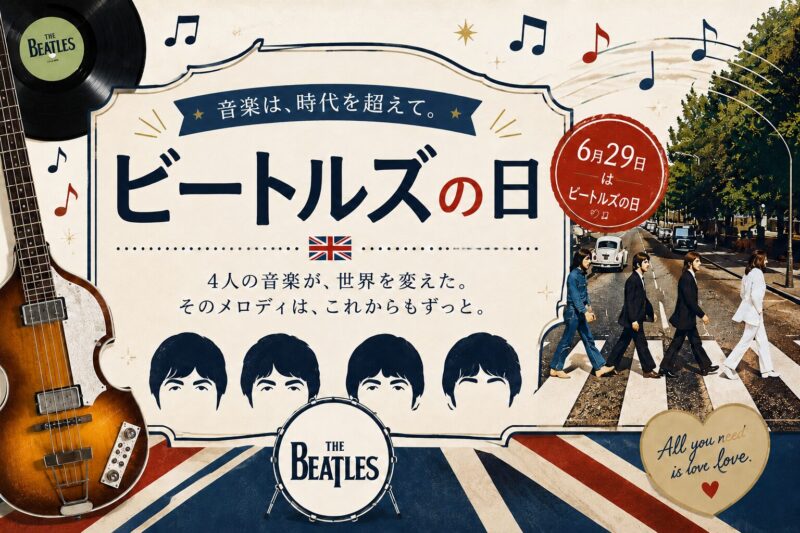
今日6月29日は、世界を席巻したロックバンドが日本に降り立った「ビートルズの日」と、永遠の名作の作者の誕生日にちなんだ「星の王子さまの日」が重なっています。
音楽と文学、二つの伝説が交差する今日のエピソードをどうぞ!
🎸 ビートルズの日——日本中が熱狂した1966年の夜明け前
1966年6月29日、午前3時39分。羽田空港に一機の飛行機が降り立ちました。乗っていたのは当時世界で最も有名なロックバンド、ザ・ビートルズ。ジョン・レノン、ポール・マッカートニー、ジョージ・ハリスン、リンゴ・スターの4人が初めて日本の地に降り立った瞬間です。
深夜にもかかわらず、空港には大勢のファンが詰めかけ、沿道警備には警察官3万人が動員されるほどの熱狂ぶり。当時の新聞は「我が国音楽界最大の話題」と報じました。
翌6月30日から7月2日にかけて、東京・日本武道館で計5回の公演を実施。しかし日本滞在中、4人はホテルの部屋から一歩も出られなかったというほど厳重な警護が敷かれていました。その”軟禁状態”の中、メンバーたちは楽器を手に取り、あの名曲「ペーパーバック・ライター」のリフを弾いたり、絵を描いたりして過ごしたと言われています。
この日本公演が、ビートルズにとって最後のワールドツアーの一部となりました。1966年8月をもってビートルズはライブ活動を引退。その後はスタジオ制作に専念し、「サージェント・ペパーズ」をはじめとした伝説のアルバムを生み出していきます。
👑 星の王子さまの日——サン=テグジュペリが遺したもの
1900年6月29日は、『星の王子さま』の作者アントワーヌ・ド・サン=テグジュペリの誕生日です。
フランスの貴族の家に生まれ、パイロットとして夜間郵便飛行に従事しながら小説を書き続けたサン=テグジュペリ。代表作『星の王子さま』は、世界200以上の国と地域で翻訳され、今も読み継がれる不朽の名作です。
彼の言葉はどれも深く、時代を超えて心に刺さります。
「大切なものは目に見えない。」
この一言だけで、どれだけの人が救われてきたことでしょう。サン=テグジュペリは1944年、偵察飛行任務中に消息を絶ち、44歳で亡くなりました。遺体は長らく発見されませんでしたが、2000年に地中海で機体の残骸が発見されています。
🍱 おまけ:「佃煮の日」でもあります
今日は「佃煮の日」でもあります。1646年6月29日、佃煮発祥の地・東京佃島の守り神・住吉神社が創建されたことが由来です。
佃煮の誕生にも面白い歴史が。大阪の佃村の漁民が徳川家康の三河脱出を船で助けたご縁から、江戸への移住を許可され、獲れた小魚を醤油・みりんで甘辛く煮た保存食を作ったのが始まりとされています。戦国時代の恩義が、日本の食文化を生んだんですね。
✍️ 今日のまとめ
ビートルズの音楽、星の王子さまの言葉、そして佃煮の味——今日は「時代を超えて愛されるもの」が揃った一日です。
目に見えないものを大切にしながら、今日も一歩ずつ前へ。
本日も良い一日をお過ごしください。
See you soon.
June 29th is “Beatles Day” 🎸 & “The Little Prince Day” 👑 — A Day Where Legends and Timeless Words Meet!
Today, June 29th, brings together “Beatles Day” — marking the moment the band that took the world by storm first set foot on Japanese soil — and “The Little Prince Day” — honoring the birthday of the author behind one of literature’s most beloved works.
Music and literature, two legends crossing paths on the same day. Here are the stories behind them!
Beatles Day 🎸 — Before Dawn on the Night Japan Lost Its Mind (1966)
At 3:39 in the morning on June 29, 1966, a plane touched down at Haneda Airport. On board were the most famous rock band in the world at the time — The Beatles: John Lennon, Paul McCartney, George Harrison, and Ringo Starr, setting foot on Japanese soil for the very first time.
Despite the early hour, crowds of fans had gathered at the airport, and an extraordinary 30,000 police officers were deployed for security along the route. Newspapers at the time called it “the biggest event in the history of Japanese music.”
From June 30th through July 2nd, the band performed five concerts at Tokyo’s Nippon Budokan. Yet throughout their stay in Japan, the four members were under such tight security that they were essentially unable to leave their hotel rooms. In that state of near-confinement, they are said to have passed the time picking up instruments and playing through riffs — and painting.
These Japan performances turned out to be part of The Beatles’ final world tour. In August 1966, the band retired from live performance altogether, turning their full attention to studio work and going on to create legendary albums including Sgt. Pepper’s Lonely Hearts Club Band.
The Little Prince Day 👑 — What Saint-Exupéry Left Behind
June 29, 1900 was the birthday of Antoine de Saint-Exupéry, the author of The Little Prince.
Born into a French noble family, Saint-Exupéry worked as a pilot on night mail routes while continuing to write. His masterpiece, The Little Prince, has been translated into more than 200 languages and regions around the world and remains a timeless classic read to this day.
Every word he wrote carries a depth that cuts straight to the heart, across any era. One line above all:
“What is essential is invisible to the eye.”
How many people have found comfort in those few words alone? Saint-Exupéry vanished during a reconnaissance flight in 1944, at the age of 44. His remains were never found, though wreckage from his aircraft was discovered in the Mediterranean Sea in 2000.
Bonus: It’s Also “Tsukudani Day” 🍱
Today is also “Tsukudani Day” — named after the founding of Sumiyoshi Shrine on June 29, 1646, the guardian shrine of Tsukudajima in Tokyo, the birthplace of tsukudani (seafood and vegetables simmered in soy sauce and mirin).
There’s a fascinating history behind tsukudani’s origins too. The fishermen of Tsukuda village in Osaka once helped Tokugawa Ieyasu escape by boat during his retreat to Mikawa. As a gesture of gratitude, Ieyasu permitted them to relocate to Edo, where they began simmering small fish in soy sauce and mirin as a preserved food — and that is said to be how tsukudani was born. A debt of gratitude from the Warring States period quietly gave rise to one of Japan’s great food traditions.
Today’s Takeaway ✍️
The music of The Beatles, the words of The Little Prince, and the taste of tsukudani — today is a day full of things that have been loved across generations.
Keeping what truly matters close to heart — even when it can’t be seen — let’s take it one step at a time today.
Have a wonderful day today.
See you soon.

コメント