5月11日。今日は2つの「歴史の転換点」が重なる、じつに重みのある日です。
ひとつは1891年——大国ロシアに脅かされた明治の日本で、たった一人の裁判官が「法の独立」を守るために立ち向かった日。
もうひとつは1997年——チェスの世界王者が、コンピューターに初めて敗れた日。人類とAIの関係が変わった瞬間です。
今日はその2つの物語と、5月11日の記念日をお届けします。
5月11日の記念日まとめ
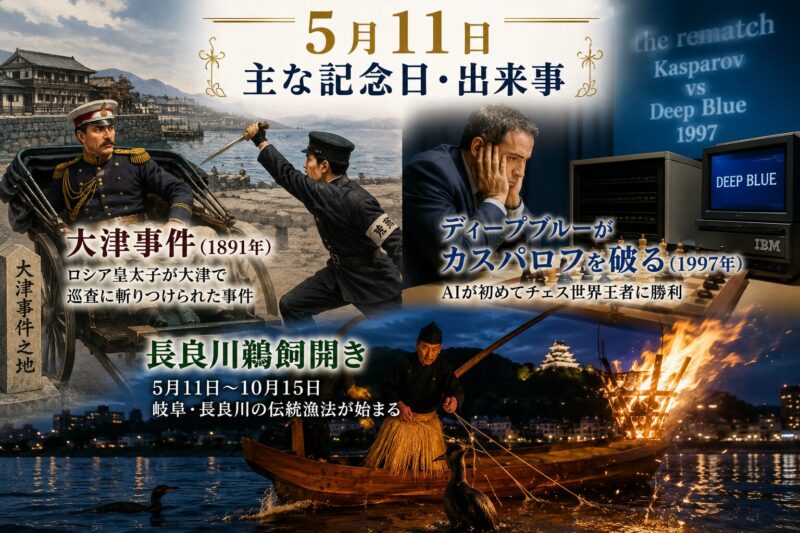
5月11日の主な記念日・出来事
・大津事件(1891年)——ロシア皇太子が大津で巡査に斬りつけられた事件
・ディープブルーがカスパロフを破る(1997年)——AIが初めてチェス世界王者に勝利
・長良川鵜飼開き——5月11日〜10月15日、岐阜・長良川の伝統漁法が始まる
・ご当地キャラの日——「ご(5)とう(10)ち(1)」の語呂合わせ
「国家か、法か」——大津事件と護法の神様・児島惟謙
1891年(明治24年)5月11日。当時の日本を揺るがす大事件が起きました。
シベリア鉄道の起工式に向かう途中、日本に立ち寄っていたロシア皇太子ニコライ(後のニコライ2世)が、滋賀県大津を人力車で移動中、警備にあたっていた巡査・津田三蔵に突然サーベルで斬りつけられ、頭部に重傷を負ったのです。
当時のロシアは世界の6分の1の領土を持つ超大国。神戸港にはロシアの艦隊が停泊していました。日本中が「ロシアが攻めてくる」と震え上がりました。
🇷🇺 大津事件(1891年5月11日)の概要
・被害者:ロシア皇太子ニコライ(後のニコライ2世、当時22歳)
・加害者:滋賀県警巡査・津田三蔵
・場所:滋賀県大津町(現・大津市)
・状況:人力車で移動中に突然サーベルで斬りつけられ頭部に重傷
・日本中の反応:「ロシアの報復で日本が滅ぶ」と大パニック
「法律にないことはできない」——政府の圧力を一人で跳ね返した裁判官
事件を受け、明治政府は大パニックに陥ります。総理大臣・松方正義をはじめ閣僚たちは「津田三蔵を死刑にしなければロシアが黙っていない」と主張。明治天皇自ら京都へ向かってニコライを見舞うほどの大騒ぎでした。
当時の刑法に「外国皇族への危害に対する規定」はありませんでした。適用できるのは通常の「謀殺未遂罪」のみ——最高でも無期徒刑です。しかし政府は「天皇・皇族への危害罪(大逆罪=死刑)」を外国皇族にも拡大解釈して適用せよと、司法に猛烈に圧力をかけます。
ここで立ち上がったのが、大審院長(現在の最高裁判所長官に相当)・児島惟謙でした。大審院長に就任してわずか6日後にこの事件が起きたにもかかわらず、児島は毅然として言いました。
児島惟謙の姿勢
「法治国家として、法は遵守されなければならない。刑法に外国皇族に関する規定はない。死刑は適用できない。」
政府の圧力は凄まじいものでした。首相・閣僚が直接乗り込み、死刑適用を迫ります。「緊急勅令で法律を変えてでも死刑にせよ」という意見まで飛び出しました。
それでも児島は一歩も引きませんでした。担当判事7人全員を一人ひとり個別に説得して回り、法の正道を貫かせたのです。
1891年5月27日、大審院は津田三蔵に「謀殺未遂罪・無期徒刑」の判決を下しました。
政府は震え上がりました。しかし——ロシア側は日本の法治国家としての姿勢を高く評価し、報復はありませんでした。欧米列強もこの判決を絶賛し、当時まだ日本に残っていた「領事裁判権(外国人は日本の法律で裁けない)」の撤廃が一気に進むきっかけになったのです。
「国家の利益か、法の正義か」——その問いに、児島惟謙は法を選びました。彼は後に「護法の神様」と称えられます。
1997年5月11日——人類がAIに初めて敗れた日
それから106年後の1997年5月11日。ニューヨークで、別の「歴史の転換点」が生まれました。
チェスの世界チャンピオン・ガルリ・カスパロフが、IBMのスーパーコンピューター「ディープブルー(Deep Blue)」との6番勝負の最終局に臨んでいました。
カスパロフ vs ディープブルー(1997年)
・カスパロフ:15年間世界チャンピオンに君臨した「史上最強のチェス王」
・ディープブルー:IBMが威信をかけて開発したスーパーコンピューター
・処理速度:人間が1秒に2〜3手を読む中、ディープブルーは1秒間に2億手を計算
・会場:ニューヨーク。ダフ屋まで現れる異様な熱気
・下馬評:専門家の大多数が「カスパロフが勝つ」と予想
ところが——。
ディープブルーが19手目を指した瞬間、カスパロフは投了しました。決着はわずか1時間足らず。1勝2敗3分けで、人類史上初めてコンピューターがチェス世界王者に勝利したのです。
その報道は一夜にして世界を駆け巡りました。「AIが人間を超えた」——衝撃は計り知れないものがありました。
敗れたカスパロフが語った「AIとの共存」という哲学
興味深いのは、その後のカスパロフの言動です。
敗北後、カスパロフはディープブルーが「不正をした」と主張し、再戦を求めました。IBMはそれを拒否。この後味の悪さはカスパロフの心に長く残りました。
しかし月日が流れ、カスパロフは次第に考え方を変えていきます。2017年に出版した著書の中でこう述べています。
カスパロフの言葉(晩年)
「私はAIを恐れていない。人間とAIが協力すれば、どちらか単独よりもはるかに強くなれる。問題はAIではなく、AIをどう使うか、という人間側の問題だ」
かつて人類の敗北を象徴した男が、今では「人間とAIの協調」を世界に訴えている——この変化もまた、歴史の面白さだと思います。
今私たちが日々触れているAIも、1997年のあの日から始まった流れの延長線上にあります。
長良川鵜飼開き——1300年続く幻想的な伝統漁法
5月11日は岐阜・長良川の鵜飼開きの日でもあります。毎年この日から10月15日まで、増水日などを除いて毎夜行われる伝統漁法です。
鵜飼とは、松明の火で鮎を引き寄せ、飼いならした鵜に鮎を捕らせる伝統的な漁法。その歴史は古く、『古事記』や『日本書紀』にも記録が残っており、1300年以上の歴史を持ちます。
鵜飼の豆知識
・鵜は飲み込んだ鮎を食道で一瞬のうちに気絶させるため、鮮度が保たれる
・長良川の鵜飼は「宮内庁式部職鵜匠」として国家公務員の鵜匠が担当
・松尾芭蕉も長良川の鵜飼を詠んだ俳句を残している
・ユネスコ無形文化遺産への登録も推進されている
闇夜に揺れる篝火、水面を泳ぐ鵜の黒いシルエット——長良川の鵜飼は、一度見たら忘れられない幻想的な光景です。岐阜を訪れる機会があればぜひ。
5月11日は「信念を貫く」ことを思い出す日
大国ロシアの圧力にも屈しなかった児島惟謙。チェスの世界王者に勝利したディープブルー。どちらも「時代の常識」を塗り替えた出来事でした。
「空気を読んで従うのが賢い」と思える状況でも、信念を持って正しいと思う道を進む——それが歴史を動かしてきたのかもしれません。
📝 まとめ
- 1891年5月11日、大津事件発生——ロシア皇太子が滋賀・大津で巡査に斬りつけられた
- 大審院長・児島惟謙は、死刑を求める政府の圧力を跳ね返し法に従い無期徒刑を貫いた
- 判決はロシアと欧米から高く評価され、領事裁判権撤廃の大きなきっかけになった
- 児島は「護法の神様」と称えられ、日本の司法独立の礎を築いた
- 1997年5月11日、ディープブルーがチェス世界王者カスパロフを破り、人類がAIに初めて敗れた
- 後にカスパロフは「人間とAIの協調」を提唱。敗者が未来を語る語り部になった
- 長良川鵜飼開き——今日から10月まで、1300年続く幻想の漁法が始まる
最後まで読んでくださってありがとうございました😊
「国家か法か」「人間かAIか」——大きな問いが重なる今日、自分ならどちらを選ぶか、少し考えてみてください。
では、よい一日をお過ごしください。
see you soon.
【May 11th】 “Nation or Law?” — The Day a Judge Stood Alone Against the Might of Russia, and the Day Humanity First Lost to AI
May 11th. Today is a day when two pivotal turning points in history overlap — and both carry tremendous weight.
The first is from 1891 — a day in Meiji-era Japan, when a single judge stood up to defend the independence of the law against the pressure of one of the world’s most powerful nations.
The second is from 1997 — the day the world chess champion lost to a computer for the first time. The moment that changed the relationship between humanity and artificial intelligence forever.
Today, let’s explore both of those stories — along with the other commemorative moments that fall on May 11th.
May 11th Commemorative Days at a Glance
Main Events & Commemorative Days on May 11th
· The Otsu Incident (1891) — A Russian Crown Prince was attacked by a Japanese police officer in Otsu, Shiga
· Deep Blue defeats Kasparov (1997) — An AI defeats the world chess champion for the first time in history
· Nagara River Cormorant Fishing Opening Day — May 11th marks the start of the season, running through October 15th
· Local Character Day — Wordplay on “Go (5) To (10) Chi (1)” (ご当地)
“Nation or Law?” — The Otsu Incident and the Judge Who Would Not Bend
On May 11th, 1891 (Meiji 24), an event shook Japan to its core.
Nicholas Alexandrovich Romanov — Crown Prince of Russia and future Tsar Nicholas II — was visiting Japan en route to the groundbreaking ceremony of the Trans-Siberian Railway. While traveling by rickshaw through Otsu in Shiga Prefecture, he was suddenly attacked by a police officer named Tsuda Sanzo, who drew his saber and slashed the Crown Prince across the head, inflicting a serious wound.
At the time, Russia was a superpower controlling one-sixth of the world’s land surface. A Russian naval fleet was anchored in Kobe Harbor. All of Japan trembled: “Russia is going to invade.”
🇷🇺 The Otsu Incident — May 11th, 1891
· Victim: Crown Prince Nicholas of Russia (future Tsar Nicholas II, then 22 years old)
· Attacker: Shiga Prefecture police officer Tsuda Sanzo
· Location: Otsu, Shiga Prefecture (present-day Otsu City)
· What happened: Attacked without warning by saber while riding in a rickshaw; serious head injury
· Public reaction: Mass panic — “Russia will destroy us in retaliation”
“The Law Does Not Allow It” — One Judge Who Refused to Yield
The Meiji government went into full crisis mode. Prime Minister Matsukata Masayoshi and his cabinet argued that Tsuda Sanzo must be executed — otherwise Russia would never be appeased. Emperor Meiji himself traveled to Kyoto to personally visit the injured Crown Prince, such was the gravity of the situation.
The problem: Japanese criminal law at the time contained no provision for attacking a foreign royal. The most that could legally be applied was an attempted murder charge — carrying a maximum sentence of life imprisonment. Yet the government pressed the judiciary to stretch the law, applying the lèse-majesté statute (which mandated the death penalty for harm against the Emperor or Imperial family) to a foreign prince by force of interpretation.
This is where Kojima Korekata — President of the Great Court of Judicature (the equivalent of today’s Chief Justice of the Supreme Court) — made his stand. The incident had occurred just six days after his appointment. And yet Kojima held firm:
Kojima Korekata’s Position
“As a nation governed by law, the law must be upheld. The criminal code contains no provision regarding foreign royalty. The death penalty cannot be applied.”
The pressure from the government was immense. Ministers arrived in person to demand he comply. Proposals were floated to change the law by emergency imperial decree just to make execution possible.
Kojima did not move an inch. He went to each of the seven judges assigned to the case — one by one — and persuaded every one of them to follow the letter of the law.
On May 27th, 1891, the Great Court of Judicature handed down its verdict: Tsuda Sanzo was sentenced to life imprisonment for attempted murder.
The government braced for disaster — but it never came. Russia acknowledged Japan’s commitment to the rule of law and chose not to retaliate. Western powers praised the verdict, and Japan’s efforts to abolish the system of extraterritoriality (by which foreign nationals could not be tried under Japanese law) gained powerful momentum as a direct result.
“National interest or legal justice?” Kojima chose the law. He would later be honored with the title “Guardian of the Law.”
May 11th, 1997 — The Day Humanity First Lost to AI
One hundred and six years later, on May 11th, 1997, another turning point was reached — this time in New York City.
Chess world champion Garry Kasparov was sitting down for the final game of a six-game match against IBM’s supercomputer Deep Blue.
Kasparov vs. Deep Blue (1997)
· Kasparov: World chess champion for 15 years — widely regarded as the greatest chess player of all time
· Deep Blue: IBM’s purpose-built chess supercomputer, the company’s prestige project
· Processing power: While a human reads 2–3 moves per second, Deep Blue calculated 200 million moves per second
· Venue: New York City — the atmosphere was electric; scalpers were selling tickets outside
· Predictions: The majority of experts expected Kasparov to win
Then — unexpectedly —
On Deep Blue’s 19th move, Kasparov resigned. The match was over in under an hour. With a final score of one win, two losses, and three draws, a computer had defeated the reigning world chess champion for the first time in human history.
The news spread around the world overnight. “AI has surpassed the human mind” — the shock was unlike anything the technology world had seen before.
The Philosophy of the Man Who Lost — Kasparov on AI and Coexistence
What’s particularly fascinating is what happened to Kasparov afterward.
In the immediate aftermath, Kasparov accused Deep Blue of cheating and demanded a rematch. IBM declined. The bitterness of that refusal stayed with him for years.
But time passed, and Kasparov’s thinking gradually evolved. In a book published in 2017, he wrote:
Kasparov’s Words (in later years)
“I am not afraid of AI. When humans and AI work together, the result is far more powerful than either alone. The question is not AI itself — it is how humans choose to use it.”
The man who once symbolized humanity’s defeat by a machine became one of the world’s foremost advocates for human-AI collaboration. That transformation, too, is part of the story.
The AI tools we interact with every day are direct descendants of the chain of events that began on that day in 1997.
Nagara River Cormorant Fishing Opening Day — 1,300 Years of Ethereal Tradition
May 11th also marks the opening day of ukai (cormorant fishing) on the Nagara River in Gifu — a tradition that continues every night until October 15th, weather and water conditions permitting.
Ukai is an ancient fishing technique in which torchlight lures sweetfish (ayu) to the surface, where trained cormorants catch them. The practice is mentioned in both the Kojiki and Nihon Shoki — Japan’s oldest historical records — giving it a history spanning over 1,300 years.
Cormorant Fishing Fun Facts
· Cormorants stun the fish in their throats almost instantly, keeping the ayu remarkably fresh
· The Nagara River’s master cormorant fishermen (usho) are employed by the Imperial Household Agency — they are national civil servants
· The poet Matsuo Basho wrote a haiku about the Nagara River’s cormorant fishing
· Efforts are underway to have it registered as a UNESCO Intangible Cultural Heritage
Torchlight flickering in the dark, the black silhouettes of cormorants gliding across the water — the Nagara River ukai is a sight that, once seen, is never forgotten. If you ever find yourself in Gifu, it’s well worth the trip.
May 11th Is a Day to Remember What It Means to Stand by Your Convictions
Kojima Korekata, who would not bow to the power of Imperial Russia. Deep Blue, which rewrote the boundary between human and machine. Both overturned what their eras assumed to be certain.
Even when “reading the room and going along” seems like the smart and easy choice, moving forward with conviction toward what you believe is right — that, perhaps, is what has driven history forward.
Summary
- On May 11th, 1891, the Otsu Incident occurred — Crown Prince Nicholas of Russia was attacked by a Japanese police officer in Shiga
- Great Court President Kojima Korekata defied intense government pressure and upheld the law, sentencing the attacker to life imprisonment rather than death
- The verdict was praised by Russia and Western powers alike, and directly accelerated Japan’s push to abolish extraterritoriality
- Kojima was honored as “Guardian of the Law” — a foundational figure in the independence of Japan’s judiciary
- On May 11th, 1997, Deep Blue defeated world chess champion Kasparov — the first time in history a human had lost to a computer in championship play
- Kasparov later became an advocate for human-AI collaboration — the man who symbolized defeat became a voice for the future
- Nagara River Cormorant Fishing opens today — a tradition over 1,300 years old begins its season through October
Thank you so much for reading all the way to the end 😊
“Nation or law?” “Human or AI?” On a day layered with big questions, take a moment to ask yourself: what would you choose?
Have a wonderful day.
See you soon.


コメント