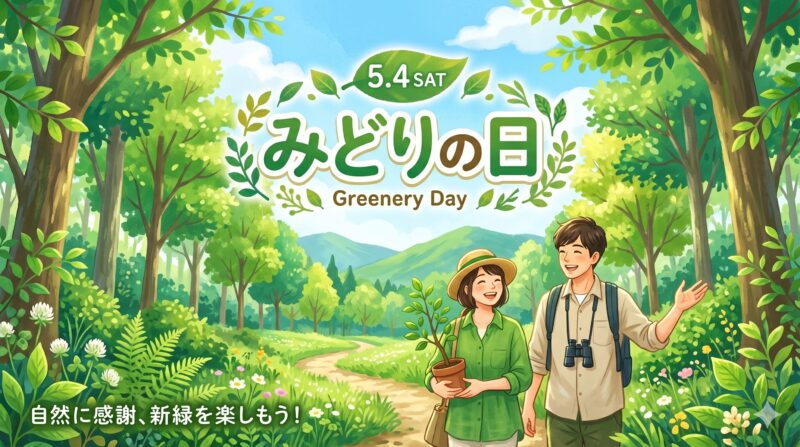
5月4日、ゴールデンウィーク真っ只中の「みどりの日」。
「なんとなく自然に関係する日でしょ?」
……そう思っているあなた、実はこの祝日、とても味わい深い誕生秘話があるんです。
昭和天皇が残した「雑草という名の草はない」という言葉、聞いたことがありますか?この一言に、みどりの日のすべてが詰まっています。今日はそんな話をしていきますね。
みどりの日とは?基本からおさらい
みどりの日は「自然に親しむとともにその恩恵に感謝し、豊かな心を育む」ことを目的として制定された国民の祝日です。毎年5月4日で、ゴールデンウィークを構成する祝日のひとつです。
英語では「Greenery Day」と表記されます。ちなみに、あのロックバンド「Green Day」とは別物ですよ(笑)
📖 ポイント整理
・正式名称:みどりの日(Greenery Day)
・日付:毎年5月4日
・趣旨:自然に親しみ、その恩恵に感謝し、豊かな心を育む
・制定:2007年(現在の5月4日として)
実は3回も名前が変わっている!4月29日の波乱万丈な歴史
みどりの日を語るうえで欠かせないのが、4月29日という日付の歴史です。この日、実は名前が3回も変わっているという異例の祝日なんです。
| 時代 | 名称 | 内容 |
|---|---|---|
| 〜1948年 | 天長節 | 昭和天皇の誕生日を祝う日 |
| 1948〜1988年 | 天皇誕生日 | 祝日法制定により名称変更 |
| 1989〜2006年 | みどりの日 | 昭和天皇崩御後、自然への愛にちなんで |
| 2007年〜 | 昭和の日 | 激動の昭和を振り返る日として制定 |
4月29日が「昭和の日」になったことで、もともとあった「みどりの日」が行き場を失いそうになりました。そこで白羽の矢が立ったのが5月4日です。
5月4日はもともと平日でしたが、5月3日(憲法記念日)と5月5日(こどもの日)の祝日に挟まれていたため、1985年の祝日法改正で「祝日と祝日にはさまれた平日は国民の休日とする」と定められ、暫定的な休日になっていました。そこにみどりの日が移動したことで、2007年から正式な祝日として昇格したわけです。
つまり5月4日は、もともと「空白の休日」だったのが、みどりの日を迎え入れてはじめて「意味のある祝日」になったんですね。
【感動エピソード】「雑草という名の草はない」——昭和天皇の自然への愛
ここが今日一番お伝えしたいところです。
みどりの日の名前の由来は、昭和天皇が植物に造詣が深く、自然をこよなく愛されたことから「緑」にちなんだ名がふさわしいという主旨からきています。
昭和天皇はただ自然が好きだったというレベルではありません。生物学者として世界的に高い評価を得ており、研究の対象はヒドロゾア(クラゲの仲間)と粘菌。100種類を優に超える新種を発見し、9編の専門論文と20冊以上の生物学書籍に関わるなど、生物分類学に大きな足跡を残しました。
そんな昭和天皇の自然への愛を象徴する、こんなエピソードが残っています。
🌿 「雑草という名の草はない」
ある日、昭和天皇が静養からお帰りになった際、侍従たちが皇居周辺の草刈りをして雑草を刈り残したことをお詫びしました。すると昭和天皇はこうおっしゃいました。
「雑草という草はない。どんな植物でもみな名前があって、それぞれ自分の好きな場所で生を営んでいる。人間の一方的な考え方で、これを雑草として決めつけてしまうのはいけない。注意するように。」
植物学者・牧野富太郎の言葉を引用されたものですが、この言葉が自然への深い敬意を持った昭和天皇らしさをよく表しています。
この言葉、なんだか植物だけの話じゃない気がしませんか?
「役に立たない」「意味がない」と切り捨てられがちなもの——でも実はそれぞれに名前があり、場所があり、生きている意味がある。そんなメッセージとして読んでしまうのは私だけでしょうか。
【もっとすごいエピソード】病床でも校正を続けた「皇居の植物」
昭和天皇の自然への情熱は、晩年になっても衰えませんでした。
昭和天皇は「皇居の植物」という著書も著されており、1470種もの植物が記載されています。かつて吹上御苑は人の手が入った立派な庭園でしたが、「いつもきれいに刈り込んだ庭園よりも、むしろ野草の生える庭がいい」という昭和天皇のご希望で、自然園に戻されました。
そして——この「皇居の植物」が刊行されたのは昭和天皇の崩御の後、平成元年11月のことでした。昭和天皇はその病床でも「皇居の植物」の校正をされていたといいます。
生涯の最後まで、自分の愛した植物の本を仕上げようとされていた——そのひたむきさに、思わず胸が熱くなりますね。
みどりの日は入園無料!知らなきゃ損するお得情報
みどりの日には国公立公園の無料開放を行うほか、恩賜上野動物園や多摩動物公園、新宿御苑、浜離宮恩賜庭園、小石川植物園、井の頭自然文化園、葛西臨海水族園などにおいても入園料が無料となります。
GWの混雑の中でも、これを知っているだけでお財布がちょっと助かります!東京近郊にお住まいの方は特にチェックしてみてください😊
みどりの月間って知ってる?
5月4日のみどりの日をはさむ形で、4月15日から5月14日を「みどりの月間」としています。月間中は、みどりに関する学術上の功績のあった個人に「みどりの学術賞」を授与する「みどりの式典」をはじめ、国公立公園の無料開放や緑化イベントなど、自然に関する様々な催しが行われます。
GWに限らず、この期間に自然の中に出かけてみるのもいいですね。
まとめ/みどりの日は「名もなき草に気づく日」
「雑草という名の草はない」
この言葉を知ってからみどりの日を過ごすと、街路の小さな草花ひとつひとつが違って見えてきませんか?
GWで賑やかな5月4日。公園を歩きながら、足元の草の名前をひとつでも調べてみる——そんな小さな発見が、「豊かな心を育む」みどりの日の本当の楽しみ方かもしれません。
📝 まとめ
- みどりの日は毎年5月4日、「自然に親しみ恩恵に感謝する日」
- もとは4月29日(昭和天皇の誕生日)にあった祝日が移動したもの
- 4月29日は「天長節→天皇誕生日→みどりの日→昭和の日」と3回名前が変わった異例の祝日
- 昭和天皇は本物の生物学者。100種以上の新種を発見し、20冊以上の著書を残した
- 「雑草という名の草はない」の言葉に自然への深い敬意が凝縮されている
- 病床でも植物の本の校正を続けた、そのひたむきさが「みどりの日」の精神に宿っている
- みどりの日は国公立公園・動物園などが無料開放されるのでお得!
最後まで読んでくださってありがとうございました😊
GWのどこかで、足元の小さな草に目を向けてみてください。きっとそこにも、名前があります。
では、よい一日をお過ごしください。
see you soon.
What Is Greenery Day? “There Is No Such Thing as a Weed” — The Touching Story Behind Japan’s May 4th Holiday
May 4th — right in the heart of Golden Week — is “Greenery Day.”
“It’s something to do with nature, right?”
…If that’s all you know, you’re in for a surprise. This holiday has a surprisingly rich and moving origin story.
Have you ever heard the phrase: “There is no such thing as a weed”? These words, attributed to Emperor Showa, hold the very essence of Greenery Day. Let’s explore that story today.
What Is Greenery Day? A Quick Overview
Greenery Day is a national holiday established with the purpose of “communing with nature, appreciating its gifts, and cultivating a rich spirit.” It falls on May 4th every year and is one of the holidays that make up Japan’s Golden Week.
The holiday is officially written in English as “Greenery Day” — not to be confused with the rock band Green Day! (laughs)
📖 Key Facts
· Official name: Greenery Day (みどりの日)
· Date: May 4th every year
· Purpose: To commune with nature, give thanks for its gifts, and nurture a rich heart
· Established: 2007 (as May 4th)
Did You Know? The Name Has Changed 3 Times — The Dramatic History of April 29th
To understand Greenery Day, you need to know the story of April 29th — a date whose name has changed three times, making it one of Japan’s most unusual holidays.
| Era | Name | Meaning |
|---|---|---|
| Up to 1948 | Tenchōsetsu (天長節) | Celebrating Emperor Showa’s birthday |
| 1948–1988 | Emperor’s Birthday | Renamed under the National Holidays Act |
| 1989–2006 | Greenery Day | Named after Emperor Showa’s love of nature following his passing |
| 2007–present | Showa Day | A day to reflect on the turbulent Showa era |
When April 29th became “Showa Day,” the original “Greenery Day” suddenly had nowhere to go. That’s where May 4th came in.
May 4th had originally been a regular weekday — but sandwiched between May 3rd (Constitution Memorial Day) and May 5th (Children’s Day), a 1985 revision to the National Holidays Act declared that “a weekday falling between two national holidays shall also be a holiday.” So May 4th became a provisional holiday. When Greenery Day moved there in 2007, it was officially elevated to a proper national holiday.
In other words, May 4th was once a “blank holiday” with no official meaning — and it was Greenery Day that finally gave it one.
【A Moving Episode】”There Is No Such Thing as a Weed” — Emperor Showa’s Love of Nature
This is the part I most want to share with you today.
The name “Greenery Day” comes from Emperor Showa’s deep knowledge of plants and his profound love of the natural world — making “green” a fitting tribute to his memory.
But Emperor Showa wasn’t just someone who happened to like nature. He was a world-renowned biologist, whose research focused on hydrozoans (relatives of jellyfish) and slime molds. He discovered over 100 new species, authored 9 academic papers, and contributed to more than 20 books on biology — leaving a lasting mark on the field of biological classification.
And yet, it’s this story that captures his spirit best:
🌿 “There Is No Such Thing as a Weed”
One day, after returning from a period of rest, Emperor Showa was met by attendants who apologized for having left some weeds uncut during garden maintenance around the Imperial Palace. The Emperor responded:
“There is no such thing as a weed. Every plant has a name, and each one lives where it chooses to live. It is wrong for humans to unilaterally label them as weeds. Please be mindful of this.”
He was drawing on the words of botanist Tomitaro Makino, and the sentiment perfectly reflects Emperor Showa’s deep reverence for the natural world.
Doesn’t this feel like it’s about more than just plants?
Things often dismissed as “useless” or “meaningless” — each one has a name, a place, and a reason for being. If that reading moves you too, you’re not alone.
【An Even More Remarkable Story】Proofreading on His Deathbed — “Plants of the Imperial Palace”
Emperor Showa’s passion for nature never faded, even in his final years.
He authored a book titled Plants of the Imperial Palace, cataloguing an extraordinary 1,470 species. The Fukiage Garden within the palace grounds had once been a meticulously manicured formal garden — but at Emperor Showa’s request, it was returned to a more natural state. “I prefer a garden where wildflowers grow to one that is always neatly trimmed,” he had said.
And here is the most poignant detail: Plants of the Imperial Palace was published in November 1989 — after Emperor Showa had already passed away. He had continued proofreading the manuscript from his hospital bed, right up until the end.
To spend one’s final days making sure a beloved book about plants was finished just right — there’s something deeply moving about that kind of dedication.
Free Admission on Greenery Day! What You Shouldn’t Miss
On Greenery Day, many national and public parks open their gates for free. In Tokyo, this includes Ueno Zoo, Tama Zoological Park, Shinjuku Gyoen, Hamarikyu Gardens, Koishikawa Botanical Garden, Inokashira Park Zoo, and Kasai Rinkai Aquarium, among others.
Even amid the Golden Week crowds, knowing this can save you a bit of money — definitely worth checking out if you’re in the Tokyo area! 😊
Ever Heard of “Greenery Month”?
Centered around May 4th, Japan observes a “Greenery Month” from April 15th to May 14th. During this period, a variety of nature-related events are held across the country, including the “Greenery Ceremony,” at which the Greenery Academic Award is presented to individuals who have made outstanding contributions to the study of nature. Free park admissions and greening events are also part of the program.
Even outside of Golden Week, it’s a wonderful time to get out into nature.
Closing Thoughts — Greenery Day Is a Day to Notice the Overlooked
“There is no such thing as a weed.”
Once you know those words, doesn’t every small roadside flower look a little different?
On this busy, lively May 4th, maybe take a moment during a walk in the park to look up the name of one plant you’ve never noticed before. That small discovery might be the truest way to celebrate a holiday dedicated to nurturing “a rich spirit.”
📝 Summary
- Greenery Day is every May 4th — a day to appreciate nature and its gifts
- It originated from a holiday that was once on April 29th (Emperor Showa’s birthday)
- April 29th has gone through 3 name changes: Tenchōsetsu → Emperor’s Birthday → Greenery Day → Showa Day
- Emperor Showa was a genuine scientist who discovered over 100 new species and wrote more than 20 books
- His words — “There is no such thing as a weed” — embody a deep respect for all living things
- He continued proofreading his plant book from his deathbed — a testament to lifelong dedication
- Many parks and zoos offer free admission on Greenery Day — don’t miss out!
Thank you so much for reading all the way to the end 😊
Somewhere in your Golden Week, I hope you take a moment to look down at the little plants growing at your feet. Each one has a name.
Have a wonderful day.
See you soon.
コメント