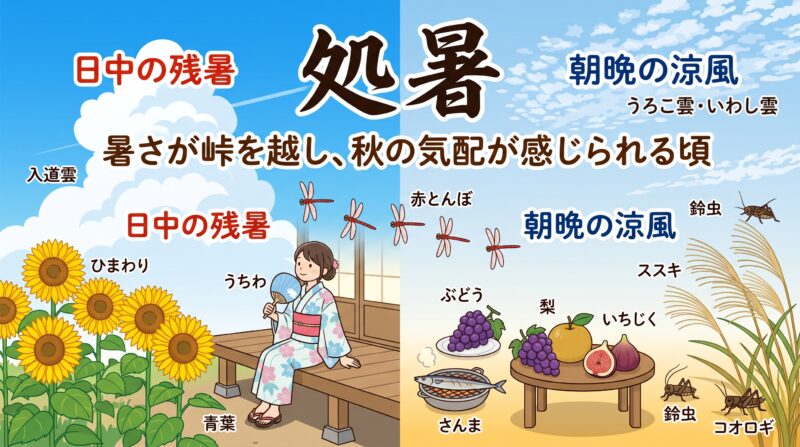
今日8月23日は、二十四節気のひとつ「処暑(しょしょ)」。暦の上では暑さが少しずつ和らぎ始めるとされる頃です。そして幕末の悲話「白虎隊自刃の日」、日本の製油の歴史を伝える「油の日」も重なります。
処暑——「とどまる」という文字に込められた季節の変化
「処」という漢字には「とどまる」「とまる」という意味があり、太陽の黄経が150度に達するこの時期から、暑さが次第に収まっていくとされています。年によって日付は変動しますが、2026年は8月23日が処暑にあたります。
とはいえ、実際にはまだまだ厳しい残暑が続くのがこの時期の特徴。実は処暑の前後、特に8月20日〜23日頃は、統計的に台風が日本列島へ上陸・接近しやすい「特異日」ともされています。夕方に少しずつ日が短くなり、どこからともなく涼やかな虫の声が聞こえ始める——そんな小さな変化の中に、確かな秋の気配を見つけてみるのも良いですね。
実際、台風18号が接近中ですしね。
白虎隊自刃の日——16、17歳の少年たちが見た、燃える城下町
1868年(明治元年)旧暦8月23日、戊辰戦争のさなか、会津藩の少年たちで編成された部隊「白虎隊」のうち、飯盛山にいた一隊が悲劇的な最期を迎えました。
新政府軍の猛攻を受け敗走した白虎士中二番隊は、山の上から燃え盛る城下町を目撃。それを主君の居城・鶴ヶ城が落城したものと誤認し、「もし敵に捕らわれ屈辱を受けるようなことがあれば、主君や祖先に申し訳が立たない」と、自刃という道を選んだと伝えられています。実際には鶴ヶ城は落城しておらず、後にこの悲劇が広く知られることとなりました。隊士の中には、藩への忠義から年齢を偽って志願した15歳未満の少年もいたと言われています。
未来ある若者たちの命が失われた戦争の虚しさを後世に語り継ぐため、この日は「白虎隊の日」として記憶されています。
油の日——「長木」が生んだ、日本の製油発祥の地
京都府大山崎町の離宮八幡宮と、油脂事業を展開するカネダ株式会社が制定した「油の日」。離宮八幡宮は、「長木(ちょうぎ)」と呼ばれるてこの原理を応用した搾油器を発明したことから、日本の製油発祥の地とされています。
普段何気なく使っている食用油も、その歴史をたどると、こうした先人たちの発明と工夫に行き着くのですね。ちなみに1962年8月23日には、湖池屋が「コイケヤポテトチップスのり塩」を発売。今も愛されるロングセラー商品が、この日に誕生していたというのも面白い偶然ですね🍟
✍️ 今日のまとめ
暑さの中に忍び寄る秋の気配、命を懸けた少年たちの忠義、そして暮らしを支える油の歴史——今日は、それぞれ違う重みを持つ出来事に想いを馳せる一日ですね。
まだまだ暑さは続きますが、夕暮れ時にふと感じる風の変化に、今日は少し敏感になってみてはいかがでしょう。
本日も良い一日をお過ごしください。
See you soon.
Today, August 23rd, marks “Shosho,” one of the 24 traditional solar terms — the point on the traditional calendar when the summer heat is said to gradually begin easing. It also coincides with “Byakkotai Jijin no Hi,” commemorating a tragic story from the late Edo period, and “Oil Day,” honoring the history of oil production in Japan.
Shosho — A Shift in Season, Captured in the Character for “Pause”
The kanji character “処” carries meanings like “to pause” or “to stop,” and it’s said that from this point onward — when the sun’s ecliptic longitude reaches 150 degrees — the summer heat gradually begins to subside. The exact date shifts slightly from year to year, but in 2026, Shosho falls on August 23rd.
That said, this time of year is still very much characterized by lingering, intense late-summer heat. In fact, statistically, the period around Shosho — particularly August 20th through 23rd — is considered a “singular day” when typhoons are especially likely to make landfall or approach the Japanese archipelago. As evenings gradually grow shorter and the cool chirping of insects starts drifting in from somewhere unseen, perhaps it’s worth noticing these small signs — genuine hints of autumn hidden within the heat.
And sure enough, Typhoon No. 18 is approaching right now, isn’t it.
Byakkotai Jijin no Hi — What 16- and 17-Year-Old Boys Saw in a Burning Castle Town
On the 23rd day of the 8th lunar month, 1868 (Meiji 1), during the turmoil of the Boshin War, one unit of the “Byakkotai” — a corps formed of young sons of the Aizu domain — met a tragic end at Mount Iimori.
Having retreated under fierce attack from the new Imperial government forces, the Byakkotai Shichū Ni-ban-tai looked down from the mountainside and saw the castle town engulfed in flames. Mistakenly believing that their lord’s castle, Tsuruga Castle, had fallen, they are said to have concluded, “If we were to be captured and endure humiliation at the enemy’s hands, we could never face our lord or our ancestors” — and chose to take their own lives rather than surrender. In truth, Tsuruga Castle had not fallen, and this tragic misunderstanding only became widely known afterward. Among the unit’s members were reportedly boys under the age of 15 who had lied about their age to volunteer, out of loyalty to their domain.
To pass down to future generations the emptiness of a war that took the lives of young people with so much ahead of them, this day is remembered as “Byakkotai Day.”
Oil Day — The Birthplace of Japanese Oil Production, Born from the “Chōgi”
“Oil Day” was jointly established by Rikyū Hachimangū Shrine in Ōyamazaki, Kyoto Prefecture, and Kaneda Co., a company in the oil and fat business. Rikyū Hachimangū is regarded as the birthplace of Japanese oil production, having invented an oil-press device called the “chōgi,” which applied the principle of leverage.
Even the cooking oil we use so casually every day, it turns out, traces back to the inventions and ingenuity of people who came long before us. As a fun bit of trivia, on August 23, 1962, Koikeya released “Koikeya Potato Chips Nori Salt” — a long-running favorite still beloved today, which just happened to be born on this very date. 🍟
Today’s Takeaway ✍️
The quiet approach of autumn within lingering summer heat, the devotion of young men who gave their lives, and a history of oil that has long supported daily life. Today brings together events, each carrying its own very different kind of weight.
The heat isn’t over yet, but perhaps today’s a good day to pay a little closer attention to the shifting breeze at dusk. 🍃
Have a wonderful day today.
See you soon.

コメント