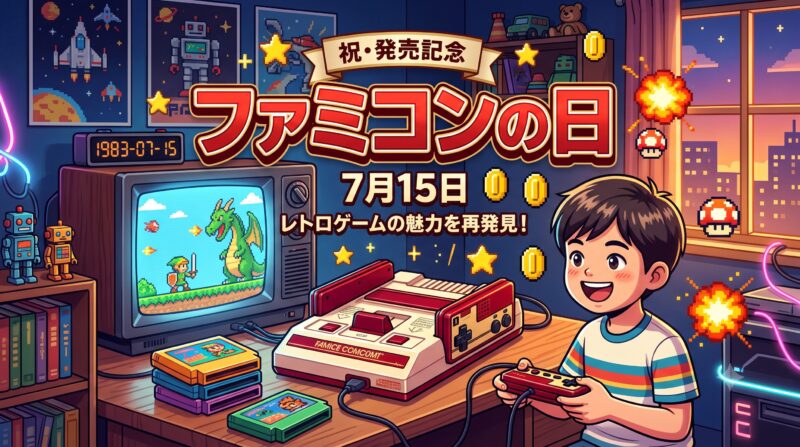
今日7月15日は、先祖の霊をお迎えする「お盆」、お世話になった方への感謝を伝える「お中元」の時期にあたり、さらに日本中の子どもを熱狂させた「ファミコン」が誕生した日でもあります。そして知る人ぞ知る、あの華やかな劇団の記念日も!
お盆・中元——先祖を迎え、感謝を届ける夏の節目
7月15日は、本来の「お盆(盂蘭盆会)」の日です(現代は8月に行う地域が多いですが、東京など一部では7月盆が続いています)。
お盆は先祖の霊が帰ってくる期間とされ、13日の迎え火から16日の送り火まで、家族で先祖を迎え供養します。もともと道教の「中元」という概念が仏教と結びついたもので、7月15日は「三元」(上元1月15日・中元7月15日・下元10月15日)のひとつ。この「中元」が日本では「お中元」として、お世話になった方への贈り物文化に発展しました。
お中元の時期を過ぎてしまったら? 立秋(8月7日頃)前なら「暑中見舞い」、以降は「残暑見舞い」として贈るのがマナーです。感謝を伝えるのに遅すぎることはありませんよ。
ファミコンの日——14,800円で始まった「家庭のゲーム革命」
1983年7月15日、任天堂が「ファミリーコンピュータ(ファミコン)」を発売しました。定価14,800円。
発売当初は品薄で入手困難でしたが、「スーパーマリオブラザーズ」「ドラゴンクエスト」などのキラーソフトが次々と登場し、瞬く間に社会現象に。ゲームセンターにしかなかった本格的なゲームが「家でできる」——この革命が子どもたちの放課後を永遠に変えました。
当時のソフトのデータ量も驚き。「スーパーマリオブラザーズ」は約40キロバイト、「ドラゴンクエスト」は約64キロバイト——今のスマホで撮る写真1枚分にも満たないデータ量で、あれほどの名作が動いていたのです。技術者たちの創意工夫に頭が下がります。
ファミコンは世界累計約6,200万台を販売。Nintendo Switchへと続く任天堂の家庭用ゲーム機の歴史は、この日から始まりました。
宝塚歌劇団の源流——温泉場の余興から世界へ
1913年7月15日、兵庫県宝塚市の温泉場で「宝塚唱歌隊」が組織されました。これが後の宝塚歌劇団の始まりです。
もともとは温泉客を集めるための余興として、少女たちが歌を披露したのがスタート。しかし評判が評判を呼び、歌に加えて劇も演じるようになり、やがて「宝塚歌劇団」として日本を代表する劇団へと成長しました。
「清く、正しく、美しく」をモットーに、女性だけで男役・娘役を演じる独自のスタイルは世界でも唯一無二。今年で創立113年を迎えてなお、多くのファンを魅了し続けています。
おまけ:ホッピーの日&ロゼッタ・ストーン発見
1948年7月15日には、ビールの代用品として誕生した「ホッピー」が発売されました。焼酎で割って飲むスタイルで70年以上愛され続ける下町の名飲料です。
また1799年7月15日、ナポレオンのエジプト遠征中にフランス軍兵士が「ロゼッタ・ストーン」を発見。古代エジプト文字(ヒエログリフ)解明の鍵となったこの石碑は、現在大英博物館に所蔵されています。
✍️ 今日のまとめ
先祖を迎える煙、子どもたちを夢中にさせたゲーム、温泉場から始まった夢の舞台——今日は「大切なものを受け継ぎ、新しい夢を紡ぐ」一日ですね。
おじーも、ファミコン世代なのでだいぶお世話になりました(笑)
やりすぎて目が悪くなりだしたのもこの頃です。ゲームにはまっている皆さんもご利用は計画的に(笑)
お盆の時期、遠く離れた家族や大切な人のことを思いながら、今日も穏やかに過ごしてみてください。
本日も良い一日をお過ごしください。
See you soon.
Today, July 15th, falls during the season of “Obon” — when the spirits of ancestors return — and “Ochugen” — the time to express gratitude to those who have supported us. It also marks the birthday of the game console that sent children across Japan into a frenzy. And for those in the know, it’s the anniversary of one of Japan’s most dazzling performing arts institutions!
Obon & Ochugen — A Summer Milestone for Welcoming Ancestors and Showing Gratitude
July 15th is the original date of “Obon” (Urabon-e) — though most regions of Japan now observe it in August, some areas including parts of Tokyo continue to hold it in July.
During Obon, ancestors’ spirits are believed to return to the world of the living. From the welcome fire on the 13th to the send-off fire on the 16th, families gather to greet and honor those who came before them. The tradition traces its roots to the Taoist concept of “Chugen” — the middle of the three sacred dates (Jogen on January 15th, Chugen on July 15th, and Kagen on October 15th) — which merged with Buddhist ancestor veneration in Japan. Over time, this “Chugen” evolved into “Ochugen” — the beloved Japanese custom of sending gifts to express appreciation to those who have shown us kindness.
What if you’ve missed the Ochugen window? If it’s still before Risshu (around August 7th), sending it as a “Shochu-mimai” (midsummer greeting) is perfectly appropriate. After that, a “Zansho-mimai” (late summer greeting) works just fine. It’s never too late to say thank you.
Famicom Day — The ¥14,800 Revolution That Changed Children’s After-School Hours Forever
On July 15, 1983, Nintendo released the “Family Computer” — the Famicom — at a retail price of ¥14,800.
It was hard to get your hands on at launch, but as hit after hit arrived — “Super Mario Bros.,” “Dragon Quest” — the console became a full-blown social phenomenon almost overnight. The idea that the kind of serious gaming you could only find at an arcade was now something you could do at home — that revolution permanently rewrote what children did with their afternoons.
The data behind the games is staggering in retrospect. “Super Mario Bros.” ran on roughly 40 kilobytes of data. “Dragon Quest” on about 64 kilobytes — less than the size of a single photo taken on a modern smartphone. And yet those masterpieces ran on it. The ingenuity of the engineers who made it happen is truly something to marvel at.
The Famicom sold approximately 62 million units worldwide. The lineage that leads all the way to the Nintendo Switch today — it all began on this day.
The Origins of the Takarazuka Revue — From a Hot Spring’s Side Show to the World Stage
On July 15, 1913, the “Takarazuka Shōka-tai” (Takarazuka Singing Corps) was organized at a hot spring resort in Takarazuka City, Hyogo Prefecture. This was the humble beginning of what would become the Takarazuka Revue.
It started simply — young women performing songs as entertainment to attract guests to the hot springs. But the reputation grew and grew, and as drama was added to the singing, the troupe evolved into one of Japan’s most celebrated performing arts institutions.
With the motto “purely, rightfully, beautifully,” and a one-of-a-kind style in which women perform both male and female roles, the Takarazuka Revue is truly unlike anything else in the world. Now in its 113th year, it continues to captivate devoted audiences.
Bonus: Hoppy Day & The Discovery of the Rosetta Stone
On July 15, 1948, “Hoppy” — a malt-based carbonated soft drink created as an affordable alternative to beer — went on sale in Tokyo. Beloved for over 70 years, particularly when mixed with shochu, it remains an icon of shitamachi (old downtown) drinking culture.
And on July 15, 1799, during Napoleon’s Egyptian campaign, a French soldier discovered the Rosetta Stone near the Nile Delta. This inscribed slab became the key to deciphering ancient Egyptian hieroglyphics, and today it is housed in the British Museum.
Today’s Takeaway ✍️
The smoke that guides ancestors home, the game that consumed children’s every waking moment, the stage that grew from a hot spring’s entertainment — today is a day for carrying forward what matters and spinning new dreams.
I’m a Famicom generation kid myself, so it definitely shaped a big part of my childhood (lol). It was also right around that time that my eyesight started going downhill… So to all of you out there deep in your gaming — please enjoy responsibly (lol).
During this Obon season, take a moment to think of family and loved ones who are far away, and spend today in a little peace and quiet.
Have a wonderful day today.
See you soon.

コメント